TDS on Sale of Property vs Agricultural Land: What Every Buyer and Seller Must Know
Discover practical gardening advice, expert landscaping tips, and inspiration to help you make the most of your outdoor space.
Sanctity Ferme Team
You've finalised the deal. The paperwork is ready. And then someone mentions TDS and the room goes quiet.
Tax Deducted at Source on property transactions is one of the most frequently misunderstood compliance requirements in Indian real estate. Many buyers skip it by mistake. Some sellers assume it's the other party's problem. And a surprising number of farmland buyers wonder whether it applies to them at all.
This post cuts through the confusion. Whether you're buying a flat in Bangalore, a plotted development, or exploring farmland for sale near Bangalore, here's exactly what TDS rules apply and where agricultural land sits outside them entirely.
What Is TDS on Purchase of Property?
The Basic Rule Under Section 194-IA
Under Section 194-IA of the Income Tax Act, any person purchasing immovable property worth ₹50 lakh or more is required to deduct 1% TDS from the payment made to the seller and deposit it with the central government.
The responsibility rests entirely with the buyer not the seller. The seller receives the sale consideration minus 1%, and the buyer deposits that 1% directly to the government using Form 26QB.
This rule applies to all types of immovable property: residential houses, flats, plots, commercial buildings, and any land that does not qualify as agricultural land.
What Counts as "Consideration" for TDS Purposes?
TDS is calculated on the higher of the actual sale consideration or the stamp duty value of the property whichever is greater. If you purchase a property for ₹70 lakh, TDS is deducted on the full ₹70 lakh, not just the amount above ₹50 lakh.
One more important point: the seller must provide a valid PAN for TDS to be deducted at 1%. If the seller does not furnish a PAN, the TDS rate rises significantly to 20%. Always collect the seller's PAN before completing the transaction.
What Is Section 194-IA of the Income Tax Act?
When and Why It Was Introduced
Section 194-IA was inserted into the Income Tax Act in 2013, effective from 1 June 2013. Before this, there was no TDS mechanism for residential or commercial property sales between individual buyers and sellers.
The government introduced it to ensure proper reporting of high-value property transactions and to track capital gains at the seller's end. It effectively puts the responsibility of upfront tax collection on the buyer.
With the Income Tax Act, 2025 effective from 1 April 2026 the underlying provision is now aligned with Section 393 of the new Act, and TDS reporting has been streamlined through a new unified Form 141, replacing multiple earlier forms. The substantive rules, however, remain largely the same.
Key Conditions for Section 194-IA to Apply
For TDS under Section 194-IA to be triggered, all of the following must be true:
The property is immovable property other than agricultural land
The sale consideration or stamp duty value is ₹50 lakh or more
The seller is a resident of India (if the seller is an NRI, different provisions under Section 195 apply)
The buyer is any person no TAN (Tax Deduction Account Number) is required; your PAN is sufficient
If any of these conditions is not met, TDS under this section does not apply.
Is TDS Applicable on Agricultural Land?
The Clear Exemption
This is the most important distinction for farmland buyers and sellers.
Section 194-IA explicitly excludes agricultural land from its scope. TDS under this section is not applicable to the sale or purchase of agricultural land even if the transaction value exceeds ₹50 lakh.
The Income Tax Department's own guidance confirms that the provisions of Section 194-IA are attracted only if immovable property other than rural agricultural land is transferred. This means that when you sell a land which is classified as rural agricultural land as per the income tax provisions, no TDS needs to be deducted.
Rural vs Urban Agricultural Land: The Line That Matters
The exemption applies specifically to rural agricultural land land that is not classified as a capital asset under the Income Tax Act. Urban agricultural land, depending on its proximity to a municipality, may be treated differently.
Agricultural land situated within a municipality with a population exceeding a specified threshold, or within a specified distance from such municipality, may be treated as urban agricultural land. In such cases, the land is considered a capital asset, and while TDS under Section 194-IA may apply, the seller may be eligible for exemptions under Section 54B on agricultural land.
If you are purchasing farmland near Bangalore in areas like Shoolagiri which falls within Tamil Nadu's rural belt it is typically classified as rural agricultural land, and TDS under Section 194-IA would generally not apply. That said, classification should always be verified with a CA before transaction completion.
How to Pay TDS on Purchase of Property
Step-by-Step: Form 26QB
If TDS does apply to your property purchase, here is how the process works:
Step 1: Log into the Income Tax e-filing portal. Under the 'e-File' menu, select 'e-Pay Tax' and click on '+ New Payment'.
Step 2: Choose 26QB TDS on Property as the payment type. Enter the buyer's and seller's PAN, property details, and the total consideration amount.
Step 3: The system auto-calculates the TDS amount at 1%. Confirm the details and complete the payment via net banking or another supported method.
Step 4: Once payment is made, a Challan 280 is generated as proof of deposit. Save this.
Step 5: Register on TRACES as a taxpayer using your PAN and challan details. After registration, download Form 16B the TDS certificate and issue it to the seller within 15 days of filing Form 26QB.
Step 6: Verify that the transaction appears in Form 26AS approximately 7 days after payment, confirming the TDS has been correctly recorded.
Deadlines to Keep in Mind
TDS must be deposited within 30 days from the end of the month in which the deduction is made. Form 16B must be issued to the seller within 15 days of the due date for filing the challan-cum-statement.
Is TDS Applicable on Instalment Payments for Property?
Yes. If the property purchase involves multiple instalments, TDS must be deducted on each instalment at the applicable rate of 1%.
For example, if you purchase a property for ₹60 lakh in five equal instalments of ₹12 lakh each, TDS of ₹12,000 (1% of ₹12 lakh) is deducted and deposited for each instalment. A separate Form 26QB must be filed for each payment.
This applies whether the instalments are for an under-construction property, a plotted development with staggered payments, or any other arrangement. The TDS obligation arises at each point of payment.
What Happens If TDS Is Not Deducted on Property Purchase?
Skipping TDS on a property transaction is not a minor oversight it triggers a chain of financial and legal consequences for the buyer.
Interest for non-deduction: If TDS is not deducted at all, interest is charged at 1% per month from the date the TDS was deductible to the date it is actually deducted.
Interest for non-deposit: If TDS is deducted but not deposited on time, interest is charged at 1.5% per month from the date of deduction to the date of deposit.
Late filing fee (Section 234E): A fee of ₹200 per day is charged for every day that Form 26QB remains unfiled until the total fee equals the TDS amount.
Penalty (Section 271H): For failing to file Form 26QB or furnishing incorrect information, the Income Tax Department can levy a penalty ranging from ₹10,000 to ₹1,00,000.
Deemed assessee-in-default: In serious cases of non-deduction, the buyer can be classified as a deemed assessee-in-default, making them liable for recovery proceedings.
Non-compliance can also affect the seller the TDS credit does not appear in Form 26AS, which disrupts their ITR filing and may increase their final tax liability.
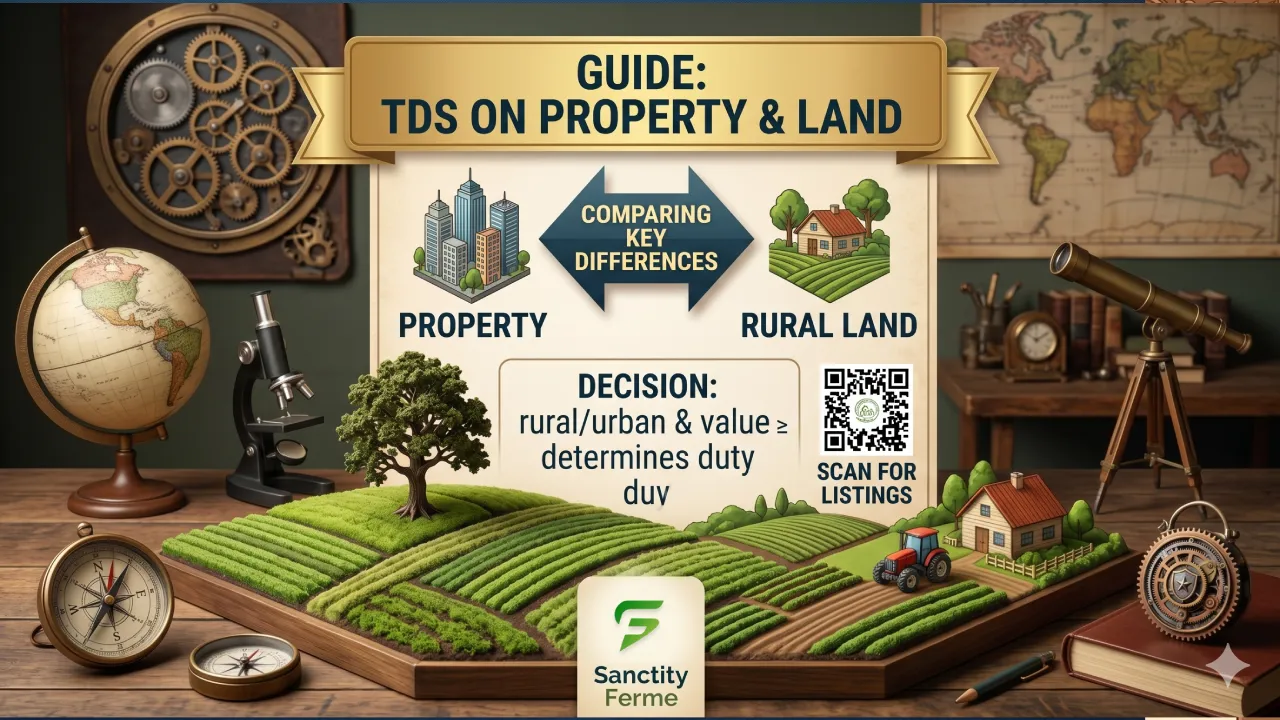
TDS on Property vs Agricultural Land: A Quick Comparison
Factor | Immovable Property (Urban/Commercial) | Agricultural Land (Rural) |
TDS Applicable? | Yes, if value ≥ ₹50 lakh | No explicitly exempt |
Governing Section | 194-IA (now aligned to Section 393) | Exempt from 194-IA |
Rate | 1% of sale consideration | N/A |
Form Required | Form 26QB | Not applicable |
Deadline | 30 days from end of month | N/A |
TDS Certificate | Form 16B | N/A |
PAN Required? | Yes (20% if not provided) | N/A |
What Does This Mean for Managed Farmland Buyers Near Bangalore?
If you are considering purchasing a plot within a managed farmland project in areas like Shoolagiri, roughly 90 minutes from Bangalore via NH44, the TDS question is one of the first practical ones to resolve.
For rural agricultural land which most managed farm plots near Bangalore qualify as TDS under Section 194-IA is not applicable. This simplifies the transaction considerably. There is no Form 26QB to file, no Form 16B to generate, and no challan to deposit. The buyer pays the seller the full agreed consideration, and the TDS compliance step falls away.
However, it is worth understanding the classification before signing. Factors like the land's proximity to a municipality and local revenue records determine rural or urban status. Before completing any purchase of agricultural land in Karnataka or Tamil Nadu, confirm the land classification through revenue documents and get a CA's input.
If you'd like to understand how agricultural land purchase loans work in 2026 or how to navigate purchase of agricultural land in Karnataka step by step, both are covered in detail in our resource library.
In Conclusion
TDS on property is a buyer's responsibility and skipping it is costly. For urban and commercial property above ₹50 lakh, 1% TDS must be deducted at source and deposited via Form 26QB before the transaction is complete. Instalments don't reduce this obligation; each payment triggers its own TDS requirement.
For rural agricultural land, the rules are more straightforward: Section 194-IA simply does not apply. The transaction is cleaner, the compliance lighter, and the paper trail shorter.
At Sanctity Ferme, our farm plots are classified as agricultural land across 300+ acres near the Shoolagiri hills, with 800+ plots sold to date and clear documentation throughout every transaction. Every purchase at Sanctity Ferme comes with the legal clarity that helps you understand exactly what applies and what doesn't.
If you'd like to see a managed farmland project firsthand and get straightforward answers to your documentation and tax questions we'd be glad to have you visit.