How to Save Tax on Agricultural Income in India: What Every Landowner Should Know
Discover practical gardening advice, expert landscaping tips, and inspiration to help you make the most of your outdoor space.
Sanctity Ferme Team
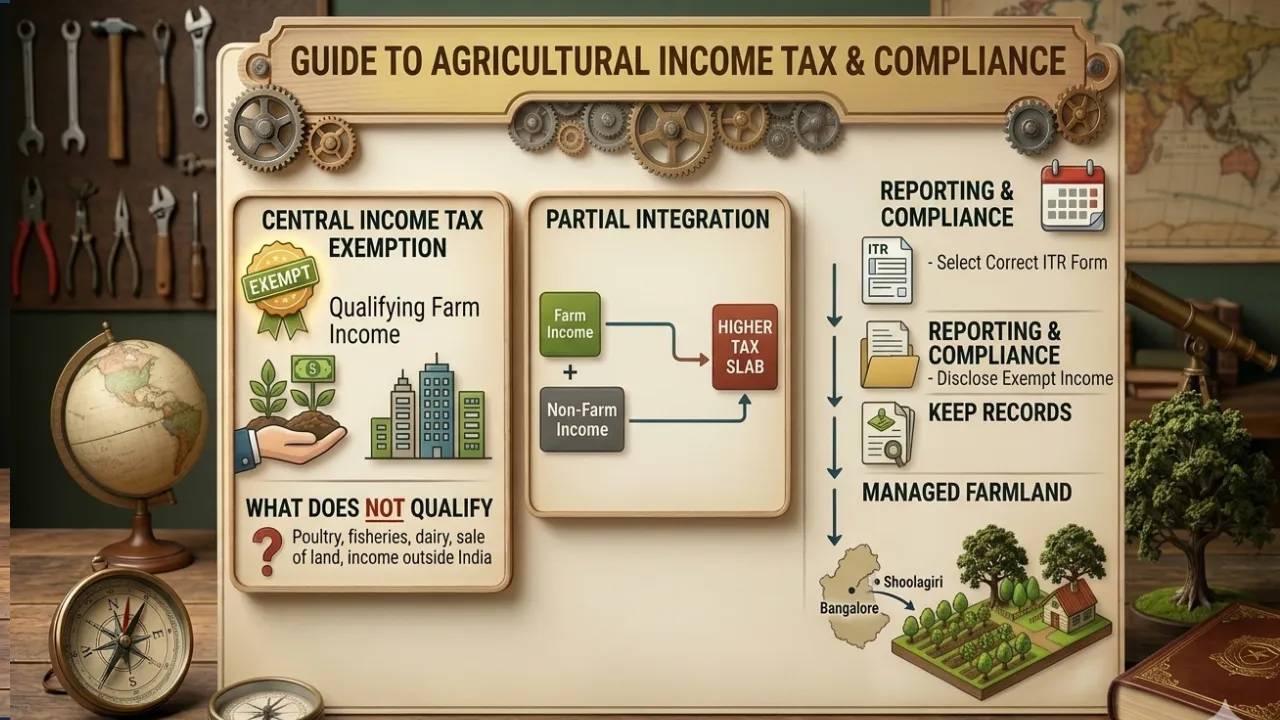
Most people assume that owning farmland means navigating complicated tax rules. The reality is far more straightforward and often more favourable than you'd expect.
Agricultural income in India is broadly protected from central income tax. But "broadly protected" is not the same as "entirely untouched." If you earn from both a salary and farmland, or if you're exploring farmlands for sale near Bangalore as a long-term investment, understanding exactly how your farm income is treated can help you plan better, file correctly, and avoid surprises.
This post breaks it down simply what qualifies as agricultural income, when it's exempt, when it's not, and what you actually need to do at tax time.
What Is Agricultural Income in Income Tax?
How the Income Tax Act Defines It
Under Section 2(1A) of the Income Tax Act, 1961, agricultural income covers three broad categories:
Rent or revenue from agricultural land situated in India and used for farming purposes
Income from cultivation and sale of agricultural produce grown on such land
Income from farm buildings located on or adjacent to the agricultural land such as a farmhouse used in connection with farming operations
The land must be in India. Income from land located outside India, even if used for agriculture, does not qualify for exemption.
What Counts and What Doesn't
This is where most confusion arises. Poultry farming, fisheries, bee-keeping, wool rearing, and dairy income are not treated as agricultural income under the Income Tax Act even if carried out on farmland. The same applies to proceeds from the sale of the land itself (that's a capital gains matter, governed separately).
What does qualify: income from growing crops, harvesting timber or bamboo raised through cultivation, rent received from farmland leased to another farmer, and income from seedlings or saplings grown in a nursery provided basic agricultural operations were carried out on the land.
A managed farmland that generates income from tree cultivation, organic produce, or land rental for farming purposes would typically fall within this definition provided proper records are maintained.
Is Agricultural Income Taxable or Not?
The Section 10(1) Exemption Explained
Under Section 10(1) of the Income Tax Act, income from agriculture is exempt from income tax and is not included in the total income used to calculate tax liability.
This exemption is broad and applies regardless of the quantum of agricultural income. Whether you earn ₹50,000 or ₹50 lakh from your farmland, the central government does not levy income tax on it directly.
The exemption applies to income earned from land situated in India that is used for agricultural purposes, irrespective of the amount of agricultural income earned by the taxpayer.
When the State Government Can Step In
While agricultural income is generally exempt at the national level, some states may impose taxes on agricultural income depending on state-specific regulations. State-level taxation can vary, so it is important to check the local tax laws and consult a tax professional when dealing with agricultural income.
In practice, most states do not actively levy agricultural income tax on individual farm plot owners. But if you own farmland in Karnataka or Tamil Nadu and earn meaningful income from it, a quick check with a local CA is worth doing.
What Is the Partial Integration Method and Does It Affect You?
This is the concept that trips up most salaried professionals who also own farmland.
The Two Conditions That Trigger Partial Integration
The concept of partial integration comes into play when your net agricultural income exceeds ₹5,000 and the non-agricultural total income exceeds the basic exemption limit. The income tax authorities use this method to calculate the tax slab applicable to you. Under this method, your agricultural income is added to your non-agricultural income to determine the overall tax rate.
In plain terms: your agricultural income itself remains exempt. But it can push your other income (salary, business income, etc.) into a higher tax bracket.
A Simple Example with Numbers
Say you earn ₹6,00,000 as salary and ₹7,00,000 from your farmland in a year.
Step 1: Calculate tax on total income (₹13,00,000). Step 2: Then calculate tax on just the agricultural income added to the basic exemption limit. Step 3: Subtract Step 2 from Step 1 the balance is the actual tax you pay on your non-agricultural income.
Your farm income never gets taxed directly. But it quietly raises the slab at which your salary is assessed. This is why farmland owners with significant non-farm income should factor this into their annual tax planning ideally before March 31 each year.
This is also relevant when evaluating the returns from a managed farmland investment near Bangalore. The income from the farm remains exempt, but understanding the full picture of your income helps you plan smarter.
Do I Need to File ITR for Agricultural Income?
ITR-1 vs ITR-2: Which Form to Use
Agricultural income should be reported in the Agriculture Income column of your ITR. ITR-1 must only be used if agricultural income is up to ₹5,000. If the stated income goes over this limit, form ITR-2 must be filed.
Many farmland owners skip this step assuming exemption means no disclosure. That's incorrect and it can create issues during scrutiny.
If you're earning from leased farmland, crop cultivation, or a managed farm project, and that income exceeds ₹5,000 in a year, ITR-2 is the form you need.
What to Report in Schedule EI
Agricultural income is to be treated as exempted income and should be disclosed in Schedule EI (Exempt Income) while filing ITR.
You don't pay tax on it, but you do declare it. Keep records of your land ownership documents, any lease agreements, crop sale receipts, or farm management statements. These serve as your proof if the income is ever queried.
Even though agricultural income is exempt, you must file an ITR if your non-agricultural income exceeds the basic exemption limit. Agricultural income is considered for rate calculation purposes.
What About Income from Managed Farmland Near Bangalore?
If you own a plot at a managed farmland project like those near Shoolagiri, approximately 90 minutes from Bangalore on NH44 the income question is a common one.
How Managed Farm Income Is Typically Classified
Income from a managed farmland plot can qualify as agricultural income when the underlying activity involves actual cultivation growing timber trees, fruit trees, medicinal plants, or food crops on the land. Income earned from the cultivation of land, including the sale of agricultural produce, is covered under the exemption for agricultural income.
If the management team is carrying out farming operations on your land which is the norm in professional managed farm projects the income generated from those operations would typically be treated as agricultural income in your hands, provided you hold the land and it is used for farming.
This is one reason why documentation matters. You need evidence that the land is actually being farmed, not just sitting idle.
Why Documented Farm Operations Matter for Exemption Claims
A well-managed farmland project maintains planting records, operational logs, and produce documentation. When you own a plot in such a project, these records support your claim that the income qualifies as agricultural. Without them, a tax officer could question whether the returns you receive are truly from cultivation.
If you're exploring the purchase of agricultural land in Karnataka or nearby regions, understanding this documentation requirement should inform which project you choose.
It's also worth knowing that if you ever decide to sell your agricultural plot, there are specific provisions like the Section 54B tax exemption on agricultural land that can help you manage capital gains liability at exit. And if financing is part of your plan, an agricultural land purchase loan may be available through select lenders.
A Quick Reference: Key Facts on Agricultural Income Tax
Aspect | Rule |
Central income tax on farm income | Exempt under Section 10(1) |
State-level tax | Possible; varies by state |
Partial integration trigger | Farm income > ₹5,000 AND non-farm income > ₹2.5 lakh |
ITR form if farm income ≤ ₹5,000 | ITR-1 |
ITR form if farm income > ₹5,000 | ITR-2 |
Where to report in ITR | Schedule EI (Exempt Income) |
Income from poultry, fisheries, dairy | Not classified as agricultural income |
Capital gains on sale of rural land | Generally not taxable |
In Conclusion
Agricultural income in India is one of the more taxpayer-friendly provisions in the Income Tax Act but "exempt" does not mean "invisible." You still need to declare it, use the right ITR form, and maintain records that support your claim.
If you own farmland as part of a managed project, the income from farming operations can qualify for exemption provided the land is actively cultivated and documented. Choosing a project where professional farm management is genuinely carried out, not just on paper, makes all the difference.
At Sanctity Ferme, all farm plots are actively maintained with 5 lakh+ trees planted across 300+ acres near Shoolagiri. Every plot in our managed farmland community has real operations behind it: planting calendars, irrigation, and soil management that you can see and document.
If you're considering a farmland investment near Bangalore that holds up both on the ground and on paper, we'd be happy to walk you through it.