Stamp Duty & Registration Charges in Karnataka: Complete 2026 Guide for Property and Farmland Buyers
Discover practical gardening advice, expert landscaping tips, and inspiration to help you make the most of your outdoor space.
Sanctity Ferme Team
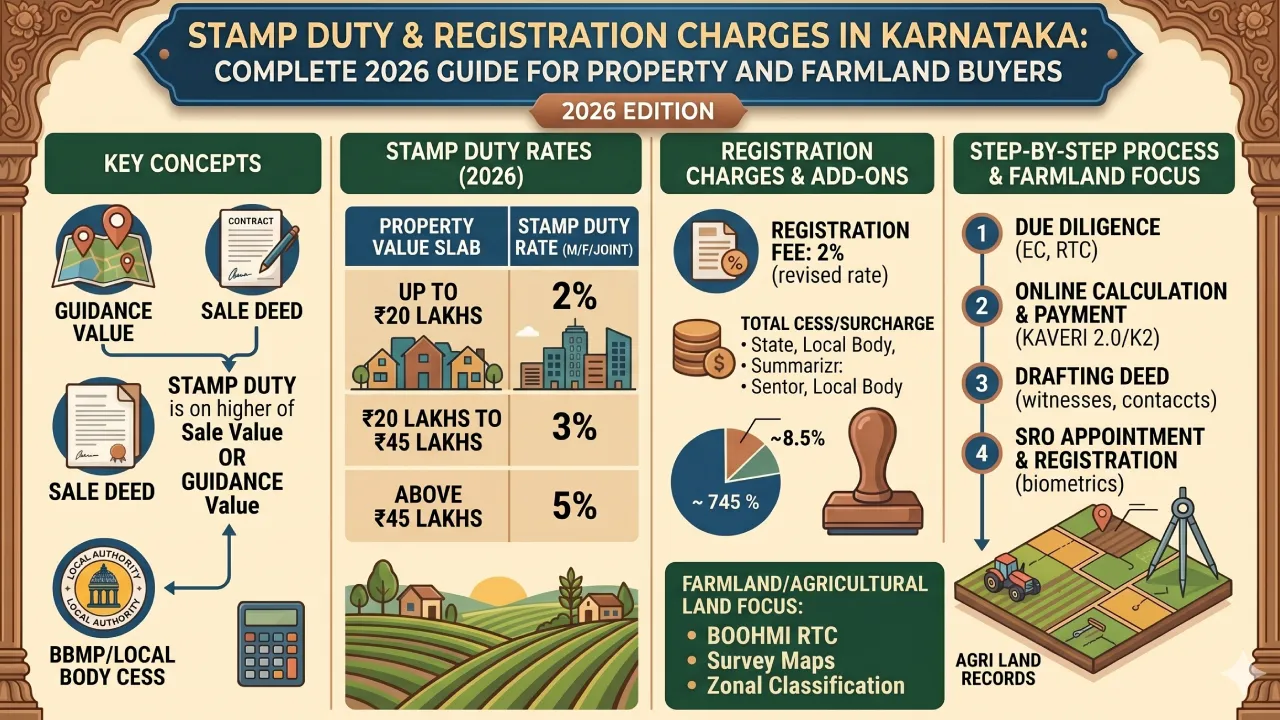
Buying land in Karnataka involves more than just agreeing on a price. Two mandatory costs stamp duty and registration charges must be paid before legal ownership transfers to you. Many buyers plan for the property cost but forget to budget for these charges. The result is a scramble close to the registration date.
This guide explains exactly what stamp duty and registration charges apply in Karnataka in 2026, what changed recently, how GPA registration works, what happens if you don't pay, and what documents you'll need at the Sub-Registrar's office including a specific note for buyers exploring farmland for sale near Bangalore.
What Are Registration Charges in Karnataka?
Why Both Charges Exist
Stamp duty and registration charges are two separate, mandatory payments levied on every property transaction in Karnataka. They are governed by different statutes stamp duty falls under the Karnataka Stamp Act, 1957, while registration is governed by the Registration Act, 1908.
Stamp duty is a state-levied tax that gives a property document its legal validity. Without it, a sale deed or any related instrument is inadmissible as evidence in court. It is calculated as a percentage of the property's market value or the stated sale consideration whichever is higher.
Registration charges are the fees paid to officially record the property in the buyer's name in government records. Without paying registration charges, legal ownership does not transfer to the buyer, regardless of any private agreement.
Both charges are mandatory. Both are the buyer's responsibility. And both must be paid before the Sub-Registrar's office will process the registration.
How Charges Are Calculated
Stamp duty and registration charges are always calculated on the higher of the actual sale consideration or the government's guidance value (also called circle rate). This protects against undervaluation of transactions.
Buyers can look up the applicable guidance value for any property on the Kaveri Online Services portal, Karnataka's official platform for property registration services.
What Is the Stamp Duty in Karnataka?
Current Stamp Duty Rates (2026)
Stamp duty in Karnataka follows a slab-based structure based on the property's value:
Property Value | Stamp Duty Rate |
Up to ₹20 lakh | 2% |
₹20 lakh to ₹45 lakh | 3% |
Above ₹45 lakh | 5% |
These rates apply uniformly across all cities and regions in Karnataka Bangalore, Mysore, Hubli, Mangalore, and rural areas for residential, plotted, and commercial transactions alike.
Additional cess and surcharge may apply depending on location. In urban areas within BBMP limits, a cess of around 0.5% is often added, which can push the effective rate for properties above ₹45 lakh to approximately 5.6%.
The 2025 Revision: Registration Charges Doubled
Effective 31 August 2025, registration charges in Karnataka increased from 1% to 2% of the property's guidance value or market value. This marks the first revision since 2003 and applies across all property types residential, commercial, and plotted developments.
For a property valued at ₹80 lakh, this means registration fees alone have risen from ₹80,000 to ₹1.6 lakh. Combined with stamp duty at 5% and applicable cess, the total statutory cost of a property transaction above ₹45 lakh can now reach approximately 7.5%–7.6% of the property value.
This is a significant planning consideration for anyone budgeting a property purchase in Karnataka this year. Factor in these costs before finalising your budget, not after.
What Are GPA Registration Charges in Karnataka?
A General Power of Attorney (GPA) is a legal document that authorises one person to act on behalf of another including for property-related matters such as collecting rent, managing a farm, or representing the owner at registration proceedings.
When Is GPA Registration Required?
Under the Registration (Karnataka Amendment) Act, 2025, GPA registration is now compulsory for any Power of Attorney that authorises the transfer of immovable property whether by sale, gift, or exchange with or without consideration. For other purposes such as rent collection, bank coordination, or general property management, adjudication of stamp duty alone may still suffice.
GPA Stamp Duty and Fees in Karnataka (2026)
For a standard GPA used for general property management:
Stamp duty: ₹1,000 (revised upward in September 2025)
Registration fee: ₹200
Scanning fee: Approximately ₹70 per page (e.g., ₹210 for a standard 3-page document)
Total government fee for a standard GPA registration: approximately ₹1,410.
If the GPA authorises sale of immovable property to a non-relative, the stamp duty may be calculated as a percentage of the property's market value rather than as a fixed amount. Always verify the applicable rate with the Sub-Registrar's office or a legal professional, as the applicable fee depends on the scope of authority granted.
For farmland owners who live away from their plots including owners within managed farmland communities near Bangalore a registered GPA in favour of a trusted representative or the farm management team can be a useful legal tool for handling day-to-day property matters in their absence.
What Documents Are Required for Property Registration in Karnataka?
When you arrive at the Sub-Registrar's office, you must bring a complete set of documents. Missing even one can delay registration.
For standard residential or plotted property:
Original sale deed (executed and signed by both parties)
Stamp duty payment receipt
Identity and address proof of both buyer and seller (PAN, Aadhaar)
Passport-sized photographs
Encumbrance certificate (EC)
Form 60/61 (if PAN is not available)
Property valuation certificate
Khata certificate (for properties within BBMP or municipality limits)
For agricultural land registration in Karnataka:
Sale deed or conveyance deed with both parties' signatures
Encumbrance certificate
Record of Rights (RTC/Pahani extract)
Mutation register extract
Khata certificate and Khata extract
Tax-paid receipts
NOC from Tehsildar (where applicable)
Identity and address proof of buyer and seller (PAN, Aadhaar)
Power of attorney, if the seller is acting through a representative
Once you have paid stamp duty online via the Kaveri portal or through an authorised SHCIL collection centre, you submit these documents at the Sub-Registrar's office. Registration should be completed within four months of the execution of the sale deed.
If you're navigating the process of purchasing agricultural land in Karnataka, our detailed guide covers the legal steps, documentation, and common pitfalls worth reading before you begin.
What Happens If Stamp Duty Is Not Paid in Karnataka?
This is one area where buyers cannot afford to cut corners. Under the Karnataka Stamp Act, non-payment or underpayment of stamp duty carries serious legal and financial consequences.
The document becomes inadmissible in court. An unstamped or insufficiently stamped sale deed cannot be used as evidence in any property dispute, legal proceeding, or dispute resolution. This effectively means your ownership claim is legally unenforceable until the duty is paid.
A penalty of up to 10 times the deficit may apply. Under Section 34 of the Karnataka Stamp Act, if a document is presented with insufficient stamp duty, the court or authority can impose a penalty of up to 10 times the shortfall. The Supreme Court has explicitly upheld the validity of this penalty.
The sale deed may be invalidated. Without proper stamp duty, your sale deed may not be treated as a legal record of ownership, leaving you vulnerable in any future dispute over the property.
Difficulty in future transactions. Banks conducting due diligence and future buyers verifying title will check that stamp duty and registration charges were paid. Any deficit complicates resale, mortgage, or transfer.
In short: underpaying stamp duty to save money today can cost far more in penalties, legal costs, and complications later.
How to Pay Stamp Duty in Karnataka
There are two methods available online and offline.
Online (Kaveri Portal or SHCIL e-Stamping): Visit the Kaveri Online Services portal, generate a challan with the required transaction details, and make payment via net banking, credit card, or debit card. An e-stamp or receipt is generated, which you carry to the Sub-Registrar's office.
Offline (SHCIL Authorised Collection Centres): Authorised collection centres (also called ACC or stockholding e-stamping counters) across Karnataka act as intermediaries. You can visit these, fill in the details, and pay in cash.
Online payment is increasingly preferred, as it leaves a verifiable digital record, reduces queuing, and integrates cleanly with the Kaveri portal's registration workflow.
Tax benefit note: Stamp duty and registration charges paid on a new residential property are eligible for deduction under Section 80C of the Income Tax Act, up to ₹1.5 lakh. This benefit applies to new properties only not to resale, commercial property, or standalone plots.
What Does This Mean for Managed Farmland Buyers Near Bangalore?
If you're buying a plot within a managed farmland project near Bangalore, particularly in the Shoolagiri region of Tamil Nadu, stamp duty and registration charges under Karnataka's rules may not apply since Shoolagiri falls under Tamil Nadu's jurisdiction. Tamil Nadu has its own stamp duty and registration structure.
However, if you are purchasing agricultural land in border districts of Karnataka or exploring plots registered under Karnataka's Sub-Registrar offices the rates above apply. Rural agricultural land transactions generally attract the same stamp duty slabs, though the guidance values in rural areas are often significantly lower than urban properties, which affects the total charge payable.
For context on what to expect when buying agricultural land in this region, the 1 Acre Land Price in India 2026 guide offers a current overview of pricing benchmarks. And if financing is part of your plan, the agricultural land purchase loan guide walks through lender options, eligibility, and documentation.
Quick Reference: Stamp Duty & Registration Charges in Karnataka 2026
Charge | Rate | Applicable To |
Stamp duty (up to ₹20 lakh) | 2% | All property types |
Stamp duty (₹20–₹45 lakh) | 3% | All property types |
Stamp duty (above ₹45 lakh) | 5% | All property types |
Registration charges | 2% (revised Aug 2025) | All property types |
Cess/surcharge (urban areas) | ~0.5–0.6% | BBMP and urban limits |
Total effective cost (>₹45 lakh) | ~7.5–7.6% | Including cess |
GPA stamp duty | ₹1,000 (fixed) | General property management |
GPA registration fee | ₹200 | Sub-Registrar's office |
In Conclusion
Stamp duty and registration charges in Karnataka are a meaningful part of any property transaction cost and with the 2025 revision doubling registration fees to 2%, they're more significant than ever. Plan for them early, verify the current guidance value before committing, and ensure all your documentation is complete before your Sub-Registrar appointment.
At Sanctity Ferme, every farmland transaction is supported with legal clarity sale deeds, encumbrance certificates, RTC extracts, and proper registration across 800+ plots sold to date. We believe clean documents are the foundation of any good land purchase.
If you'd like to understand what a managed farmland plot near Bangalore actually involves legally, practically, and financially we'd be glad to walk you through it on a site visit.