Best Investment Options in India 2026: FD vs Gold vs Land vs Stocks
Discover practical gardening advice, expert landscaping tips, and inspiration to help you make the most of your outdoor space.
Sanctity Ferme Team
Every year, the same question surfaces: where should I put my money?
In 2026, that question is harder than ever. Interest rates are stabilising. Gold has had a remarkable run and a sharp correction. Stock markets remain rewarding but volatile. And land, particularly farmland on the fringes of growing cities, is quietly accumulating interest from investors who want something real beneath their feet.
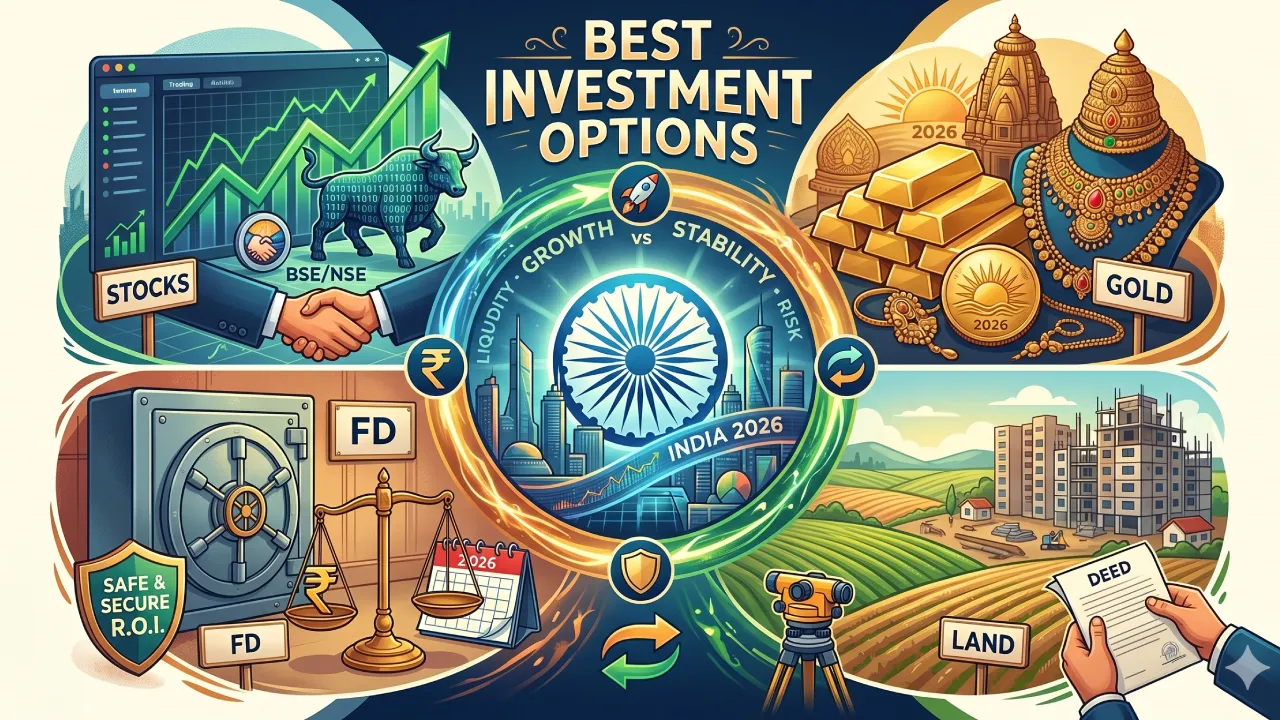
This post compares four of the most common investment options in India Fixed Deposits, Gold, Land, and Stocks across return potential, risk, liquidity, tax efficiency, and what each one actually asks of you as an investor. The goal is not to pick a winner, but to help you understand which combination suits your situation.
Which Investment Is Best in India in 2026?
There is no single correct answer but there is a useful framework.
The right investment depends on three things: your time horizon, your need for liquidity, and your tolerance for uncertainty. A retired professional managing a corpus needs a different allocation than a 35-year-old salaried employee building long-term wealth. What changes across options is not just return it is the nature of the risk you carry and the effort required to manage it.
Here is how the four main options compare in 2026.
Fixed Deposits: Safe, Predictable, and Quietly Eroding
What FDs Offer
Fixed Deposits remain the preferred savings vehicle for millions of Indian households and for good reason. Your principal is guaranteed. The interest rate is locked in at the time of deposit. DICGC insurance covers up to ₹5 lakh per depositor per bank. There is no market risk.
In 2026, one-year FD rates range from around 6.25% at public sector banks to over 8% at small finance banks. Senior citizens typically earn an additional 0.50% above standard rates. For a 3–5 year tenure, rates at private banks like RBL and Yes Bank are around 7.0–7.2%, while large public sector banks cluster around 6.45–6.60%.
The Real Problem with FDs
FDs feel safe. They are not entirely safe from the one risk that quietly matters most: inflation.
If an FD earns 7% and inflation runs at 5–5.5%, the real return is under 2%. Before tax. For investors in the 30% bracket, FD interest which is added to total income and taxed at the applicable slab rate can reduce the post-tax real return to near zero or below.
Over a decade, ₹1 lakh in an FD at 7% grows to roughly ₹1.97 lakh. After tax, somewhat less. An FD keeps your money intact. It does not compound it meaningfully.
Best for: Capital preservation, short-term goals (1–3 years), risk-averse investors, retirees seeking predictable income.
Gold: A Hedge, Not a Growth Engine
Gold's Strong Recent Run
Gold has been a standout performer in recent years. Prices have risen sharply on the back of geopolitical uncertainty, central bank buying, and global rate expectations. In March 2026, prices experienced a meaningful intraday correction a reminder that the same forces that drive gold up can also drive it down, quickly.
Gold's 10-year compounded appreciation in India has been solid. It consistently beats FDs over long stretches. But the path is not smooth, and the timing of your entry and exit matters significantly.
The Limits of Gold as an Investment
Gold does not produce income. It does not generate rent, dividends, or yield. Its return is entirely price-based which means it depends on factors that no individual investor can reliably forecast: currency movements, US Fed policy, geopolitical developments, and central bank decisions.
For tax purposes, gold held for more than 24 months is subject to long-term capital gains at 12.5% without indexation benefit, following the Budget 2025 amendment. Physical gold carries additional costs making charges for jewellery, storage risk, and potential impurity. Gold ETFs and Sovereign Gold Bonds reduce these friction costs, though SGBs have seen no new issuances announced for FY 2026–27 as of April 2026.
Gold works best as portfolio insurance typically 10–15% of a long-term portfolio. It is not the primary engine of wealth creation. Over-allocating to gold after a strong rally which is when most investors buy tends to underperform.
Best for: Hedging against inflation and currency risk, preserving wealth during uncertainty, a minority allocation within a diversified portfolio.
Is FD Better Than Stocks in India?
For short time horizons (under 3 years): yes, FDs are usually better. Capital protection matters more than return potential when you cannot afford to wait out a market downturn.
For long time horizons (7 years and beyond): equities have historically delivered meaningfully higher returns than FDs. The Nifty 50 has delivered a 10-year compounded annual growth rate of approximately 12–13%. In a strong year like FY 2023–24, the Nifty returned nearly 29%.
But stocks require emotional resilience. A market correction of 20–30% which happens periodically can cause investors to exit at exactly the wrong moment. The investor who stays invested through cycles, ideally through a Systematic Investment Plan, typically benefits. The investor who enters on euphoria and exits on fear does not.
For most salaried investors in 2026, a combination works better than a binary choice: FDs for short-term safety and liquidity, equities (through mutual funds or direct stocks) for long-term compounding. Equities are not better than FDs. They are different and appropriate at different stages of a financial plan.
What Gives the Highest Return in India?
Historically, over 10-year periods, equities have delivered the highest returns among conventional asset classes. But returns vary enormously depending on when you entered, which sectors you held, and whether you stayed invested.
Land has also generated exceptional long-term returns particularly in peri-urban and growth corridor locations. In regions near Bangalore, Hosur, and Chikkaballapur, property values in farmland and agricultural land corridors have seen consistent appreciation. Growth corridors with infrastructure development, road access, and water availability have witnessed double-digit compounding over medium-to-long holding periods.
In growth corridors in South India, areas once on the periphery of Bangalore's orbit have seen land prices climb significantly over the past decade as urbanisation, highway infrastructure, and demand from the IT workforce have expanded the investable radius outward.
The important difference between equities and land is the nature of the return. Stocks offer liquidity but require daily market attention and emotional discipline. Land is illiquid by nature but it does not fluctuate with daily headlines, requires no active monitoring, and offers a tangible asset that neither depreciates the way financial instruments do nor gets affected by the sentiment cycles of Dalal Street.
Land vs Gold vs FD vs Stocks: A Comparison
Factor | FD | Gold | Stocks | Land (Agricultural) |
Typical returns (10Y CAGR) | 6–7% | 10–12% | 12–14% | 8–15% (location-dependent) |
Risk level | Very low | Medium | Medium–High | Low–Medium |
Liquidity | High | High | High | Low |
Income generation | Yes (interest) | No | Partial (dividends) | Yes (agricultural income, exempt from tax) |
Inflation protection | Weak | Strong | Moderate | Strong |
Tax on returns | Slab rate | 12.5% LTCG | 12.5% LTCG (equity) | Agricultural income largely exempt under Sec 10(1) |
Active management needed | No | No | Yes | Managed projects: No |
Entry amount | Low (₹500+) | Low–Medium | Low | Medium–High |
How Should I Divide My Investment in India?
There is no formula that works for everyone, but a commonly used framework for a 35–45 year old Indian investor with moderate risk appetite in 2026 looks something like this:
Equities / Mutual Funds (40–50%): The growth engine of the portfolio. Best accessed through SIPs in diversified equity mutual funds. Requires a 7+ year horizon and the patience to hold through downturns.
Fixed Deposits / Debt instruments (20–25%): The stability layer. Useful for goals within 3 years, emergency reserves, and as a rebalancing buffer during market volatility.
Gold (10–15%): The hedge. Not the primary return driver. Best held through digital gold, Gold ETFs, or Sovereign Gold Bonds rather than physical jewellery.
Land / Real Assets (15–25%): The foundation. Land appreciates over time, generates income where farmed or leased, and when it is agricultural land enjoys meaningful tax efficiency. It requires a longer holding period than stocks, but it also asks for less daily attention.
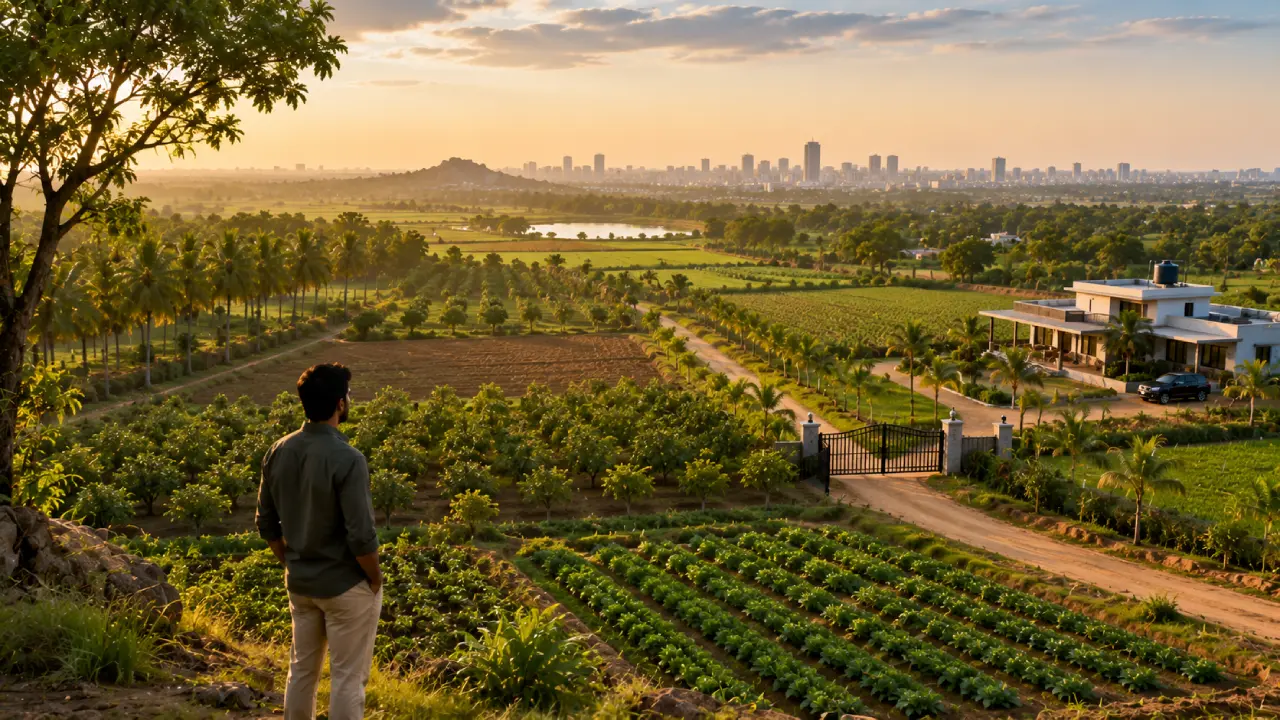
Within the land allocation, managed farmland near growing cities like Bangalore has attracted interest from salaried professionals and business owners who want real asset exposure without the complexity of managing a farm themselves. The model separates land ownership from operational involvement you hold the title, a professional team manages the farming operations, and you benefit from both land appreciation and income from the agricultural activity.
Why Agricultural Land Deserves a Place in a 2026 Portfolio
Agricultural land in India carries a combination of characteristics that few other asset classes can match:
Supply is structurally shrinking. Urbanisation converts farmland to residential and commercial use continuously. The stock of high-quality agricultural land near growing cities only decreases over time.
Income is largely tax-exempt. Agricultural income from farming operations on Indian land is exempt from central income tax under Section 10(1) of the Income Tax Act. For investors already in high tax brackets, this tax efficiency meaningfully improves net returns.
Inflation protection is strong. When food prices rise as they consistently do in India the income from farmed land tends to rise with them. Land is a hard asset whose intrinsic value is anchored in food production, not financial markets.
It is uncorrelated with equities. When stock markets correct, farmland values do not. For a portfolio that is heavily equity-weighted, adding a land allocation reduces overall volatility without sacrificing long-term return potential.
At Sanctity Ferme, land value has grown from ₹55 per sq. ft. to over ₹450 per sq. ft. over four years across our managed farmland projects near Shoolagiri approximately 90 minutes from Bangalore on NH44. With 300+ acres under professional management, 5 lakh+ trees planted, and 800+ plots sold to 1,400+ community members, our projects offer land ownership that is active in its farming operations and passive in its management demands.
If you're exploring farmlands for sale near Bangalore as part of a broader investment plan, we can walk you through how a managed farmland plot fits alongside your existing portfolio without disrupting the liquidity and equity allocation you already have.
You can also read how agricultural income is treated under income tax to understand the tax dimension of farmland ownership, and review the Section 54B tax exemption on agricultural land if you plan to exit the investment in the future.
In Conclusion
In 2026, the best investment in India is not a single asset class it is the combination that fits your timeline, tax situation, and risk tolerance.
FDs protect your capital. Gold insures your portfolio. Stocks grow your wealth over the long run. Land particularly agricultural land in growth corridors anchors the portfolio with a tangible asset that appreciates, generates income, and enjoys meaningful tax advantages.
The question is not which one wins. It is which combination serves your specific goals.
At Sanctity Ferme, we believe land is the forgotten asset in most urban Indian portfolios and managed farmland makes it accessible without the complexity that has historically kept people away.
Book a site visit to see our farmland projects near Bangalore →