
What Is Agroforestry and Why It's the Future of Sustainable Farming in India
Discover practical gardening advice, expert landscaping tips, and inspiration to help you make the most of your outdoor space.
26 Mar 2026
Sanctity Ferme Team
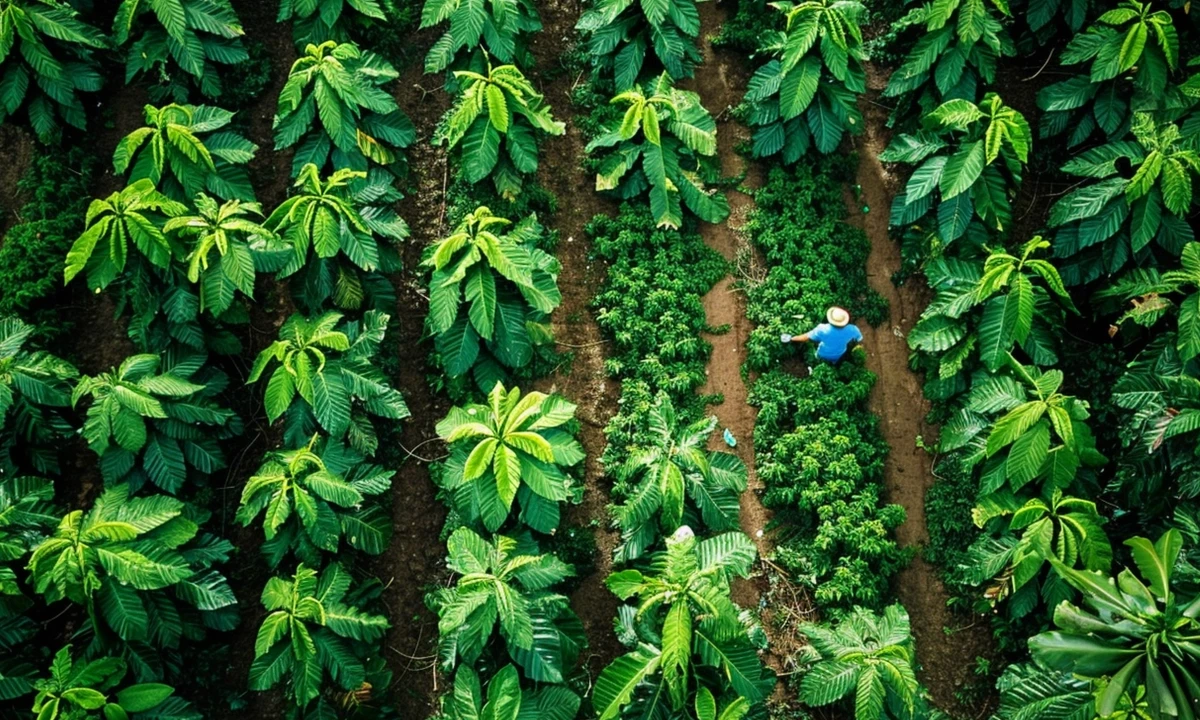
India's farmland is tired. Not in a dramatic, headline-grabbing way but quietly, steadily, in ways that farmers feel season after season. Decades of monocropping, heavy chemical inputs, and increasingly erratic monsoons have left millions of acres with thinner soil, falling groundwater, and yields that no longer behave the way they once did. Farmers who built their livelihoods around a single cash crop are finding that bet gets riskier every year.
And yet, there is something interesting happening alongside all of this. An approach to farming that Indian growers understood intuitively for centuries long before it had a name or a research paper attached to it is getting serious scientific and policy backing. Agroforestry is not new. But the scale of attention on it right now is.
India is now the first country in the world with a dedicated national agroforestry policy. NITI Aayog has mapped agroforestry potential down to the district level. Tamil Nadu released its own state policy in 2026. And the research keeps confirming what experienced farmers have known for a long time: land that works with trees simply works better.
This post explains what agroforestry actually is, why it matters so much for Indian soil and Indian farmers right now, and what it looks like when it is done right including in the Shoolagiri–Hosur–Bangalore belt where Sanctity Ferme has been practising it for nearly a decade.
What Is Agroforestry? A Simple Definition
Agroforestry is a land-use system that deliberately brings trees and shrubs together with crops and livestock on the same piece of land. Not trees planted as an afterthought on the edge of a field. A managed, intentional system where every element, whether a timber tree, a fruit tree, a seasonal crop, or a fodder plant, is chosen and placed because it contributes something to the whole.
India's National Agroforestry Policy 2014 defines it as a system that integrates trees and shrubs on farmlands and rural landscapes to enhance productivity, profitability, diversity, and ecosystem sustainability. That last part is worth sitting with. Ecosystem sustainability is not a side benefit here it is the design goal the whole thing is built around.
How Is Agroforestry Different from Regular Farming?
Conventional farming tends to simplify. One crop. One season. One income event. That approach can maximise short-term output but it quietly depletes the land doing it. Soil nutrients get stripped. The earth gets compacted. Its ability to hold water slowly diminishes.
Agroforestry works in the opposite direction. It borrows from the logic of a natural ecosystem multiple species at different heights, different root depths, different seasonal rhythms, all interacting with each other. Trees fix nitrogen into the soil. They improve water infiltration. They create microclimates that shield crops from heat stress and wind. The farm becomes more layered, more alive, and over time, more productive not less.
For a useful contrast between how this plays out against conventional methods, this overview of the difference between traditional and modern farming is worth reading.
What Are the Main Types of Agroforestry Systems in India?
There are three broad categories that most systems fall into.
Agrisilvicultural systems bring trees and crops together alley cropping, home gardens, boundary planting. Silvopastoral systems combine trees with livestock grazing land, which is particularly common in drier regions where shade and tree fodder reduce animal stress through the hot months. Agrosilvopastoral systems are the most integrated form crops, trees, and livestock all working together within one managed landscape.
Which model fits a particular plot depends on soil type, rainfall, and what the landowner wants to produce. In the Shoolagiri region, a combination of timber species, fruit trees, and seasonal crops has shown strong results both ecologically and economically.
How Does Agroforestry Improve Soil Health?
Why Soil Degradation Is a Crisis Indian Farmers Can't Ignore
Around 16.96% of India's total geographical area is classified as wasteland land that has lost meaningful productive capacity. And even the farmland that is still being cultivated often has significantly diminished fertility, worn down by years of chemical dependency and tillage without adequate organic replenishment.
Tree roots change this from the ground up. They run deep and wide. They break up compacted layers, open the soil to air, and draw up minerals that shallow-rooted annual crops simply cannot reach. When leaves fall and decompose at the surface, they return organic matter to the soil. Nitrogen-fixing species add fertility that would otherwise have to come from a purchased input.
Research published in a peer-reviewed ecology review found that agroforestry systems reduce soil erosion by 50 to 70% compared to monoculture fields. That is not a marginal improvement that is structural protection for land that might otherwise degrade beyond recovery within a generation.
A long-term experiment in Haryana found that fields with trees grown alongside barley crops showed an average yield increase of around 51%, while simultaneously improving soil nutrient content. Less input. More output. That is the agroforestry proposition, in concrete terms.
At Sanctity Ferme, none of this was theoretical. When we began work on our first projects near Shoolagiri, parts of the land were barren. The transformation into a functioning, thriving biosphere took years of deliberate tree planting and careful soil management. You can read about how we cultivated life on barren earth and what that process actually looked like on the ground.
Can Tree Planting Increase Farmland Returns Quickly?
Most farmland investors ask this at some point and it is a fair thing to wonder about.
The honest answer is that tree-based income is not immediate. Timber species like teak take years, sometimes more than a decade, before they are worth harvesting. But that is also a somewhat misleading way to think about agroforestry, because the whole point of the model is that it does not depend on any one thing happening at any one time.
Seasonal crops bring income in months. Fruit trees start producing in two to four years. Timber comes in ten to fifteen. Each layer funds the next, and the farm keeps moving forward even when one element is still maturing.
The income case for agroforestry is compelling not because of one number but because of a pattern. Research from the Cauvery Calling initiative tracked 69,760 farmers in Tamil Nadu who shifted from conventional cash crops to tree-based farming. Over five to seven years, their incomes rose between 300 and 800%. These were real farms, real families, real land. Not a controlled experiment.
And beyond the income figures, there is a buffer worth naming. When unseasonal rain damages one crop, or pest pressure hits a particular variety, the rest of the system continues. That resilience does not show up on a single season's balance sheet but over years of ownership, it quietly changes everything.
The Real Benefits of Agroforestry for Farmers in India
More Income Streams, Less Dependence on One Crop
One of the things people consistently underestimate about agroforestry is how much a single plot can produce when it is layered thoughtfully timber, fruit, honey, medicinal plants, fodder different products, different timelines, different buyers. For a farmland investor or a smallholder farmer, that spread means no single bad season can undo the whole picture.
A meta-analysis across agroforestry interventions in developing countries found the income improvement at around 40% for smallholder farmers who adopted the model. The reason is not complicated: the land is simply doing more with the same space, working vertically and horizontally at once.
There is also the rhythm of it. Unlike annual cropping with its long fallow stretches where the land sits quiet an agroforestry farm has something happening in every season. Something growing, something maturing, something that needs tending. That keeps labour employed, keeps the soil fed, and keeps the landowner genuinely connected to what is happening on their plot.
Climate Resilience Why Agroforestry Farmland Weathers Uncertainty Better
Indian agriculture is under real pressure. Longer dry spells. Flash rainfall. Temperatures that are slowly, steadily climbing. Monoculture fields exposed, rootless, dependent on a single growing window are carrying most of that risk.
Tree cover changes the calculation considerably. The same meta-analysis found that agroforestry systems produce a localised cooling effect of 2 to 5°C compared to open cropland. That protects the understorey plants, reduces water loss through evapotranspiration, and stretches the productive growing season further into periods that would otherwise be too hot or dry. Tree roots slow surface runoff during heavy rain, which keeps topsoil in place and sends water downward into the ground, where it is actually needed. In rain-dependent regions like Krishnagiri and Dharmapuri, this matters enormously.
Agroforestry is also drawing increasing attention as a carbon sequestration strategy, with tree-based systems storing between 0.5 and 2 metric tonnes of carbon per hectare per year. For landowners, this means their plots sit within India's long-term climate commitments and potentially within reach of emerging carbon market revenues as that framework matures.
India's National Agroforestry Policy and What It Means for Landowners
The GROW Initiative and What It Changes on the Ground
In 2014, India became the first country in the world to adopt a national-level agroforestry policy. That was the beginning. What has followed is considerably more consequential for landowners who are paying attention.
NITI Aayog's GROW initiative Greening and Restoration of Wastelands with Agroforestry launched in 2024 and uses GIS and remote sensing to map agroforestry suitability across every district in the country. The findings are striking. Agroforestry currently covers around 2.84 crore hectares roughly 8.65% of India's geographical area. But 7.56 crore hectares have been identified as highly suitable for expansion. The GROW initiative's stated aim is to triple the area under agroforestry by 2030.
This is not conservation policy for its own sake. It creates a financial and regulatory environment that actively favours tree-based farming. Around 25 states have already simplified transit and felling rules for farm-grown timber. In June 2025, the Ministry of Environment issued model rules to standardise and liberalise the process for felling trees on agricultural land quietly removing a barrier that had discouraged farmers from planting timber trees for decades.
For landowners and investors, this shift deserves attention. Agroforestry is being moved into the mainstream of Indian agricultural policy. Not a niche. Not an exception. The centre.
Tamil Nadu's New Agroforestry Policy 2026 A Regional Signal
Closer to home, Tamil Nadu released its own Agroforestry Policy in 2026 under Chief Minister M.K. Stalin. It focuses on encouraging commercially valuable timber species teak, sandalwood on agricultural land, with simplified rules for harvesting and transport. The stated goal is to bring Tamil Nadu's forest and tree cover to 33%, with private agricultural land playing a central role in getting there.
The policy came after multiple rounds of consultation with farmers across the state, including growers in Krishnagiri and Dharmapuri the districts that sit right in the natural hinterland of the Shoolagiri farming region.
If you own or are considering land in this belt, that is a direct signal. State policy determines what you can plant, how you can harvest, and what support you can access. Tamil Nadu is now pointed clearly in a direction that rewards landowners who think in trees.
Which Agroforestry Models Suit Karnataka, Tamil Nadu, and the Hosur Region?
Species That Work in the Shoolagiri–Hosur–Bangalore Belt
The land around Shoolagiri sits at roughly 900 to 1,000 metres above sea level red laterite soil, well-drained, semi-arid, but tempered and moderated by the Eastern Ghats. It is terrain that responds very well to the right species mix.
Timber trees like teak, silver oak, and mahogany establish reliably here and form the long-term structural layer of a serious agroforestry plot. Fruit trees mango, sapota, guava, jackfruit come into production earlier and provide the medium-term income while the timber matures. Neem earns its place twice over: ecologically as a pest suppressant and soil builder, commercially as a product with consistent demand. Bamboo works well along boundary rows it grows fast, stabilises slopes, and begins generating income from its fourth year onwards.
In the early years of a plot, the gaps between younger trees can carry seasonal crops: ragi, pulses, vegetables. As the canopy closes in, shade-tolerant species take their place in the understorey.
This stacked approach where biodiversity, water conservation, and productive land use are not competing priorities but one integrated system is the foundation of the sustainability work at Sanctity Ferme.
What Does a Well-Managed Agroforestry Plot Actually Look Like?
Not a forest. That is the first thing to say. A well-managed agroforestry plot in this region is a purposeful, working landscape. Trees spaced to let light through to the understorey. Irrigation designed around the water needs of multiple species at different growth stages. Leaf litter composted and returned to the soil. Canopy closure, groundwater levels, and crop yields tracked through the seasons.
The management layer is what separates a plot that simply has trees from one that actually functions as a productive agroforestry system. This is precisely the model behind managed farmland near Bangalore at Sanctity Ferme professional stewardship of a layered, working farm that you own outright.
Over 5 lakh trees have been planted across 300+ acres under management. And the land has been keeping score: value has moved from ₹55 to over ₹450 per sq. ft. over four years. Not projections. Not estimates. The outcome of deliberate, sustained agroforestry practice one growing season at a time.
Agroforestry by the Numbers
Metric | Figure |
India's land currently under agroforestry | 2.84 crore hectares (8.65% of total area) |
Potential land suitable for agroforestry | 7.56 crore hectares |
Soil erosion reduction vs. monoculture | 50–70% |
Income improvement for adopting farmers | ~40% (meta-analysis average) |
Tamil Nadu farmers' income growth (5–7 years) | 300–800% |
Carbon sequestration potential | 0.5–2 Mg C/ha/year |
Localised cooling effect | 2–5°C vs. open cropland |
Conclusion: The Land Remembers How to Work
Agroforestry is not a new idea. It is a return to a way of working with land that Indian farmers understood long before synthetic inputs arrived. What has changed is the scientific evidence behind it, the policy architecture supporting it, and the sheer urgency of the ecological problems it is designed to address.
For farmland investors and landowners, there is something agroforestry offers that monoculture simply cannot: a system that improves over time. The longer the trees grow, the more productive and resilient the land beneath them becomes. That is a rare quality in any asset.
If you want to see what life on a working agroforestry farm actually looks like the trees, the soil, the community that has grown around it a site visit is the clearest answer there is. Sanctity Ferme's projects near Shoolagiri are just 90 minutes from Bangalore via NH44, and we are always happy to walk you through what is growing.
More from the blog





From a peaceful retreat to a thriving investment it all starts with one
conversation.
Let's help you find your perfect plot at
Sanctity Ferme.