The Complete Plant Tracker Guide for New Sanctity Ferme Plot Owners
Discover practical gardening advice, expert landscaping tips, and inspiration to help you make the most of your outdoor space.
Sanctity Ferme Team
You have done the hard part you own land. Now comes something most new farm owners are not quite prepared for: keeping meaningful track of what is actually growing on it.
When you are 90 minutes from your plot and visiting on weekends, it is surprisingly easy to lose the thread. Which trees were planted where? How tall was the neem sapling last month? Did the drumstick you put in the far corner survive the dry spell? Without a system, your farm becomes a pleasant blur enjoyable to visit, but not the purposeful, evolving ecosystem you had in mind when you bought it.
A plant tracker changes that. Here is everything you need to know to set one up simply, practically, and in a way that actually fits the life of a Sanctity Ferme plot owner.
What Is a Plant Tracker and Why Does a Farm Owner Need One?
A plant tracker is any system an app, a spreadsheet, a notebook that records what you have planted, where it is, when it went in, and how it is progressing over time. The format is secondary. The habit is what matters.
For a managed farmland owner specifically, a tracker serves three distinct purposes that are worth naming clearly.
Memory is the obvious one. After six months and a dozen visits, you will not remember which tree is which, which sapling came from the management team, or which corner you planted the amla in. A tracker is your permanent record one that does not depend on your recall.
Progress is the less obvious one. Plants grow slowly, and slow change is nearly invisible unless you have documented it. Photos and notes taken monthly reveal transformation that is genuinely hard to see week to week. Watching a sapling become a canopy tree is one of the more satisfying things about farmland ownership but only if you have the record to look back on.
Care decisions are where a tracker earns its keep practically. Knowing the age, species, and current condition of each plant on your plot helps you and your farm management team make better decisions about watering, pruning, and fertilisation. A two-year-old tree has different needs from a five-year-old one. A tracker is how you know which is which.
At Sanctity Ferme, where over 5 lakh trees have been planted across 300+ acres, every tree has a role in the broader ecosystem. On your individual plot, tracking your own plantings connects you to that larger picture and makes the land feel genuinely, actively yours rather than something you visit and admire from a distance.
What Is the Best Plant Tracker App for Indian Farm Owners?
Several apps are worth knowing about, and the right one depends on what you actually need from it.
Plantix Best for Crop Diagnosis
Plantix is the most downloaded ag-tech app worldwide, having helped farmers work through more than 100 million crop-related questions. The process is simple: photograph your crop, and within seconds you receive a free diagnosis along with treatment suggestions. It is particularly useful for identifying diseases, pest damage, and nutrient deficiencies on vegetable beds or fruiting trees problems that can look similar on the surface but require completely different responses.
For Sanctity Ferme plot owners growing vegetables or managing fruit trees, Plantix functions as more than a tracker. It is a working advisor you carry in your pocket.
Google Lens Best for Tree Identification
Google Lens does one thing for farm owners particularly well: you point your camera at an unfamiliar plant or tree, and AI tells you what it probably is. It carries a 4.8 out of 5 rating across more than 2.71 million reviews and has been downloaded over a billion times globally. It is not infallible no identification tool is but for confirming a species or identifying an unfamiliar sapling that appeared on your plot, it is fast, free, and accurate enough for most practical purposes.
Plant Tracker App Best for Personal Plant Logs
For building a dedicated record of your own plantings, a plant tracker journal app does what a general notes app cannot quite replicate. The key feature for a farmland owner is the timestamped photo gallery a visual log of each plant that builds into a meaningful, searchable record over months and years. Adding new plants, setting care reminders, and maintaining a photo history are all straightforward even for users who are not particularly tech-comfortable.
Farmonaut Best for Larger Plot Management
Farmonaut is in a different category from the apps above. It uses multispectral satellite imagery, AI, and machine learning to deliver real-time crop health monitoring, disease prediction, nutrient deficiency analysis, and pest infestation alerts across large areas. For a single plot, it is more than you need. For owners managing larger parcels or multiple plots across different projects, it offers a level of remote oversight that no ground-level tool can replicate.
How Do You Track a Tree on Your Plot? A Simple System
You do not need a sophisticated app to build a useful tracking system. The basics are straightforward and can be set up on your next visit with nothing more than your phone.
A Plot Map
Start by sketching or photographing your plot from above a rough hand-drawn diagram is entirely sufficient at this stage. Mark the location of every tree you have planted, every vegetable bed, and every key landmark: the water point, the boundary wall, the main path. Number each planting location.
Many Sanctity Ferme owners use a Google Maps satellite view of their plot with numbered pins dropped directly on the image. This becomes your permanent spatial reference the foundation everything else is built on.
A Plant Log
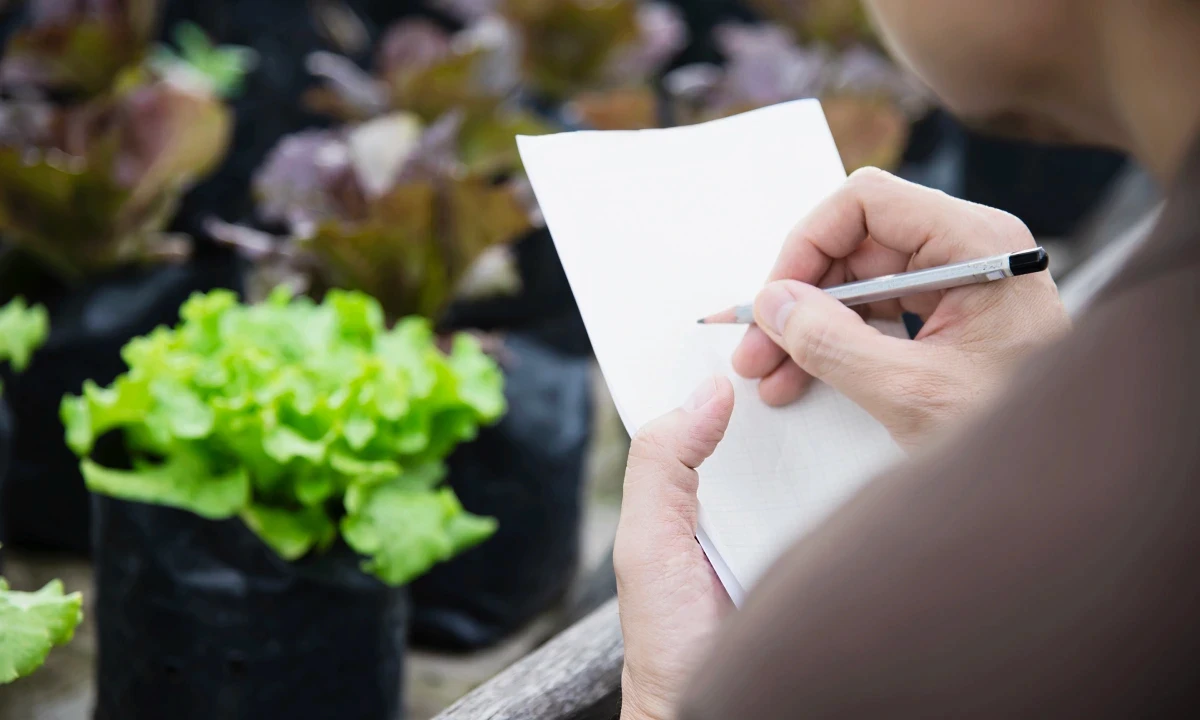
For each numbered location on your map, record the species name, date planted, source of the sapling, height at planting, and condition notes from each subsequent visit. A shared spreadsheet, a notes app, or a dedicated plant tracker app all work equally well. The format genuinely matters less than the consistency a simple system you actually use is worth more than a sophisticated one you abandon after two visits.
Monthly Photo Documentation
Photograph each tree or bed on every visit, from the same angle and approximately the same distance each time. After six months, these images become a time-lapse of your farm's development one of the most rewarding records a farmland owner can have. The change that is invisible week to week becomes striking across a season.
Tracking Plants on a Managed Farmland: What Is Different
A standard plant tracker is designed for someone who is present every day. A managed farmland owner is not and that changes the approach in a few important ways.
You are tracking between visits, not in real time. Your record needs to be robust enough that you can return after three or four weeks away and immediately understand what has happened on your plot in the interim what has grown, what has struggled, what needs attention on this visit.
Your farm management team is your eyes between your visits. At Sanctity Ferme, the management team handles the daily care that keeps the farm running. Your personal tracker becomes a shared communication tool a way to note what you want done, flag what you have observed, and identify what you want to check on when you are next there. A WhatsApp thread with your plot manager, maintained alongside your personal plant log, covers most of what a managed farmland owner needs without adding complexity.
Trees are, fundamentally, the long game. The Shoolagiri hills ecosystem that surrounds Sanctity Ferme's projects supports remarkable tree biodiversity and planting native species like neem, peepal, tamarind, arjuna, and amla on your individual plot is not just an ecological act. It builds a living asset that appreciates alongside your land value over time. Sanctity Ferme's land has seen value growth from ₹55 to ₹450+ per sq. ft. over four years, and healthy, well-established tree cover is a meaningful part of what drives that trajectory.
Frequently Asked Questions
What Is a Tracker Tree?
A tracker tree is not a fixed botanical term it refers to a tree that has been formally logged, tagged, or registered in a plantation or land management system. In managed farmland contexts, tracker trees are individual trees assigned to plot owners and recorded in a management register with species name, planting date, GPS coordinates, and growth milestones at each stage. At Sanctity Ferme, the management team maintains project-wide records of key plantation trees. Your own tracking layer supplements this with the personal, plot-level detail that a project-wide system cannot capture which tree you planted yourself, which one your child named, which one you are watching most carefully.
What Is the Best App to Track Plants on My Farm?
It depends on what you are tracking. For disease diagnosis on crops or fruiting trees, Plantix is the most practically useful tool available for Indian conditions. For identifying unknown plants or trees on your plot, Google Lens is fast and reliable enough for most situations. For building a personal log with photos, care reminders, and species notes, a dedicated plant tracker journal app or even a well-organised photo folder with consistent naming works well. The honest answer is that the best system is the one you will actually open and update on every visit.
Can I Track Plants on My Managed Farmland Remotely?
Yes and this is genuinely where plant tracker apps earn their place for managed farmland owners. A photo log maintained from each visit, shared with your farm management team between visits, keeps you connected to what is happening on your land even through long absences. Satellite-based tools like Farmonaut can add a layer of remote monitoring for owners managing larger plots. For most individual plot owners at Sanctity Ferme, a personal photo log combined with regular updates from the on-site management team is entirely sufficient no satellite subscription required.
Which Trees Should I Prioritise Tracking First?
Start with your fruit-bearing trees mango, amla, tamarind, drumstick. These are the trees that will produce visible, tangible results within two to three years and are most worth documenting carefully from the beginning. After that, track your shade trees neem, peepal and then your boundary or windbreak plantings. Medicinal plants and vegetable beds can be tracked more casually in a general bed log rather than individually, unless something specific needs monitoring.
Start Your Plant Tracker on Your Next Visit
The best time to start a plant tracker is your first visit to a new plot. The second best time is your next visit whenever that is.
Bring your phone. Take a satellite screenshot of your plot. Walk every corner and photograph every tree you can find. Name what you know, note what you do not. That first record however rough, however incomplete becomes the baseline that everything else is measured against. Everything that follows is just adding to it.
If you are still exploring farmland for sale near Bangalore and want to understand the land, the existing plantings, and how the management system works at Sanctity Ferme, visit the project pages for Sunset Slopes or Divine Grove or better still, come and walk the land in person.
Book a site visit and we will walk you through what is growing, what has been planted, and how you can start tracking your own plot from day one.