What Is Drip Irrigation in Agriculture? A Complete Guide
Discover practical gardening advice, expert landscaping tips, and inspiration to help you make the most of your outdoor space.
Sanctity Ferme Team
Every year, India loses an enormous amount of freshwater to flood irrigation water that runs off fields, evaporates in the midday heat, or sinks far below where any root could ever reach it. For a country where roughly 55% of its 141 million hectares of cropped land depends on irrigation, that loss is not just a statistic. It is a slow, quiet drain on the land itself and on the farmers who depend on it.
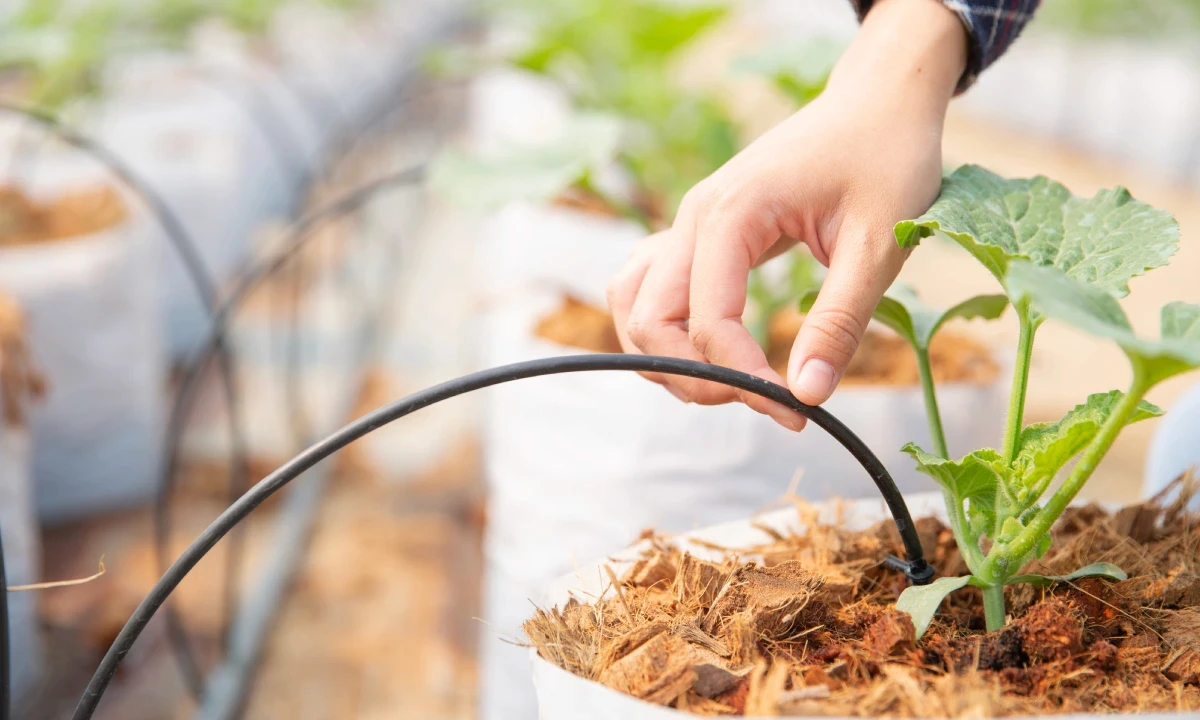
Drip irrigation works differently. Instead of flooding a field and hoping the right amount of water finds the right place, a drip system delivers water slowly and precisely drop by drop directly to the root zone of each plant. It sounds almost too simple. But that simplicity is exactly what makes it powerful.
If you own farmland, manage an agricultural plot, or are exploring managed farmland investment near Bangalore, understanding drip irrigation is not optional. It is the difference between a farm that builds soil health season after season and one that quietly loses it.
In this guide, you will find out what drip irrigation actually is, how the system works end to end, what its real-world benefits look like on Indian farms, and how to access government subsidies in Tamil Nadu and Karnataka. We will also look at how this technology fits into the broader story of sustainable managed farmland.
What Is Drip Irrigation? The Basic Idea
Drip irrigation sometimes called trickle irrigation or micro-irrigation applies water slowly and directly to the root zone of plants through a network of pipes, tubes, valves, and emitters. The goal is straightforward: put the right amount of water in the right place at the right time, with as little waste as possible.
Unlike flood irrigation, which spreads water across an entire field indiscriminately, or sprinkler systems, which wet both soil and foliage, drip irrigation targets only the soil zone immediately around each plant's roots. Water soaks in before it can evaporate or run off the surface, keeping that root zone consistently moist while the surrounding soil stays relatively dry.
Modern drip systems can achieve water use efficiencies of up to 90% compared to 50 to 70% for sprinklers and just 30 to 40% for surface flood irrigation. On a one-acre plot, those water savings across a single growing season can be substantial enough to support additional crops or meaningfully reduce operating costs sometimes both.
A Brief History Worth Knowing
The idea behind drip irrigation is older than most people realise. Buried clay pots filled with water, placed near plant roots, were in use in China as early as the first century BCE. Modern drip systems, however, trace their origins to 1960s Israel, where engineers Simcha Blass and his son Yeshayahu developed the first plastic emitter one that released water through friction-controlled passageways rather than easily clogged holes.
The company they founded, Netafim, went on to become a global leader in irrigation technology. Their systems now operate across millions of hectares worldwide, including significant stretches of farmland across India.
How a Drip System Actually Works
A drip irrigation system is not a single device it is an integrated network. Water travels from a source through progressively finer pipes and tubes until it emerges as a slow, steady drip at each plant's root zone. Understanding what each component does helps you make better decisions when designing or evaluating a system.
The Core Components
A pump draws water from a bore well, pond, tank, or municipal supply and pressurises the system. Pump size determines how many laterals and emitters the system can feed simultaneously getting this wrong at the design stage is one of the most common and costly mistakes.
Filters are the most underappreciated part of any drip system and the most important for long-term performance. Sand separators, disc filters, and screen filters remove particles, algae, and debris from the water before it enters the pipes. Emitters clog easily. Good filtration is what keeps a system running productively year after year, rather than requiring constant maintenance and replacement.
Mainline and sub-mainline pipes typically larger-diameter PVC or HDPE carry water from the pump across the farm to different zones. These are usually buried or run along field edges where they will not interfere with cultivation.
Lateral lines are smaller polyethylene tubes that branch off from the sub-mainlines and run alongside each crop row. Emitters are attached along these laterals at intervals calibrated to crop type and spacing.
Emitters or drippers are the heart of the system. Each one releases water at a controlled rate, typically 1 to 8 litres per hour, directly at the plant's root zone. Spacing and flow rate are calibrated to crop type, soil texture, and water availability getting these wrong affects yield more than almost any other design decision.
Pressure regulators and control valves keep pressure consistent throughout the entire network. Uneven pressure means uneven watering, and uneven watering shows up quickly as variable crop performance across the field.
A fertigation unit is an optional but genuinely valuable addition a tank and injector that dissolves fertilisers into the irrigation water and feeds nutrients directly to roots alongside the water. More on this below.
Surface vs. Subsurface Drip
In surface drip systems, lateral lines run along the soil surface beside crop rows. This is the most common setup for annual crops and is easier to install, inspect, and maintain when something goes wrong.
Subsurface drip irrigation buries the laterals 10 to 45 centimetres underground, delivering water even closer to roots with virtually no evaporation from the soil surface. It works particularly well for perennial crops like fruit orchards and protects the laterals from UV degradation, rodent damage, and field equipment. The trade-off is higher installation cost and more careful maintenance blocked emitters underground are significantly harder to locate and clear than surface ones.
What Is Fertigation and Why Does It Matter?
Fertigation is the practice of dissolving fertilisers into the irrigation water and delivering them through the drip system directly to plant root zones. It is one of the most powerful practical advantages drip irrigation offers and one that experienced farmland managers rely on as a matter of course.
With traditional fertiliser application broadcasting granules across the soil or spraying foliar nutrients from above a significant portion of every dose is lost to leaching, runoff, or evaporation before it reaches a root that can use it. Research has shown that fertigation through drip systems can reduce fertiliser use by up to 95% while maintaining or improving crop response, simply because nutrients are delivered precisely where roots can actually absorb them.
In practice, this means you can tailor nutrition to each crop's growth stage more nitrogen during vegetative growth, shifting toward phosphorus and potassium during flowering and fruiting. The result is more balanced plant nutrition, better yield quality, and meaningfully lower input costs over the course of a season.
The fertigation unit connects into the drip headworks via a Venturi injector or dosing pump. Only water-soluble fertilisers should be used, and the system needs to be flushed thoroughly after each fertigation cycle to prevent emitter clogging from residue.
The Real Benefits for Indian Farmers
Drip or Trickle Is There a Difference?
The terms drip and trickle irrigation are used interchangeably and refer to the same thing. If you are choosing between micro-irrigation methods, the relevant comparison is drip versus sprinkler or drip versus flood not drip versus trickle.
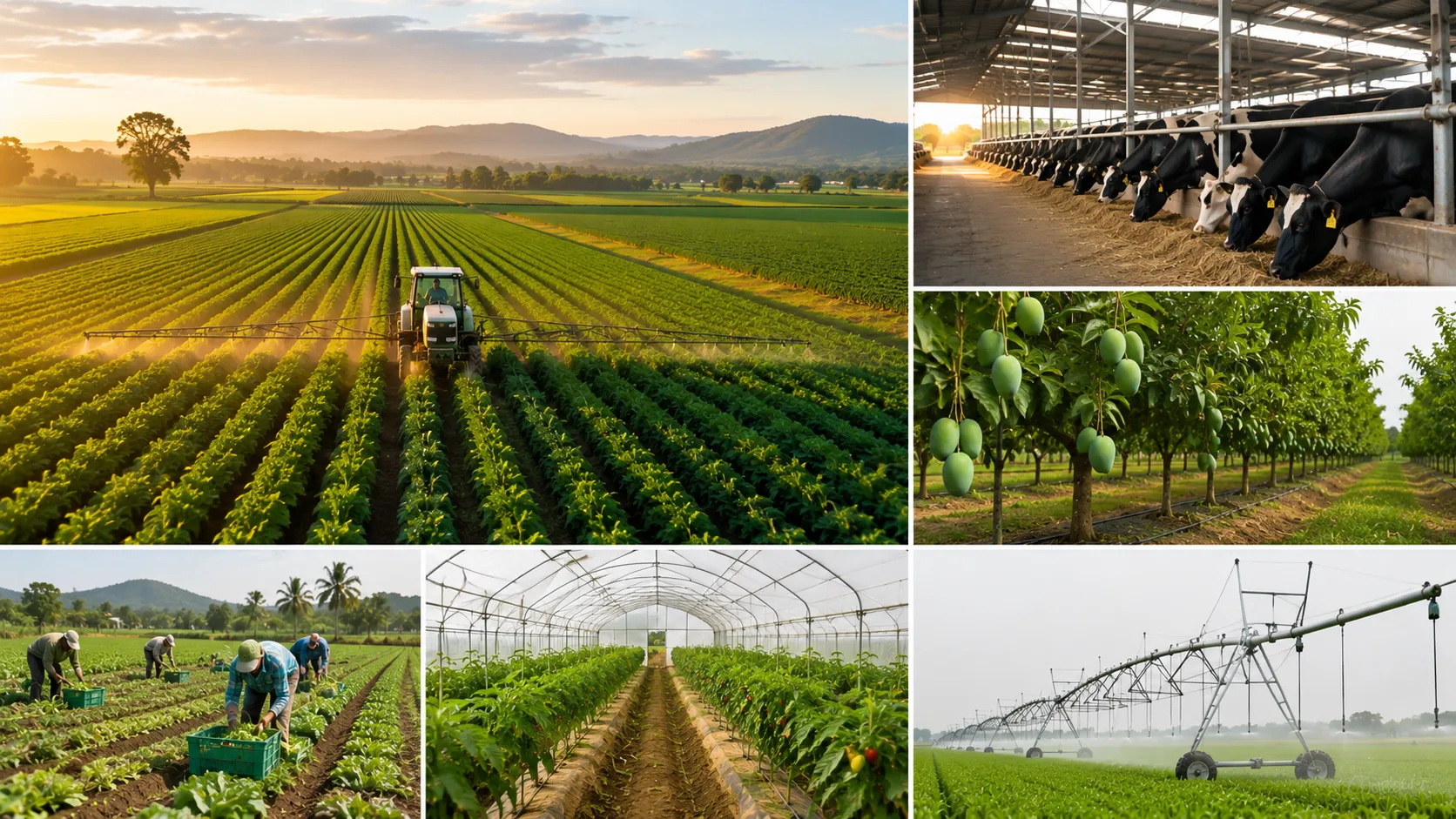
Drip works best for row crops, orchards, vegetables, and spaced plantings where individual root zones can be targeted precisely. Sprinklers are sometimes preferred for densely planted crops like turf or paddy nurseries. For most high-value farmland including managed farmland near Bangalore growing fruit trees, vegetables, or timber species drip is the more efficient and cost-effective choice across almost every metric that matters.
Drip vs. Sprinkler: Which Wins?
Drip irrigation typically outperforms sprinklers on water efficiency, fertiliser use, weed suppression, and disease risk. Sprinklers wet the entire soil surface and foliage, creating conditions that promote fungal disease and encourage weed germination between rows. Drip keeps foliage completely dry and concentrates water only where crops are planted naturally reducing weed pressure without additional herbicide use.
The trade-off is cost and complexity. A drip system requires more infrastructure filters, pressure regulators, carefully selected emitters and the upfront investment per hectare is higher than a sprinkler setup. For most commercial farming contexts, including managed farmland in Tamil Nadu and Karnataka, the productivity gains and water savings typically justify that cost within a few growing seasons.
Yield and Productivity Gains
Field data from across India consistently shows that drip-irrigated crops outperform their conventionally irrigated counterparts in yield, quality, and input efficiency. Studies indicate 20 to 50% yield gains across cereals, cotton, and horticulture crops under drip conditions. For specific high-value crops, the numbers are even more compelling capsicum trials have shown yield improvements of 29 to 46% under drip fertigation conditions compared to conventional irrigation.
The mechanism is straightforward. Consistent soil moisture without waterlogging keeps roots active and nutrient-absorbent throughout the entire growing season. The stress cycles that are common under flood irrigation too dry for days, then suddenly waterlogged are largely eliminated. Crops that do not experience water stress produce more, and produce better.
Key Statistics at a Glance
Metric | Value |
India drip irrigation market size (2024) | USD 859.9 million |
Projected market size by 2030 | USD 1.89 billion |
Market CAGR (2025–2030) | 14.4% |
Water savings vs. flood irrigation | 20%–50% |
Crop yield improvement | 20%–50% |
Drip irrigation efficiency rating | Up to 90% |
PMKSY subsidy small/marginal farmers (Tamil Nadu) | Up to 100% |
Trees planted at Sanctity Ferme | 5 lakh+ |
How Deep Should Drip Lines Be Buried?
For surface systems, laterals simply lie on the soil no burial required. For subsurface drip, the right depth depends on your crops and their root architecture.
Shallow-rooted vegetables like tomato, chilli, and capsicum are best served by laterals 10 to 20 centimetres below the soil surface. Orchard crops mango, banana, citrus typically need laterals at 20 to 30 centimetres for young trees, deeper for mature root systems that have spread further. Sugarcane and deep-rooted field crops generally require 30 to 45 centimetres, to reach the active root zone reliably.
Burial depth also affects clogging risk. Lines buried too deep can develop root intrusion in the emitters over time a problem managed with root-repelling chemicals or anti-root emitter designs. Your irrigation designer should calibrate depth to your specific crop mix, soil type, and water availability rather than applying a generic standard.
How Long and How Often Should You Water?
Irrigation scheduling comes down to three things: crop evapotranspiration demand, soil water-holding capacity, and emitter flow rate. Unlike flood systems where you irrigate every few days in large volumes, drip systems often run daily or even twice daily for shorter cycles that maintain steady soil moisture without ever saturating the root zone.
A useful starting point for most vegetable and orchard crops in Karnataka and Tamil Nadu: 1 to 4 hours of drip irrigation per day, adjusted for season, growth stage, and rainfall. During dry summer months from March to June, irrigation duration increases meaningfully. During the monsoon, the system may be paused or reduced significantly to account for natural rainfall running drip during heavy rain simply wastes water and can waterlog roots.
Automation makes scheduling practical for anyone who is not on-site every day. Timer-controlled valves or smart controllers connected to soil moisture sensors can manage the whole system with minimal daily intervention a genuine advantage for managed farmland owners visiting on weekends rather than monitoring daily.
Government Subsidies for Drip Irrigation in India
The Government of India's Pradhan Mantri Krishi Sinchayee Yojana specifically its Per Drop More Crop component provides financial assistance for drip and sprinkler irrigation systems. Between 2016 and 2025, the programme disbursed over ₹21,968 crore to support micro-irrigation adoption across Indian states. The scale of that commitment reflects how seriously policymakers are taking water efficiency in agriculture.
The subsidy structure as of 2025 is worth knowing in detail before you plan any installation.
In Tamil Nadu, small and marginal farmers can access up to 100% subsidy on drip system installation costs for holdings up to 2.5 acres. Other farmers in Tamil Nadu receive a 75% subsidy for up to 5 hectares per beneficiary. In Karnataka under PMKSY, small and marginal farmers receive a 55% subsidy, while other categories receive 45%. Renewal support is also available farmers who have already benefited can claim subsidy to replace laterals after 7 years of use.
To apply, farmers connect with their local State Horticulture Department or apply directly through the PMKSY portal. Krishnagiri district in Tamil Nadu adjacent to Sanctity Ferme's properties near Shoolagiri operates its own PMKSY implementation office that farmers can approach in person.
One important practical note: subsidy approval requires the use of government-approved suppliers and equipment specifications. Work with registered drip irrigation dealers who are familiar with PMKSY compliance requirements. A rejected application because of a non-approved supplier can delay your entire setup by months an avoidable problem with the right guidance upfront.
Drip Irrigation and Managed Farmland
For anyone who owns or is seriously considering managed farmland near Bangalore, drip irrigation is not a luxury add-on. It is the infrastructure that makes professional farm management viable in the first place.
Most farm investors are not on-site every day and they should not need to be. A managed farmland project handles day-to-day operations: irrigation, pruning, crop maintenance, security. Drip systems are central to this model because they allow consistent, scheduled watering without requiring constant human presence. An automated drip network with a timer and pressure-regulating valves can reliably water an entire plot while the landowner is in Bangalore, Hyderabad, or anywhere else entirely.
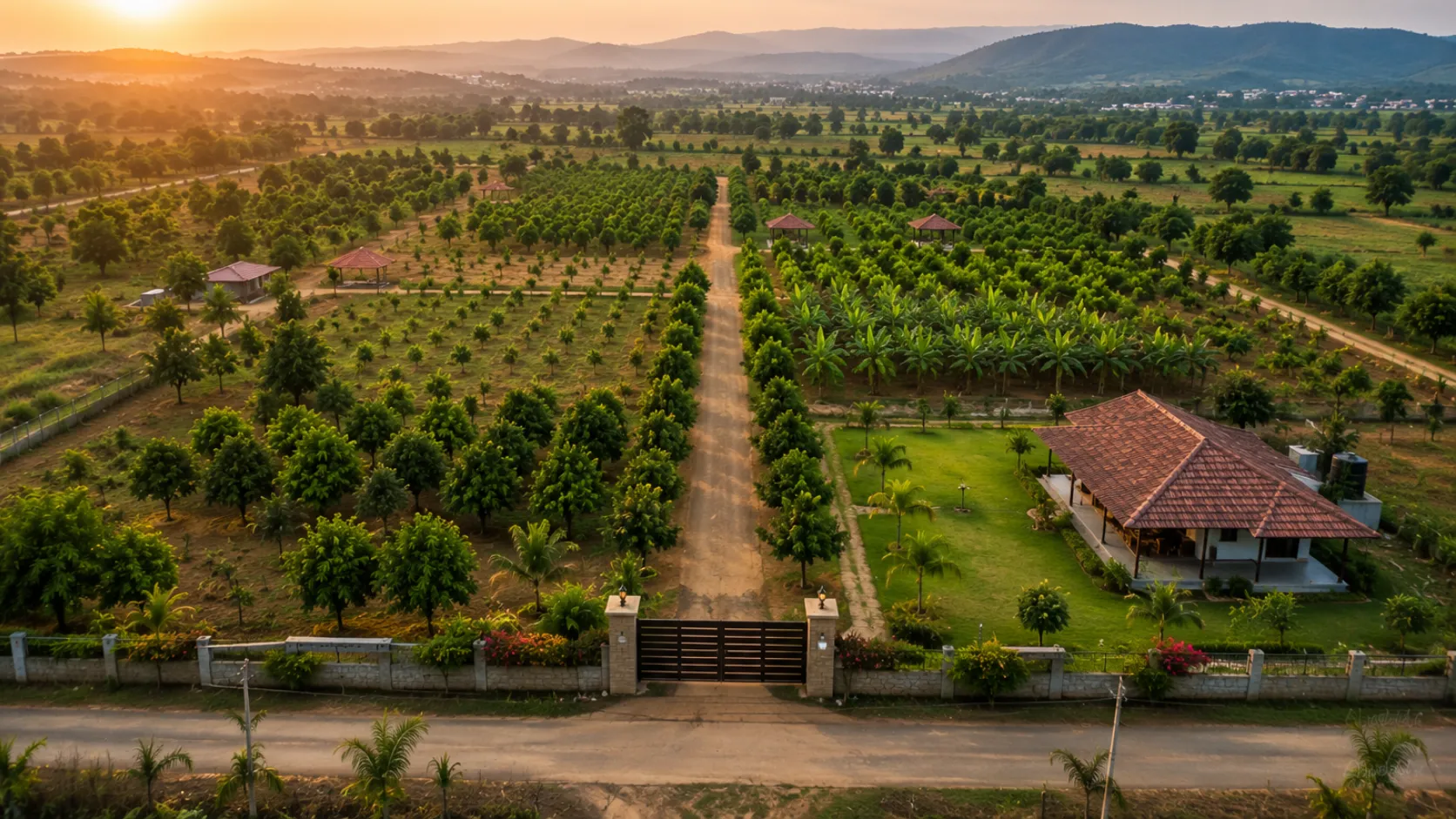
At Sanctity Ferme, water management is woven into how we care for every plot across our projects. With over 5 lakh trees planted across 300+ acres near Shoolagiri, irrigation calibrated to species and season is part of what keeps the land productive and the ecosystem genuinely healthy over time.
Our approach to sustainability goes beyond crop yields. You can read more about how we integrate regenerative farming principles on our sustainability page.
If you are curious about how a working managed farm actually operates day to day including how irrigation, plantation, and maintenance are handled together as one system visiting in person is the clearest way to see it. Take a look at life at Sanctity Ferme, or explore our current farm plots available near Bangalore.
Final Thoughts
Drip irrigation is not a complicated idea. It is about putting water exactly where it needs to go no more, no less. In a country where water resources are under increasing pressure and agricultural productivity needs to keep improving, it is also one of the most important practical tools available to modern farmers.
Whether you are managing a small vegetable plot, a fruit orchard, or thinking seriously about farmland investment near Bangalore, understanding how drip irrigation works and how to implement it well gives you a real, practical edge over farms that are still flooding fields and hoping for the best. Combine it with fertigation, smart scheduling, and government subsidy support, and a drip system that might feel like a significant upfront investment typically pays for itself within a few growing seasons.
If you are exploring farmland for sale near Bangalore and want to understand what professionally managed farmland looks like in practice including how irrigation infrastructure is set up and maintained across an active project we would be glad to show you around. Book a site visit to Sanctity Ferme and walk the land with our team.