What Is Land Degradation? Causes, Effects & Solutions Explained
Discover practical gardening advice, expert landscaping tips, and inspiration to help you make the most of your outdoor space.
Sanctity Ferme Team
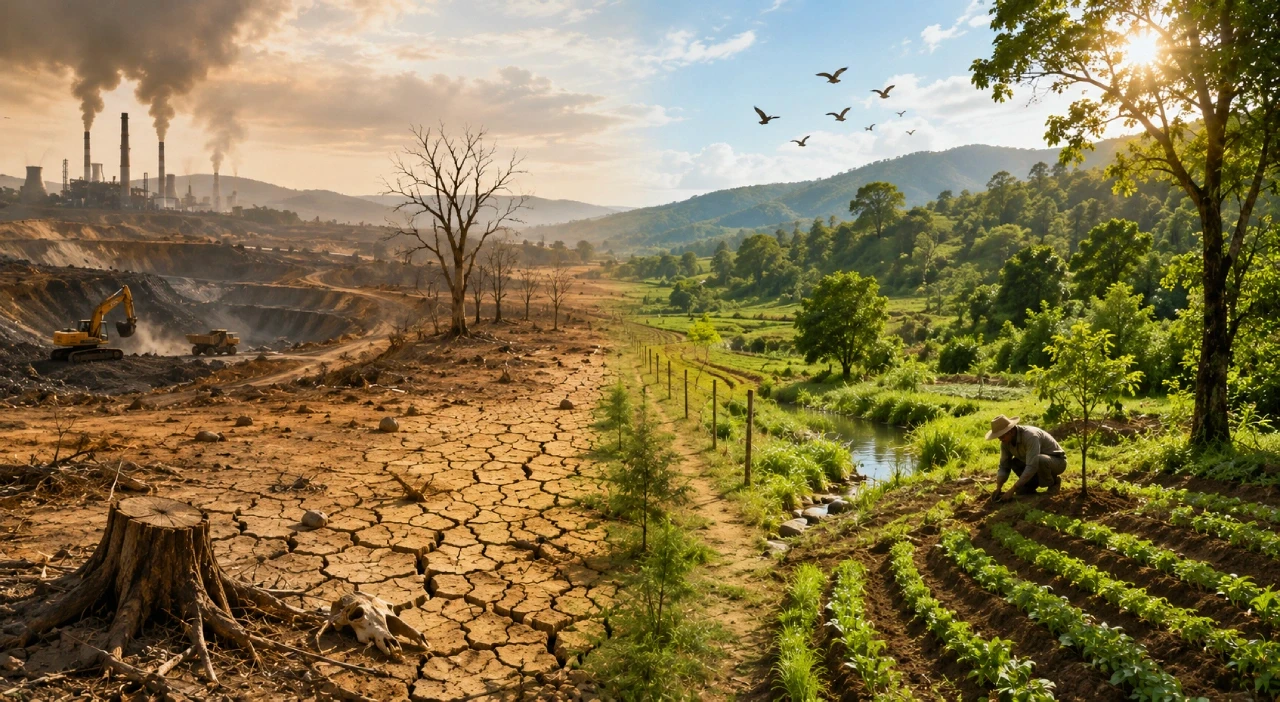
India is losing its land quietly, steadily, and at a scale most people don't notice until it's too late. Nearly 30% of India's total land area is already degraded or facing desertification. That's not a distant statistic. It shows up in falling crop yields, disappearing groundwater, and communities that can no longer sustain themselves on land their families farmed for generations.
Understanding land degradation what it means, why it happens, and how it can be reversed is essential for anyone who cares about food security, the environment, or the future of Indian agriculture. It's also increasingly relevant to anyone thinking about owning or investing in farmland, because how land is managed today determines whether it will remain productive tomorrow.
This post covers the full picture: the land degradation definition, its primary causes, its wide-ranging effects, and the solutions that genuinely work including how responsible managed farmland practices can be part of the answer.
What Is Land Degradation? Understanding the Definition
Land degradation refers to the decline in the biological or economic productivity of land, caused by a combination of human activity and natural processes. In plain terms, it means land that was once fertile, stable, or ecologically rich becomes less capable of supporting plants, crops, or life.
The land degradation definition used by international bodies focuses on three core changes: loss of soil fertility, reduction in biodiversity, and weakening of ecosystem functions like water retention and carbon storage. When any or all of these deteriorate, the land's ability to sustain agriculture or natural habitats diminishes often irreversibly without active intervention.
In India, the numbers are stark. Of the country's total geographical area of 328.72 million hectares, around 96.4 million hectares are under various stages of desertification. Twenty-six of twenty-nine Indian states have reported an increase in degraded land area over the past decade.
This is not just an environmental problem. It's an economic and human crisis unfolding in slow motion.
What Are the Main Causes of Land Degradation?
Unsustainable Agricultural Practices
Farming is both the primary user of land and when done poorly one of the biggest drivers of degradation. Overuse of chemical fertilisers strips the soil of its natural microbial life. Excessive irrigation leads to waterlogging and salinisation. Monoculture farming depletes specific nutrients over time, leaving soils structurally weak and less resilient to drought or erosion.
Over-cultivation growing crops continuously without rest periods or crop rotation pushes soil beyond its natural regenerative capacity.
Deforestation and Loss of Vegetation
Trees anchor soil. Their roots hold the ground together, their canopies reduce the force of rain on the surface, and their leaf litter feeds the soil's biological ecosystem. When forest cover is removed for timber, for agriculture, or for development the soil below becomes vulnerable almost immediately.
Loss of vegetation is one of the two factors most consistently identified across degraded landscapes worldwide. Without plant cover, topsoil erodes rapidly through both wind and water action.
Water and Wind Erosion
Water erosion is the most widespread form of land degradation in India, affecting approximately 126 million hectares. It begins simply: raindrops hitting bare soil dislodge particles, runoff carries them downslope, and over time the productive topsoil layer disappears. On sloped terrain, this process accelerates dramatically.
Wind erosion, while more geographically limited (primarily in arid regions), affects around 11 million hectares in India. It removes the finest soil particles which are also the most nutrient-rich and leaves behind coarser, less fertile material.
Overgrazing
When livestock graze beyond what the land can sustain, they remove vegetation faster than it can regrow and compact the soil with their hooves. Compacted soil absorbs less water, increases runoff, and becomes progressively harder for plant roots to penetrate. Overgrazing is particularly damaging in semi-arid zones where vegetation recovery is already slow.
Mining and Industrial Activity
Open-cast mining strips land of all vegetation and topsoil across large areas. The spoil dumps and tailings left behind are often chemically hostile to plant growth. Nearby land is contaminated by leachate and heavy metals. Even after mining ceases, remediation of these lands is slow and expensive.
Chemical pollution from industrial discharge and excessive use of agrochemicals can render soil biologically inert unable to support the microbial communities that make soil fertile in the first place.
What Are the Effects of Land Degradation on the Environment and Human Life?
The consequences of land degradation ripple outward well beyond the degraded land itself.
Declining agricultural productivity is the most immediate effect. As soil fertility falls, farmers need more inputs to achieve the same yields a cycle that becomes economically unsustainable. Food security weakens as a result.
Water scarcity intensifies. Degraded soils lose their ability to absorb and retain rainfall. Instead of percolating down to recharge groundwater, rain runs off quickly, increasing flood risk while reducing dry-season water availability. Aquifers recharge more slowly; wells run dry sooner.
Biodiversity loss follows land degradation closely. Thousands of species depend on healthy soil ecosystems. Insects, birds, reptiles, and mammals all rely on intact land habitats. When degradation sets in, these habitats shrink, fragment, and eventually disappear.
Climate change is both a cause and a consequence. Degraded land releases stored carbon into the atmosphere, contributing to warming. Warming, in turn, accelerates drought conditions, making degradation worse. It's a feedback loop that's genuinely difficult to interrupt without active intervention.
For farming communities, the social cost is severe. Reduced yields mean reduced income. Families that depended on agriculture for generations find themselves unable to sustain livelihoods. This drives rural-to-urban migration, placing pressure on cities and hollowing out agricultural communities.
The Economics of Land Degradation Initiative has estimated that every ₹100 invested in restoring degraded land can return approximately ₹500 in long-term economic benefits through improved crop yields, water security, and carbon sequestration. The return on responsible land stewardship is not abstract.
What Is the Difference Between Land Degradation and Soil Erosion?
This is a common point of confusion, and it's worth clarifying.
Soil erosion is a specific physical process the removal of the topsoil layer by wind or water. It's one of the most visible and measurable forms of land degradation.
Land degradation is a broader concept. It encompasses soil erosion, but also includes soil salinisation, chemical contamination, waterlogging, compaction, loss of organic matter, and desertification. Erosion is a mechanism; degradation is the outcome a reduced capacity of land to function productively and ecologically.
Think of it this way: all soil erosion contributes to land degradation, but land degradation can occur even without visible erosion through salinisation from poor irrigation, for example, or through chemical pollution that destroys soil biology while leaving the physical topsoil layer intact.
How Can Land Degradation Be Prevented and Reversed?
Sustainable Land Management
Sustainable Land Management (SLM) practices include crop rotation, cover cropping, contour farming on slopes, and organic matter additions that rebuild soil structure over time. These are not new ideas they're proven approaches that work when consistently applied.
Integrating trees into farmland (agroforestry) is particularly effective. Trees reduce erosion, increase soil organic matter, improve water infiltration, and create microclimates that buffer crops from temperature extremes.
Afforestation and Reforestation
Planting trees on degraded and wasteland is one of the highest-leverage interventions available. Trees stabilise soil within years and begin restoring ecosystem function within a decade. Programmes like the Great Green Wall of Africa demonstrate this at scale.
At Sanctity Ferme, over 5 lakh trees have been planted across 300+ acres of managed farmland near Bangalore. What began as land that needed careful stewardship has developed, over years, into a green landscape with measurable improvements in soil health and biodiversity. Regenerative approaches like these show what's possible when land is managed with long-term thinking rather than short-term extraction.
Soil Reclamation
Salt-affected and acidic soils can be reclaimed through targeted chemical and biological amendments. Phytoremediation using specific plants to absorb heavy metals or break down pollutants offers an ecologically sound approach for chemically contaminated land.
Responsible Farmland Ownership
One underappreciated solution is keeping agricultural land in the hands of owners who are invested in its long-term health. Managed farmlands near Bangalore represent a model where land is professionally maintained, trees are planted at scale, and farming practices are designed to preserve and improve soil quality not extract from it.
If you're exploring farm land for sale in Bangalore, understanding the land's management philosophy matters as much as its location or price. Land that is restored and maintained well holds value. Land that is extracted from doesn't.
For a deeper look at how Sanctity Ferme approaches ecological restoration, see how the team has worked on cultivating life on previously barren land a practical example of what responsible stewardship can produce.
How Does Land Degradation Affect Soil Fertility?
Soil fertility is not just about the presence of nutrients. It's about the living ecosystem of microorganisms, fungi, earthworms, and organic matter that makes nutrients available to plants and maintains the soil's physical structure.
Land degradation attacks this ecosystem from multiple directions simultaneously. Erosion removes the topsoil where organic matter and microbial life are most concentrated. Salinisation creates osmotic conditions that stress plant roots and harm soil microbes. Compaction destroys the pore structure that allows air and water to move through soil. Chemical contamination kills the biological communities that cycle nutrients.
When soil loses its biological complexity, it becomes chemically simpler fewer nutrient forms, less biological activity, and lower resilience to drought or disease. Restoring soil fertility requires rebuilding this ecosystem, not just adding synthetic nutrients, which is why long-term, biology-focused approaches to sustainable farming practices consistently outperform chemical-input-heavy approaches over time.
The Path Forward: Stewardship Over Extraction
Land degradation is serious. But it is not irreversible. Across the world and here in India land that was damaged has been restored. The tools exist. The knowledge exists. What's needed is commitment to long-term stewardship rather than short-term extraction.
For individuals, that commitment can take many forms: supporting regenerative agriculture, choosing food produced sustainably, or directly owning land that is managed responsibly.
At Sanctity Ferme, we've spent years demonstrating that land can be both economically productive and ecologically healthy. Our managed farmlands near Shoolagiri just 90 minutes from Bangalore via NH44 are maintained with that principle at their core. If you'd like to see it firsthand, we'd welcome you for a site visit.
Book a visit or reach out to our team to learn more about current available plots.
Frequently Asked Questions (FAQs) on Land Degradation
What are the main causes of land degradation?
The primary causes of land degradation are unsustainable agricultural practices (over-cultivation, excessive agrochemical use, poor irrigation), deforestation, overgrazing, and industrial activities like mining. In India, water erosion is the most widespread cause, affecting over 126 million hectares. Wind erosion, soil salinisation, and chemical pollution are also significant contributors depending on the region.
Two factors that consistently appear across most degradation scenarios are the removal of vegetative cover which leaves soil exposed and disruption of the water cycle, which accelerates erosion and reduces the land's capacity to recover naturally.
What are the effects of land degradation on the environment?
Land degradation causes a cascading series of environmental effects. Soil erosion removes the productive layer of earth, reducing the land's capacity to support crops or natural vegetation. Loss of vegetation cover destroys habitats for insects, birds, and mammals, driving biodiversity decline. Water retention in degraded soils falls sharply, intensifying both flood risk and dry-season water scarcity.
At a global scale, degraded land releases stored carbon, contributing to climate change which in turn creates more drought and extreme weather conditions, accelerating further degradation. Dust storms from severely degraded land also affect air quality across large regions.
What is the impact of land degradation on human life?
The human impact of land degradation is profound. Falling agricultural productivity means reduced food availability and higher food prices, affecting food security. Farming families see their incomes drop as yields decline, pushing many below the poverty line.
Water scarcity worsens in degraded areas, creating conflicts over irrigation sources. Communities dependent on agriculture are often forced to migrate to urban centres in search of livelihoods a process that hollows out rural communities while adding pressure to already crowded cities. The United Nations estimates that land degradation currently affects 3.2 billion people worldwide.
How can land degradation be prevented?
Land degradation can be prevented and reversed through a combination of approaches: adopting sustainable land management practices like crop rotation, cover cropping, and contour farming; planting trees through agroforestry and afforestation programmes; reclaiming salt-affected or acidic soils through targeted amendments; and managing irrigation water quality to prevent salinisation.
At the policy level, enforcing the "polluter pays" principle for industrial land contamination and integrating Land Degradation Neutrality (LDN) targets into national planning frameworks are important systemic steps. At the individual land owner level, committing to regenerative rather than extractive farming practices is the most direct preventive action available.
How does land degradation affect soil fertility?
Soil fertility depends on a complex ecosystem of microorganisms, organic matter, and chemical processes that make nutrients available to plants. Land degradation disrupts all of these simultaneously. Erosion removes the topsoil layer where biological activity is highest. Salinisation creates osmotic stress that harms both plant roots and soil microbes. Compaction destroys the physical structure that allows water, air, and root systems to penetrate the soil.
Restoring soil fertility after degradation requires rebuilding this biological ecosystem a process that takes years and cannot be shortcut simply by adding synthetic nutrients. This is why long-term, biology-focused land management consistently outperforms short-term chemical-intensive approaches.
What is the difference between land degradation and soil erosion?
Soil erosion refers specifically to the physical removal of topsoil by wind or water. It is one mechanism of damage to land.
Land degradation is a broader term that encompasses all processes that reduce land's biological or economic productivity including erosion, but also salinisation, waterlogging, chemical contamination, compaction, and loss of organic matter. You can have significant land degradation without visible erosion: for example, through gradual salinisation from poor-quality irrigation water, which leaves the physical topsoil intact while making it increasingly hostile to plant life.