Modern Farming Techniques Every Farmer Should Know
Discover practical gardening advice, expert landscaping tips, and inspiration to help you make the most of your outdoor space.
Sanctity Ferme Team
Indian agriculture is changing faster than at any point in its history. A growing population, shrinking water tables, unpredictable monsoons, and rising input costs have made one thing clear: farming the way it was done a generation ago is no longer sufficient.
The good news is that modern farming techniques are not reserved for large industrial operations or well-funded agribusinesses. Many of the most effective advanced farming methods are now accessible to small and marginal farmers across India and the results in crop yield, water efficiency, and income are measurable.
Understanding these modern methods of agriculture is no longer optional. Whether you own a small plot, manage a few acres, or are exploring farmland ownership near Bangalore, knowing what these techniques are and which ones suit your situation gives you a meaningful edge.
What Is Modern Farming and Why Does It Matter?
Modern farming refers to the use of technology, data, and science-backed systems to improve how crops are grown and land is managed. The goal is not to replace traditional agricultural knowledge but to build on it using better tools to make more precise, resource-efficient decisions.
India is home to the world's second-largest agricultural land area, yet productivity per hectare remains below global averages for many crops. Closing that gap doesn't require more land. It requires smarter use of the land that already exists.
Modern methods of agriculture address this directly by reducing input waste, improving crop monitoring, extending growing seasons, and helping farmers respond faster to changing conditions.
1. Precision Farming
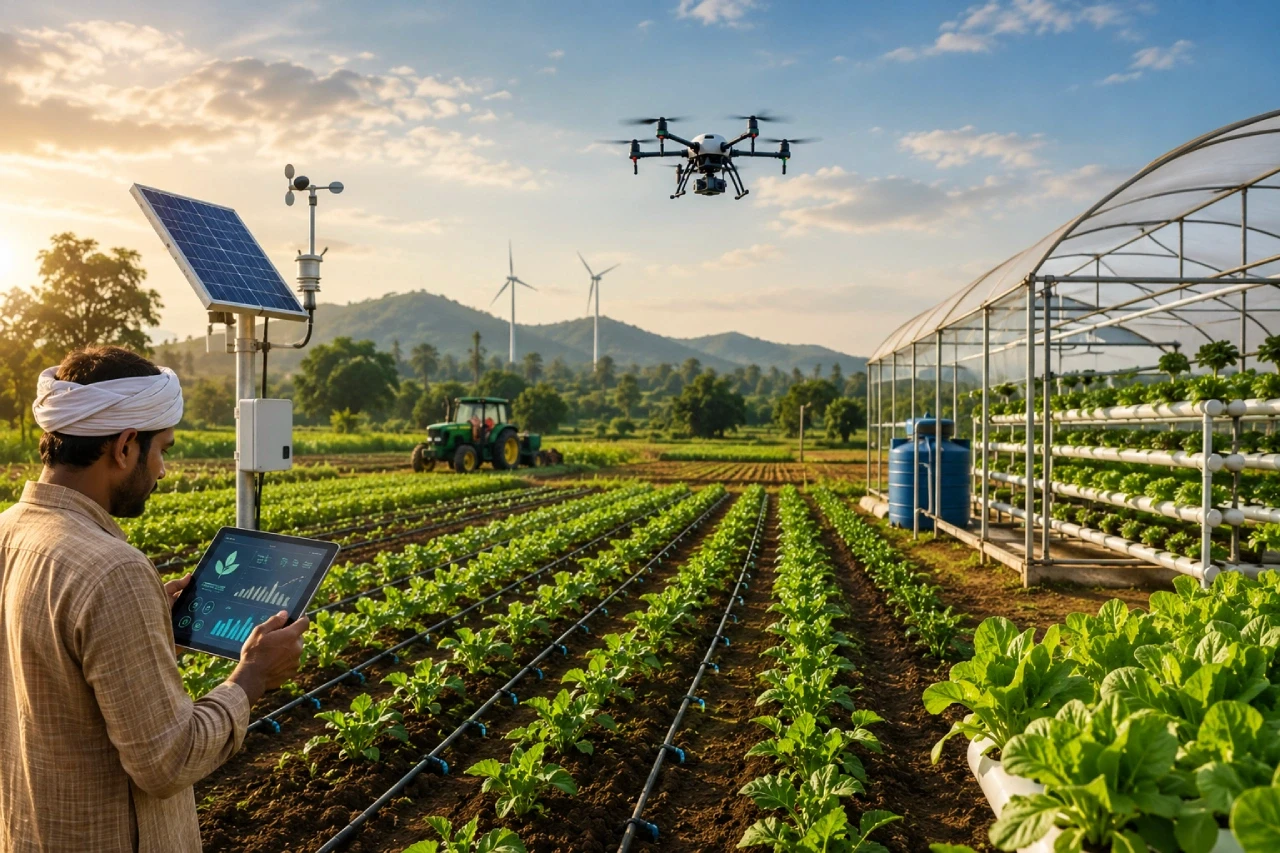
Precision farming is the practice of treating different parts of a field differently based on real data rather than uniform application across the entire plot. Instead of irrigating an entire field on a fixed schedule or applying fertiliser evenly, precision farming uses sensors, GPS mapping, and data analysis to understand variation within the field and respond to it.
In practice, this means a farmer can identify that one section of a field is moisture-deficient while another is adequate, and irrigate accordingly. Or detect early signs of pest pressure in a specific zone before it spreads. Precision farming has been shown to increase yields by around 21% while reducing chemical use by up to 26% a combination that improves both profitability and soil health simultaneously.
Drone-based crop monitoring and spraying is one of the most visible applications of precision farming now being adopted across India. IFFCO's deployment of 2,500 agricultural drones for fertiliser spraying is a notable example of how precision delivery is moving from pilot programmes into mainstream practice.
For managed farmlands near Bangalore, precision irrigation and soil monitoring are increasingly part of how well-run farm projects maintain soil health and crop productivity across their plots.
2. Drip and Micro-Irrigation
Water is agriculture's most constrained input across most of southern India, and innovative farming techniques around irrigation have perhaps the most immediate and measurable impact for farmers working in water-scarce conditions.
Drip irrigation delivers water directly to the root zone of each plant through a network of pipes and emitters, eliminating the evaporation and runoff losses that characterise flood or furrow irrigation. Micro-sprinklers serve a similar function for crops that need broader coverage.
The efficiency gains are significant. Conventional flood irrigation typically uses 2–3 times more water than drip systems for the same crop output. In a region where groundwater is depleting and electricity costs for pumping are rising, drip irrigation reduces both water consumption and energy costs in a single investment.
Karnataka's government has actively promoted drip irrigation through subsidy programmes, making this one of the most accessible new agriculture technologies for farmers in the region. For high-value crops like turmeric, ginger, and vegetables the crops with the strongest returns for small landowners drip irrigation is particularly well-matched.
3. Hydroponics and Controlled Environment Agriculture
Hydroponics is a soil-free growing method where plant roots are suspended in or misted with nutrient-rich water solutions. Without soil as a medium, crops grow faster, use significantly less water, and can be produced year-round in controlled environments independent of weather or season.
Urban Kisaan, a Hyderabad-based agri-startup, has demonstrated that hydroponic systems can produce leafy greens like methi and palak in climate-controlled indoor environments at commercial scale including on rooftops and in small urban spaces where conventional farming is impossible.
For India's growing urban population and peri-urban zones around cities like Bangalore, hydroponics represents one of the latest farming techniques with strong commercial potential for high-value crops like lettuce, basil, cherry tomatoes, and microgreens.
The upfront investment is higher than conventional farming, but operating costs per cycle are lower, and the ability to produce consistent, pesticide-free produce year-round commands strong premium pricing in urban markets.
4. Agroforestry
Agroforestry the deliberate integration of trees with crops and/or livestock on the same land is one of the oldest farming systems in India and simultaneously one of the most relevant modern agriculture techniques for building long-term land productivity.
When trees are planted alongside crops, they provide multiple benefits simultaneously: shade regulation for understorey crops, organic matter through leaf litter, nitrogen fixation (in the case of leguminous trees), wind protection, and habitat for beneficial insects that naturally control pest populations.
From an economic standpoint, agroforestry creates multiple income streams from the same land parcel. Timber or fruit trees generate long-term value while annual crops provide shorter-cycle income. This layered approach significantly reduces the income risk that comes from relying on a single crop.
At Sanctity Ferme, agroforestry has been central to how the land has been developed across 300+ acres near Shoolagiri. Over 5 lakh trees have been planted not as a carbon offset gesture, but as a core component of how the land functions. The result is measurable improvement in soil health, biodiversity, and microclimate stability across the farm community.
5. Organic Farming and Bioinputs
Modern farming methods are not exclusively technology-driven. Organic farming the elimination of synthetic fertilisers and pesticides in favour of biological inputs represents a sophisticated agronomic approach that increasingly commands premium market prices.
India's organic food market has been growing steadily, driven by urban consumer demand for chemically-clean, traceable produce. Certified organic crops typically fetch 30–50% price premiums over conventionally grown equivalents, with export markets offering even stronger returns.
The transition requires patience a 2–3 year conversion period during which the land recovers from chemical dependency and builds biological complexity. But for farmers starting on fresh land, beginning with organic principles from day one means the soil builds health from the start rather than having to recover from degradation.
Bioinputs microbial inoculants, vermicompost, green manure crops, and natural pest deterrents like neem-based sprays are now widely available and supported by state agricultural departments across Karnataka. These are advanced farming methods that cost less per application than synthetic equivalents while building rather than depleting soil fertility over time.
6. Vertical Farming
Vertical farming stacks growing layers in a controlled indoor environment typically using LED lighting, hydroponics or aeroponics, and climate control systems. It enables year-round production of leafy vegetables, herbs, and microgreens in a fraction of the horizontal footprint of conventional farming.
While the technology is still relatively capital-intensive for individual small farmers, vertical farming is increasingly viable as a commercial venture in peri-urban zones near major cities. It's particularly relevant for farm land for sale in Bangalore regions where urban proximity creates strong demand for fresh, locally grown produce.
Several Indian startups are now building vertically farmed supply chains for supermarkets and restaurant groups in Bangalore, Hyderabad, and Mumbai creating commercial opportunities for landowners willing to invest in the infrastructure.
7. Farm Management Technology and Digital Tools
Beyond specific growing techniques, new agriculture technology in farm management software, crop monitoring apps, weather analytics, and commodity price platforms is transforming how farmers plan, track, and market their output.
Satellite-based crop health monitoring, accessible through mobile apps, allows farmers to track vegetation indices across their plots without physical inspection. Soil health apps connected to testing laboratories provide actionable nutrient recommendations. Digital mandi platforms allow direct price comparison and reduce dependency on intermediaries.
For farmland owners and managers, these tools reduce information asymmetry a historically significant disadvantage for small farmers and enable more data-driven decisions about what to grow, when to irrigate, and when to sell.
Modern Techniques and the Managed Farmland Advantage
The adoption of innovative farming techniques is significantly easier when the infrastructure is already in place. For working professionals and families considering farmland ownership, one of the practical challenges is implementing modern methods on a plot without prior agricultural expertise or ongoing time commitment.
This is precisely where professionally managed farmlands offer a meaningful advantage. At Sanctity Ferme's farmlands near Bangalore, plots are maintained using established soil management, irrigation, and plantation systems incorporating the kind of regenerative and modern agricultural thinking that individual landowners would otherwise need years to develop.
With land value growing from ₹55 to ₹450+ per sq. ft. over four years across Sanctity Ferme's projects, and over 800 plots already sold to a community of 1,400+ members, the model demonstrates that thoughtful, technique-driven land management has real and measurable economic outcomes.
If you're curious about what this looks like on the ground, you can visit the farm or explore current available projects to get a clearer picture.
Farming is changing. The techniques are available. The question is simply whether you're ready to use them.
Talk to the Sanctity Ferme team to learn more.
Frequently Asked Questions (FAQs) on Modern Farming Techniques
What is precision farming and how does it work?
Precision farming uses sensors, GPS mapping, drones, and data analytics to monitor variation across a field and apply inputs water, fertiliser, pesticide only where and when they're needed. Instead of treating an entire field uniformly, precision farming responds to real conditions at a granular level. This reduces input waste, lowers costs, and improves yield. Studies show precision farming can increase yields by around 21% while cutting chemical use by up to 26%.
In India, drone-based spraying is one of the most rapidly adopted precision farming tools, now being used across multiple states for fertiliser and pesticide application with significantly improved coverage accuracy compared to manual spraying.
What is vertical farming and where is it used?
Vertical farming stacks crop-growing layers in a controlled indoor environment using artificial lighting, hydroponics or aeroponics, and precise climate management. It allows year-round production of leafy vegetables, herbs, and microgreens in a very small horizontal footprint making it well-suited to urban and peri-urban locations where land is scarce or expensive.
In India, vertical farming is gaining traction in cities like Bangalore, Hyderabad, and Mumbai, where proximity to high-value urban markets makes premium, pesticide-free produce commercially viable. It requires significant upfront investment in infrastructure but offers consistent, weather-independent production cycles throughout the year.
How do modern farming techniques increase productivity?
Modern farming techniques increase productivity by improving the precision of input use, extending growing seasons, reducing crop losses to pests and disease, and enabling data-driven decision-making. Drip irrigation reduces water waste while maintaining optimal root-zone moisture. Precision tools detect pest pressure early, allowing targeted treatment before losses escalate. Organic and biological inputs build soil biology over time, improving nutrient availability and crop resilience.
Collectively, these techniques allow more output from the same land area and the same or lower input costs which is the fundamental definition of productivity improvement in agriculture.
Are modern farming methods profitable for farmers?
Yes, when chosen appropriately for the crop, climate, and market context. Drip irrigation has one of the highest return-on-investment profiles of any agricultural technology typically paying back the installation cost within 2–3 seasons through water and energy savings. Organic farming commands 30–50% price premiums once certified. Precision farming reduces overuse of expensive inputs like fertilisers and pesticides.
The key is matching the technique to the specific situation. Not every modern method suits every farm or every crop. Beginners are best served starting with one technique typically irrigation efficiency or organic soil management and building from there as confidence and resources allow.
Which modern farming technique is most profitable?
For most small and marginal farmers in Indian conditions, drip irrigation combined with high-value crop selection offers the strongest return relative to investment. The capital requirement is moderate, the payback period is short, and the technique is compatible with a wide range of crops.
For those with access to urban markets and higher capital, hydroponics and vertical farming can generate stronger per-square-foot returns particularly for leafy greens and herbs. For long-term land value and soil health, agroforestry integrated with organic farming consistently outperforms extractive models over a 5–10 year horizon, which is why it forms the foundation of well-managed farmland projects near Bangalore.