Top Profitable Farming Ideas for Beginners in India
Discover practical gardening advice, expert landscaping tips, and inspiration to help you make the most of your outdoor space.
Sanctity Ferme Team
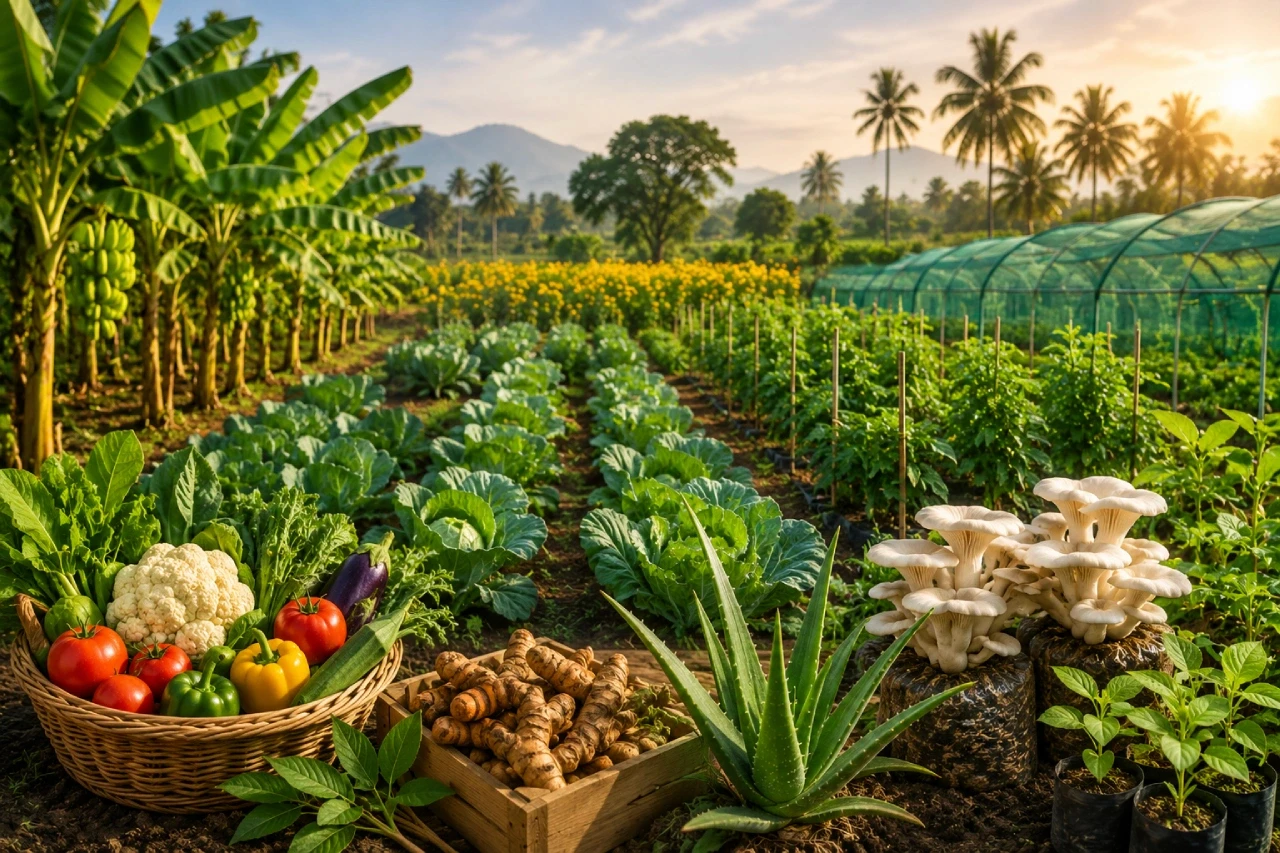
India is an agricultural nation yet most people who want to start farming don't know where to begin. Which crop to grow? How much land do you need? What's the realistic return? These are practical questions that rarely get practical answers.
The good news is that profitable farming in India is achievable even for beginners, on small plots of land, with moderate investment. The key is choosing the right crop, understanding your climate and soil, and managing your land with long-term thinking rather than short-term speculation.
According to the Ministry of Agriculture, over 86% of Indian farmers are small and marginal farmers meaning the bulk of Indian agriculture is driven by people working with limited land, not large industrial operations. If they can build viable livelihoods from small farms, so can you.
This guide covers the most profitable farming ideas in India for beginners what to grow, what to expect, and how to get started on the right foot.
Why Crop Selection Is the Most Important Decision You'll Make
Before buying seeds or breaking ground, the choice of what to grow determines almost everything else your investment requirement, your labour needs, your market, and your profit margin.
Most profitable farming crops in India share a few common traits: they have consistent domestic demand, a relatively short crop cycle, and tolerance for Indian climate conditions. High-value crops that take years to mature can be excellent long-term investments, but beginners are better served starting with something that gives visible results within a single season.
Two factors consistently separate profitable farms from struggling ones: matching the crop to the local agroclimatic zone, and ensuring there's a reliable market before planting. Growing the right crop in the wrong region or growing the right crop with no buyer nearby erases margins quickly.
Most Profitable Farming Ideas for Beginners in India
1. Vegetable Farming
Vegetables offer some of the fastest returns in agriculture. Crops like tomatoes, capsicum, brinjal, okra, and cauliflower can be harvested within 30–90 days of planting. Profit margins in commercial vegetable farming typically range from 45–65%, and demand remains consistent year-round across urban and semi-urban markets.
For beginners, starting with 2–5 varieties suited to your season reduces risk while keeping production volume manageable. Proximity to a mandI or urban market significantly improves returns by cutting transport time and spoilage.
2. Turmeric
Turmeric is one of the most profitable farming crops in India for small landowners. It has deep roots in domestic consumption and growing export demand driven by its medicinal properties. Average yields of 25–30 quintals per acre are achievable with proper soil preparation and irrigation, and profit margins regularly exceed 50%.
Turmeric does require a crop cycle of 8–10 months and adequate water during growth, but it stores well post-harvest giving farmers flexibility on when to sell.
3. Ginger
Ginger is another high-value spice crop that has seen sustained profitability across India's growing spice export market. It grows well in well-drained, loamy soils with partial shade making it compatible with agroforestry systems where it can be grown under the canopy of fruit or timber trees.
For beginners with moderate land (half an acre to 2 acres), ginger is a practical high-value crop that doesn't require heavy mechanisation.
4. Herbal and Medicinal Plants
India's herbal and wellness market has been growing at approximately 15% annually, creating strong and expanding demand for medicinal crops. Aloe vera, ashwagandha, tulsi, and lemongrass are among the high value crops in India that require relatively low maintenance, tolerate a range of soil conditions, and have guaranteed buyers through herbal product companies and pharmaceutical intermediaries.
Aloe vera in particular is well-suited to drier zones like Karnataka and Rajasthan, requires minimal irrigation once established, and can generate meaningful returns on small plots.
5. Mushroom Farming
Mushroom cultivation stands out as one of the most profitable farming ideas for beginners because it requires very little land. Button and oyster mushrooms can be grown in a shaded shed of just a few hundred square feet and generate profit margins of 70–120% per growing cycle.
Cycles are short 45–60 days allowing multiple harvests per year. The primary investment is in controlled environment setup (humidity, temperature, substrate), not land. For urban and peri-urban beginners, this makes mushroom farming a highly accessible entry point.
6. Fruit Crops: Papaya, Banana, and Watermelon
Among fruit crops, these three offer the best combination of early yield and high margins for beginners. Papaya begins producing within 10 months of planting and continues for 2–3 years. Watermelon has profit margins of 50–95% per season and a crop cycle of just 75–90 days. Banana, once established, requires relatively little labour and produces year-round.
All three have strong demand in Indian markets and are well-suited to Karnataka's agroclimatic conditions, making them practical choices for those exploring farm land for sale in Bangalore or surrounding districts.
7. Organic Farming
Across all crop categories, organic production commands a 30–50% price premium over conventionally grown equivalents. As urban consumers increasingly prioritise food safety and traceability, certified organic produce whether vegetables, grains, or spices finds willing buyers at premium prices through organic stores, direct-to-consumer boxes, and export channels.
The transition to organic farming requires 2–3 years of chemical-free management before certification, but for beginners starting fresh on new land, this timeline works in their favour. Sustainable farming practices that build soil health from the start are simultaneously the most ecologically sound and the most economically strategic approach for the long run.
Which Farming Is Most Profitable for Indian Climate Conditions?
The honest answer is: it depends on your zone. India's agricultural diversity is enormous, and which farming is most profitable in India varies significantly by state, elevation, rainfall, and soil type.
In Karnataka and the broader Deccan plateau region the zone most relevant to farmland near Bangalore the following broadly apply:
Dry season (October–February): vegetables, sunflower, lentils
Wet season (June–September): ginger, turmeric, maize, paddy
Year-round options: herbal crops, fruit orchards, mushroom (controlled environment)
Matching your crop calendar to the natural rainfall cycle reduces irrigation dependency and input costs both important levers for beginners managing limited budgets.
Managed Farmland: A Practical Starting Point for Beginners
One barrier beginners consistently face is the gap between knowing what to grow and knowing how to do it. Soil preparation, irrigation setup, pest management, harvest timing, and market linkages all require experience that takes years to build.
This is where managed farmlands near Bangalore offer a meaningful advantage. At Sanctity Ferme, farm plots are professionally maintained with established irrigation, plantation, and soil management systems already in place. Owners benefit from the infrastructure and expertise of an experienced team rather than starting from zero.
Over 800 farm plots have been sold across five projects, with 300+ acres under active management near Shoolagiri just 90 minutes from Bangalore via NH44. Land value has grown from ₹55 to ₹450+ per sq. ft. over four years, reflecting both the appreciation of well-managed agricultural land and the growing interest in farm ownership among working professionals and families.
If you're exploring the idea of owning productive land without navigating everything alone, view available farmland projects or visit the farm to see the approach firsthand.
The Long View on Profitable Farming
Profitable farming in India is real but it requires patience, the right crop-climate match, and a genuine commitment to soil and land health over time. The farms that generate the strongest returns after five to ten years are almost always the ones that started with good soil management, not just good crop selection.
Whether you're starting with a kitchen garden, a leased plot, or looking at managed farm ownership near Bangalore, the principles are the same: start with what you can manage, match your crops to your conditions, and treat the land as a long-term asset.
Reach out to the Sanctity Ferme team to learn more about how managed farmland ownership works in practice.
Frequently Asked Questions (FAQs) on Profitable Farming in India
How much investment is required to start farming in India?
The investment required depends significantly on the type of farming and the land area. At the lower end, mushroom farming can be started in a small controlled space for ₹50,000–₹1.5 lakh. Vegetable farming on 1 acre typically requires ₹30,000–₹80,000 per season including soil preparation, seeds, and basic irrigation. High-value crops like turmeric and ginger require a higher upfront investment (₹80,000–₹1.5 lakh per acre) but offer stronger returns per unit of land.
Land cost is separate and varies enormously by location. For beginners evaluating managed farmland ownership near Bangalore, professional management handles much of the operational complexity, reducing the knowledge-intensive burden of starting entirely from scratch.
What are the best farming ideas for small landowners?
For small landowners those with half an acre to 2 acres the best approach is high-value crops that maximise return per square foot rather than total volume. Turmeric, ginger, vegetables, herbal plants, and mushrooms are all well-suited to small land parcels. Mushroom farming in particular requires almost no land, making it viable even for urban beginners.
Agroforestry integrating fruit trees with understorey crops like ginger or aloe vera is an increasingly popular model for small landowners that generates multiple income streams from the same plot while improving soil health over time.
Which farming is best suited for Indian climate conditions?
India's climate diversity means there's no single answer, but the broadly reliable crops across most of India's farming zones include vegetables (high demand, fast cycle), turmeric and ginger (strong domestic and export markets), and fruit crops like papaya and watermelon (suited to tropical and semi-arid conditions). In Karnataka specifically, the Deccan plateau's climate supports vegetables in the dry season, spice crops during the monsoon, and year-round herbal cultivation.
The most important principle is matching your crop to your specific agroclimatic zone elevation, rainfall, soil type, and seasonal temperatures rather than following national-level advice that may not apply to your region.
Is dairy farming a good business for beginners?
Dairy farming can be profitable, but it requires significant upfront investment in animals, housing, feed, and veterinary care. It also demands consistent daily labour unlike crop farming, dairy has no off-season. For beginners with no prior experience, the learning curve is steep.
That said, small-scale dairy (2–5 animals) integrated with crop farming using manure for composting, growing fodder on the land is a practical and mutually beneficial model. It works best as a complement to crop income rather than a standalone business for first-time farmers.
What is hydroponic farming and is it profitable?
Hydroponic farming is a soil-free method of growing plants in nutrient-rich water solutions, typically in a controlled indoor or greenhouse environment. It allows year-round production of vegetables and herbs regardless of season or outdoor conditions, and uses significantly less water than conventional farming.
It can be profitable particularly for high-value crops like lettuce, basil, cherry tomatoes, and microgreens but the upfront infrastructure cost is substantial (₹5–₹20 lakh or more depending on scale). For beginners, hydroponics is better approached after gaining some farming experience, or through a partnership with an existing operation. It rewards precision and technical understanding more than most traditional farming methods.