How Permaculture Principles Can Transform Your Farmland Investment
Discover practical gardening advice, expert landscaping tips, and inspiration to help you make the most of your outdoor space.
Sanctity Ferme Team
Most farmland investors think about location, title documents, and price per square foot. These things matter no question. But there is a layer beneath all of them that quietly determines whether a piece of land grows in value and productivity over time, or slowly wears itself out.
That layer is how the land is managed.
Permaculture farming offers a design philosophy that can fundamentally change the trajectory of a farmland investment. Not because it involves growing exotic crops or following a lifestyle trend but because it works with the natural logic of a landscape instead of fighting it, and lets that logic do most of the heavy lifting.
This post explains what permaculture actually means, what its core principles are, how they apply to farmland in India, and why any of this matters if you own or are considering farm plots near Bangalore and the Shoolagiri–Hosur belt.
What Do You Mean by Permaculture? A Working Definition
Permaculture is a word formed from two others: permanent and agriculture or culture, depending on who you ask. It was coined in the 1970s by Australian ecologists Bill Mollison and David Holmgren, who asked a simple but genuinely radical question: why does agriculture not work the way natural ecosystems do?
A forest does not need external fertiliser, irrigation schedules, or pest control. It feeds itself, holds water, builds soil, and recovers from stress season after season, decade after decade. Permaculture attempts to design farms that function by that same logic: producing food, timber, fodder, and other yields while becoming richer in soil, biodiversity, and water over time rather than poorer.
As Holmgren defines it, permaculture involves consciously designed landscapes that mimic the patterns and relationships found in natural ecosystems.
In India, permaculture farming is increasingly seen as the answer to a specific set of compounding problems declining soil fertility, unpredictable monsoons, rising input costs, falling farm incomes. It draws on the same indigenous knowledge that Indian farmers practised for centuries, and layers modern ecological design thinking on top of it.
What Is the Difference Between Organic Farming and Permaculture?
This comes up often, and the distinction is worth being clear about.
Organic farming is primarily about what you do not use no synthetic fertilisers, no chemical pesticides. A farm can be fully certified organic and still grow a single crop in rows, deplete its soil over years, and depend on significant external labour and inputs to keep going.
Permaculture is about how you design the whole system. It uses organic methods by default, but goes considerably further: integrating trees with crops, managing water flows across the entire landscape, choosing plant combinations that support and feed each other, and building soil fertility as an ongoing output of the farm itself not something that has to be trucked in from outside.
Put simply: organic farming is an input standard. Permaculture is a design standard.
Who Is the Father of Permaculture in India?
Bill Mollison and David Holmgren co-founded permaculture globally, publishing their first formal work Permaculture One in 1978. In India, the concept spread through ecological farming communities, and Tamil Nadu became one of its early strongholds. Auroville near Pondicherry established one of the country's first large-scale permaculture communities. The Poomaale Collective in Karnataka applied permaculture within coffee-growing ecosystems and documented measurable improvements in soil health and climate resilience on working commercial farms.
What Are the Three Pillars of Permaculture?
Before getting into design principles, it helps to understand the three foundational ethics that everything in permaculture is built around.
Earth Care the farm should leave the land in better condition than it found it. Soil, water, and biodiversity should be protected and actively enhanced, not extracted until there is nothing left.
People Care the farming system should sustain the livelihoods and wellbeing of everyone who depends on it whether that is a resident farmer, a farm manager, or a plot owner who visits on weekends and wants their land to mean something.
Fair Share surplus should be shared appropriately, and consumption should be held at levels the land can sustain indefinitely.
These three ethics are not abstract ideals posted on a wall somewhere. They are the actual design brief. Every decision on a permaculture farm what to plant, where to place a water tank, which species to grow alongside each other is made in reference to them.
The Core Permaculture Design Principles and What They Mean for Your Farmland
David Holmgren published 12 permaculture design principles in 2002, and they have since become the most widely applied framework in sustainable land management worldwide. The following are the principles most directly relevant to farmland investment and managed farm plots in India.
Observe and Interact
The first principle is also the most counterintuitive one for investors who are used to moving quickly. Before you design, plant, or develop anything observe the land through at least one full seasonal cycle. Where does the water flow during heavy rain? Where does topsoil accumulate? Which areas stay dry when everything else is wet? Where do insects concentrate?
Most farmland failures trace back to decisions made without this knowledge. A well-observed plot one where drainage patterns, prevailing winds, and seasonal moisture have been mapped and understood is far easier and cheaper to manage productively than one where these things were guessed at from the beginning.
This is one genuine reason why managed farmland near Bangalore that has been under professional stewardship for years carries a real advantage. The land has been observed, documented, and designed around not just maintained.
Catch and Store Energy
On a farm, energy arrives primarily as sunlight and rain both in seasonal pulses, both gone if you miss them. Permaculture design captures them at peak abundance. Water stored in tanks, ponds, and swales during monsoon becomes available in dry months when nothing else is. Soil organic matter built during productive seasons stores solar energy as fertility that can be drawn down when conditions are harder.
For farmland investors in rain-fed regions like Shoolagiri and the Hosur belt, this principle is not theoretical it is critical. Water harvesting infrastructure contour bunds, farm ponds, swales converts a plot from weather-dependent to largely weather-resilient. And that infrastructure compounds in value each year as the soil deepens and water retention improves.
Obtain a Yield
A permaculture farm is not a conservation project. It is a productive system that should generate meaningful returns for the people who own and manage it. Every element in the design should contribute something timber, fruit, fodder, soil fertility, or water management.
This aligns directly with what a farmland investor needs: a plot that earns from multiple income streams across multiple timelines. Seasonal vegetables in the early years. Fruit trees from year three or four. Timber in years ten to fifteen. A well-designed permaculture farm stacks these yields so the land produces something of value in every season not just one.
Use and Value Diversity
Single-crop farming is fragile. If the crop fails from pest pressure, drought, or market collapse the entire year's income goes with it. Permaculture responds by deliberately building diversity into the system: multiple species, multiple yield types, multiple harvest windows.
On a managed farm plot in the Shoolagiri region, this translates to a mix of timber species like teak and silver oak, fruit trees like mango and sapota, seasonal crops like ragi and pulses, and perennial plants like moringa that produce year-round with minimal inputs. If any one element underperforms in a given season, the others carry the farm forward.
Produce No Waste
In a well-designed permaculture system, every output from one element becomes an input for another. Leaf litter from timber trees becomes mulch for understorey crops. Kitchen and harvest waste is composted and returned to the soil. Even grey water from a farmhouse can be directed to irrigate fruit trees through simple filtration. Nothing leaves the system without purpose.
This closed-loop logic gradually reduces dependency on purchased inputs fertilisers, pesticides, pumped water and builds a farm that becomes more self-sufficient as it matures. For a farmland investor, that means a slow but real reduction in operating costs year on year.
What Is an Example of Permaculture Farming in Practice?
The Forest Garden Model
One of the clearest permaculture applications for farm plots in South India is the forest garden sometimes called a food forest. It is a multi-layered planting system that mimics the structure of a natural forest, where every layer produces something useful.
On a one-acre plot near Shoolagiri, a typical forest garden layout might look something like this:
Canopy layer: Teak, silver oak nitrogen-fixers that provide shade and windbreak
Sub-canopy layer: Mango, jackfruit, sapota
Shrub layer: Moringa, curry leaf, drumstick
Ground cover: Turmeric, ginger, sweet potato
Climbing layer: Pepper, passion fruit, beans
Each plant supports the others around it. Nitrogen-fixing trees enrich the soil for the fruit trees alongside them. Dense lower layers suppress weeds and reduce labour needs. The canopy moderates temperature and slows water loss from the soil below. The whole system feeds itself.
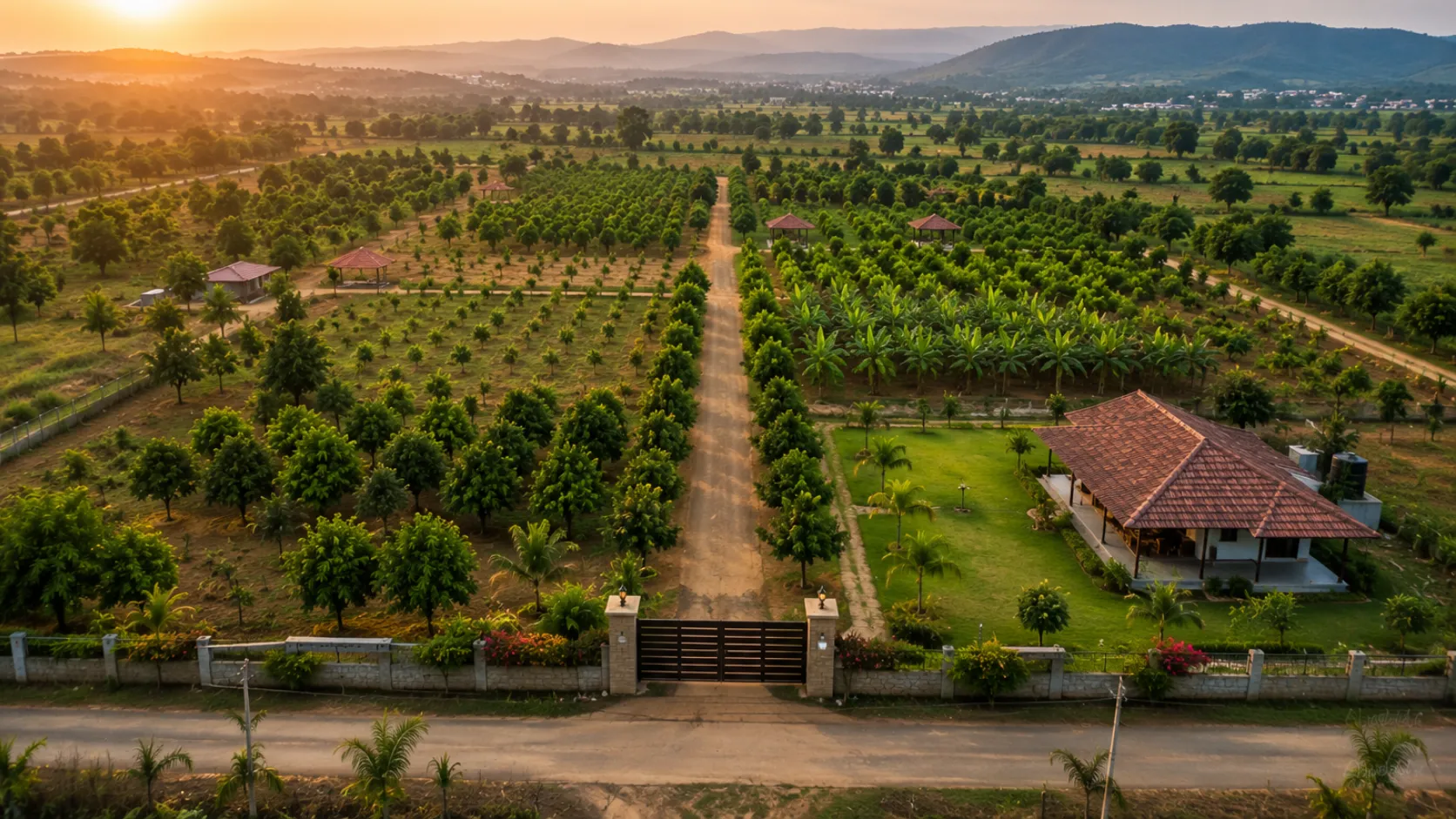
This is the kind of landscape that Sanctity Ferme's sustainability practices are built around. The goal is not just to grow plants it is to design a landscape that genuinely improves itself over time.
Water Harvesting on Sloped Land
The Shoolagiri terrain gently sloping red laterite land with seasonal rainfall is well suited to contour-based water harvesting. Swales, which are water-absorbing trenches dug along the natural contour lines of a slope, slow rainwater down and let it infiltrate into the soil rather than run off the surface. This recharges the water table, reduces erosion, and creates reliably moist planting zones along the swale edges.
A single season of contour swale work on a one-acre plot can permanently change the farm's water availability in dry months. Pair that with a farm pond and you have a plot that is far more productive and far more climate-resilient than anything left unmanaged.
At Sanctity Ferme, we have seen exactly what these interventions look like over time how barren, depleted land transforms into a functioning, thriving biosphere through patient, cumulative work that lasts.
Permaculture Farming in India: Why the Timing Is Right
Policy Tailwinds
India's agriculture policy is shifting in a direction that rewards exactly what permaculture recommends. The National Mission on Natural Farming, approved in 2024 with a ₹2,481 crore outlay, targets one crore farmers across 7.5 lakh hectares offering incentives of ₹4,000 per acre per year to support the transition to chemical-free, nature-based farming systems.
Tamil Nadu's Agroforestry Policy 2026 adds a regional layer of support, simplifying rules for cultivating and harvesting high-value timber species like teak and sandalwood on agricultural land. The state's goal of reaching 33% tree cover is directly aligned with the multi-layer planting that permaculture design has always promoted.
For farmland owners in the Krishnagiri–Hosur belt, this regulatory environment means the farming methods that permaculture recommends are now backed by active government support and real financial incentives.
Land Value Impact
Farmland managed on permaculture principles tends to appreciate faster than comparable unmanaged or conventionally farmed land and the reason is straightforward: the land itself gets better each year. Soil organic matter increases. Water infrastructure matures. Tree canopy develops. These are not abstract ecological benefits they are physical improvements to a tangible asset.
Research on sustainable farmland investment suggests that land certified as organic or practising climate-smart farming can attract valuations 15% higher than conventionally farmed equivalents. Peri-urban farmland near Bangalore in areas like Hosur and Thalli has seen price appreciation of 10 to 14% CAGR in recent years, with plots in sustainable farming corridors outperforming.
At Sanctity Ferme, farm land for sale near Bangalore follows permaculture-aligned management which is a direct factor in how land value has moved from ₹55 to over ₹450 per sq. ft. over four years.
Permaculture Design at Scale: What It Means for a Managed Farm Plot Owner
You Don't Need to Be a Farmer
One of the most common misconceptions about permaculture is that it requires the landowner to be present, technically skilled, and involved in daily decisions. In a well-designed managed farmland system, that is simply not true.
Permaculture design front-loads intelligence. The critical decisions water catchment, species selection, planting zones, companion planting combinations are made at the design stage by experienced practitioners. Once the system is established, it becomes progressively easier to manage over time, not harder. A forest garden in year eight requires far less intervention than a conventionally farmed plot of the same size in year one.
This is what makes permaculture-aligned managed farmlands near Bangalore genuinely well suited to urban professionals and families who want real ownership of productive land without the weight of daily farm management sitting on their shoulders.
The Long Game
Permaculture is not a strategy for extracting maximum value from a plot in year one. It is a strategy for building a plot that becomes more valuable, more productive, and more self-sufficient with every year that passes. For investors with a five-to-fifteen year horizon, this is a fundamentally different kind of asset from a vacant plot or a conventionally cropped farm.
The land compounds. The trees grow. The soil deepens. The water infrastructure matures. And the cumulative value of all of it ecological, productive, and financial grows quietly alongside.
To understand what this looks like as a community experience, not just a financial model, you can explore what life at Sanctity Ferme means for the 1,400+ members who have been part of it.
Permaculture Farming at a Glance
Aspect | Conventional Farming | Permaculture Farming |
Input dependency | High fertiliser, pesticide | Low and declining over time |
Soil health | Degrades without intervention | Builds year on year |
Climate resilience | Vulnerable to single weather events | Buffered by diversity and water harvesting |
Income streams | One or two crops | Multiple yields across multiple timelines |
Labour intensity | High seasonal peaks | Moderate and distributed |
Land value trajectory | Flat or declining if mismanaged | Compounding as the system matures |
Conclusion: Design the Land Before You Plant
Permaculture is not really about what you grow. It is about how you think about the land before you grow anything at all.
A farm designed with permaculture principles water harvested, species layered, soil fed from within the system, yields diversified is a fundamentally different asset from one that is simply cropped seasonally and topped up with inputs. It improves over time rather than wearing down. It produces without requiring increasing external support. It becomes more climate-resilient as it matures.
For anyone investing in farmland in India in 2026, these are not small differences. They are the difference between land that works for you and land that quietly stops working altogether.
Sanctity Ferme has been practising these principles across 300+ acres near Shoolagiri for nearly a decade planting over 5 lakh trees, restoring degraded land, and building farm communities where the land genuinely gets better with time.
If you want to see what a permaculture-informed managed farm plot looks like on the ground, a site visit is the clearest answer there is.