Most Profitable Farming in India: Crops, Models, and What Works in 2026
Discover practical gardening advice, expert landscaping tips, and inspiration to help you make the most of your outdoor space.
Sanctity Ferme Team
India's farmers are increasingly asking a sharper question. Not just "what should I grow?" but "what actually pays?"
The gap between farming as subsistence and farming as a profitable enterprise has narrowed significantly over the last decade. Export demand for Indian spices, herbs, and timber has grown. The domestic wellness and natural products market is expanding. Contract farming models and managed plantations have made high-value crops accessible to landowners who are not full-time farmers.
This post covers the most profitable farming types in India in 2026 from high-value crops and medicinal plants to timber plantations and organic farming along with an honest look at what profitability requires and how managed farmland near Bangalore fits into this picture.
Which Farming Is Most Profitable in India?
There is no single correct answer profitability depends on the crop, the location, the soil, water availability, market access, and the farmer's ability to manage post-harvest. However, certain farming types consistently generate higher margins than conventional crops like wheat, rice, or sugarcane.
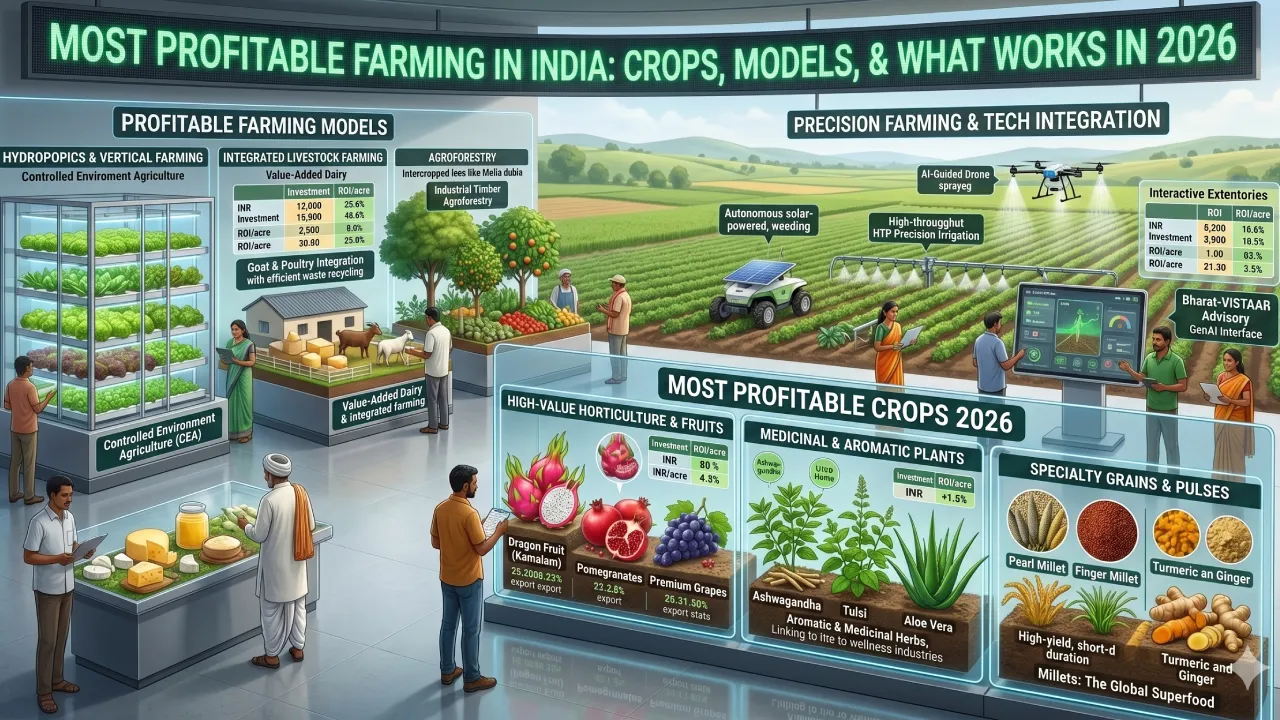
The highest-returning farming models in India in 2026 fall broadly into five categories: medicinal and herbal plant cultivation, spice farming, agroforestry and timber plantations, horticulture (fruits and exotic vegetables), and organic farming with value-added products.
High-Profit Crops in India: What Works and Why
Medicinal and Herbal Plants
This is one of the most profitable farming segments in India right now and one that remains undercultivated relative to demand.
Ashwagandha is a standout. The root is in surging demand globally for its use in Ayurvedic medicine and nutraceuticals. Cultivation is suited to dry, well-drained soils with minimal water input. The crop cycle is 5–6 months, and at current market prices of ₹1,200–₹1,500 per kg for export-quality dried roots, net profit per acre can range from ₹2 lakh to well above ₹5 lakh depending on yield and quality. Companies like Dabur, Himalaya, and Emami are consistent buyers.
Aloe vera offers a different profile a perennial crop that begins yielding in 6 months and continues for up to 5 years from the same plant. Farmers in Karnataka, Rajasthan, and Tamil Nadu earn an average of ₹2–3 lakh per acre annually, with contract farming arrangements providing price certainty. The cosmetic and pharmaceutical industries are the primary buyers, with demand expected to grow consistently.
Tulsi (Holy Basil) is low-maintenance, requires minimal chemical inputs, and is naturally pest-resistant. Tulsi oil fetches ₹3,000–₹5,000 per litre. Cultivated organically with direct processor tie-ups, margins of 45–50% are achievable.
The herbal farming category benefits from a structural tailwind: global wellness spending is growing, Indian medicinal herbs are trusted worldwide, and the National Medicinal Plants Board subsidises cultivation of some endangered species by up to 75%.
Spice Farming
Turmeric and saffron are the most cited high-profit spices in India and for good reason.
Turmeric in Karnataka yields net returns of around ₹1 lakh per acre on a ₹30,000 investment, far ahead of rice or wheat in the same geography. Organic turmeric commands a price premium of 20–40% over conventional produce in both domestic and export markets.
Saffron is considered one of the most profitable individual crops in India by value per kilogram, though it is geographically restricted to Kashmir and parts of Himachal Pradesh. For those with access to suitable agroclimatic conditions, the returns are exceptional.
Ginger and cardamom are worth noting for Kerala, Karnataka, and the Northeast both command strong export prices, particularly when produced organically.
What Is the Best Farming Business in India?
If profitability over a 10–15 year horizon is the criterion, agroforestry and timber plantation farming stands apart from all annual crop-based approaches.
Sandalwood Farming
Sandalwood is widely regarded as one of the most profitable long-term farming ventures in India. Indian sandalwood (Santalum album) is used in perfumery, cosmetics, religious products, and Ayurvedic medicine and global supply consistently falls short of demand.
The numbers are compelling. A well-managed acre with 400–500 trees can yield returns ranging from ₹1.5 crore to ₹2.5 crore over a 12–15 year cycle. Investment per acre covering seedlings, host plants, irrigation, and maintenance is typically ₹80,000 to ₹1.2 lakh. The return on that investment can be 20–30 times the initial cost over the plantation cycle.
Karnataka has liberalised sandalwood cultivation regulations for private landowners, allowing individuals to grow and own sandalwood trees with the appropriate forest department permits. The heartwood begins forming at around 8 years and is typically harvested at 12–15 years for maximum economic value.
One important caveat: sandalwood requires patience, security infrastructure (it is a high-value crop that attracts theft), and proper legal compliance around harvest permits and transport. It is ideally suited to managed farm settings where professional oversight is continuous.
Teak Plantation Farming
Teak is the most widely planted timber tree in South India, particularly in Karnataka, Kerala, and Tamil Nadu. The wood is globally prized for furniture, shipbuilding, and construction. A teak plantation typically reaches commercial maturity in 9–12 years.
Teak provides multiple income streams thinnings (intermediate harvests at 4–5 years) generate early income, while the final harvest at full maturity delivers the primary return. The wood is sold in cubic feet, and well-grown teak commands premium prices in both domestic and export markets.
Beyond the financial return, teak and mixed timber plantations contribute to carbon sequestration, watershed management, and biodiversity making them an attractive choice for environmentally oriented landowners.
Is Farming Profitable in India?
Farming in India is profitable but profitability is not automatic. It depends on three factors that many conventional farmers overlook: crop selection, market linkage, and management quality.
The gap between a farmer growing rice at ₹40,000 per acre net return and one growing turmeric or ashwagandha at ₹1–3 lakh per acre is not primarily a capital gap. It is a knowledge and market access gap. The crop itself is only part of the equation. The farmer who sells directly to an exporter or processor earns meaningfully more than one who sells through a wholesale mandi.
This is why the managed farmland model has grown in relevance for urban investors and non-resident landowners. In this model, a professional team manages all farming operations crop selection, planting, irrigation, maintenance, harvest, and buyer coordination while the landowner holds full title to the property. The landowner benefits from both land appreciation and agricultural income without needing to be present or operationally involved.
For salaried professionals, NRIs, and business owners who own or are considering agricultural land near Bangalore, this model resolves the central challenge of farming: it is profitable when managed well, but most urban landowners lack the time, expertise, or proximity to manage it themselves.
How Can I Make Farming More Profitable?
The pathways to higher farm profitability are well-established. Here are the most effective levers:
Choose high-value crops over commodity crops. Rice and wheat are stable but offer thin margins. Medicinal plants, timber trees, exotic fruits, and spices offer far higher returns per acre often 3–10 times more when grown with proper market linkage.
Go organic where feasible. Organic certification adds a price premium of 20–40% on most produce. Buyers in pharmaceutical, cosmetic, and export segments increasingly require or prefer certified organic inputs. The investment in certification pays back within one or two crop cycles for most medicinal and spice crops.
Reduce dependence on middlemen. A 30–40% commission is typically extracted at the wholesale market level. Contract farming arrangements, direct processor tie-ups, or farmer producer organisations (FPOs) help bypass this layer and improve net margins significantly.
Adopt mixed and intercropping systems. Planting short-duration crops between long-gestation timber trees (like sandalwood or teak) generates income during the waiting period. Intercropping medicinal plants like aloe vera or ashwagandha between sandalwood rows is a proven model in South Indian agroforestry.
Invest in water management. Drip irrigation reduces water consumption by 30–50% while improving yield consistency. In water-scarce regions near Bangalore, efficient irrigation is a profitability multiplier, not just an environmental consideration.
Profitable Farming Near Bangalore: The Managed Farmland Opportunity
The Shoolagiri region of Tamil Nadu, approximately 90 minutes from Bangalore on NH44, offers a combination of favourable soil, mild climate, water availability, and proximity to one of India's largest urban markets. These conditions make it well-suited to a range of high-value crops including timber trees, fruit orchards, and medicinal plants.
At Sanctity Ferme, our managed farmland projects across 300+ acres incorporate multi-species plantations timber trees alongside fruit and shade trees managed by a professional team with deep local expertise. With 5 lakh+ trees planted across five projects and 800+ plots sold, the model has demonstrated that farmland near Bangalore can be both actively farmed and financially productive without requiring the owner to be present.
If you own farmland or are considering farmland for sale near Bangalore, the choice of crop and farming model determines whether that land appreciates quietly in the background or actively generates agricultural income alongside it. Our team can walk you through what grows best on your plot's soil type, orientation, and water conditions.
You can also explore our broader farmland investment approach and understand how the sustainability practices at Sanctity Ferme shape which species we plant and why from soil health to biodiversity to long-term yield.
Quick Reference: Most Profitable Farming Types in India 2026
Farming Type | Key Crops | Typical Net Return (per acre/year) | Time to Yield |
Medicinal plants | Ashwagandha, Aloe vera, Tulsi | ₹2–8 lakh | 6–12 months |
Spice farming | Turmeric, Ginger, Cardamom | ₹1–3 lakh | 8–12 months |
Timber plantation | Teak, Sandalwood | ₹1.5–2.5 crore (at harvest) | 10–15 years |
Horticulture | Mango, Guava, Dragon fruit | ₹1–4 lakh | 2–5 years |
Organic farming | Mixed vegetable/herb | ₹1.5–4 lakh | 3–6 months |
In Conclusion
The most profitable farming in India is not the most complex it is the most deliberate. Choosing the right crop for your soil and climate, connecting to the right buyer, and managing quality consistently is what separates farming that earns from farming that survives.
Medicinal plants and spices offer high returns in short cycles. Timber plantations build multi-generational wealth. Organic farming adds a price premium across virtually every crop category. And managed farmland near Bangalore offers urban investors a way to participate in all of these without leaving the city.
At Sanctity Ferme, we believe every acre of good farmland near Bangalore is an asset worth activating not just holding. If you'd like to see what active, professionally managed farming looks like on the ground, a site visit is the best place to start.