Mango Orchards as a Wealth-Building Strategy for Farmland Owners
Discover practical gardening advice, expert landscaping tips, and inspiration to help you make the most of your outdoor space.
Sanctity Ferme Team
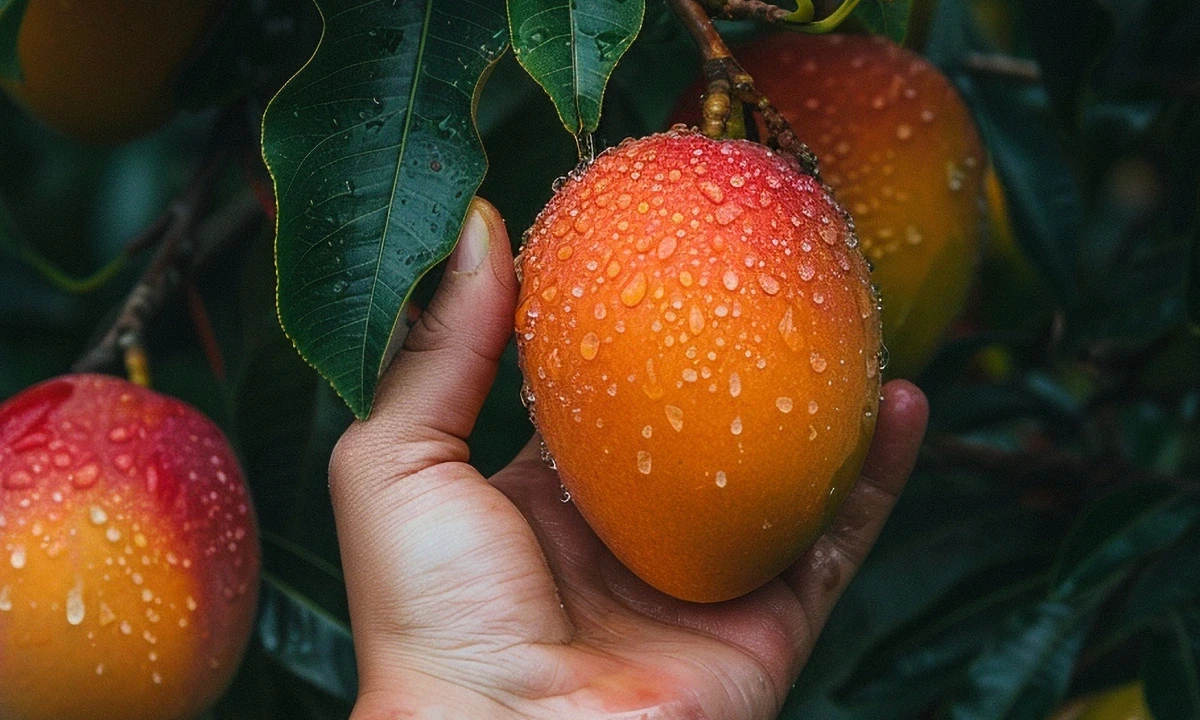
India's national fruit is also one of its most financially compelling crops. And yet, mango orchard farming is consistently underestimated as a long-term wealth strategy treated as a seasonal crop rather than the compounding asset it actually is.
That perception is worth questioning seriously.
A mango tree planted today takes four to six years to reach commercial bearing. But once it does, it produces for fifty years or more with yields increasing each decade as the tree matures and roots deepen. The math on a well-managed mango orchard, across a ten-to-fifteen year holding period, is genuinely compelling for anyone thinking about farmland as an investment rather than just a lifestyle purchase.
This post breaks down what mango orchard farming actually looks like as an investment what it costs, what it returns, which varieties work in the Bangalore–Hosur–Shoolagiri belt, and how to make the orchard work even harder by integrating it with other farm elements.
What Are Mango Orchards?
A mango orchard is a managed plantation of mango trees typically a single variety or a thoughtfully curated mix designed for commercial fruit production. Unlike a kitchen garden or a few trees planted along a boundary, an orchard is laid out with deliberate spacing, irrigation, and management practices aimed at maximising both yield quality and consistency over time.
India has over 2 million hectares under mango cultivation, producing around 22 million tonnes annually roughly 40% of global mango production. Karnataka, Tamil Nadu, Andhra Pradesh, and Uttar Pradesh are among the top producing states. Krishnagiri district in Tamil Nadu, immediately adjacent to the Shoolagiri farming region, is considered the largest mango-producing district in the country producing around 30,000 tonnes per year, a significant portion of which comprises commercial varieties like Totapuri and Alphonso processed for pulp and export markets.
For farmland owners in the Hosur–Shoolagiri belt, this geography is not a coincidence it is an asset. Established market linkages, agricultural labour with generations of mango cultivation experience, and soil and climate conditions that have supported this crop for decades. These things take time to build and are difficult to replicate elsewhere.
What Is the Difference Between a Mango Orchard and a Mango Farm?
The terms get used interchangeably, but there is a useful distinction worth making. A mango farm is the broader landholding it may include other crops, support infrastructure, storage, and staff quarters. A mango orchard refers specifically to the planted grove of trees, managed as a horticultural unit.
When farmland investors talk about mango orchard farming, they typically mean a managed plot where mango trees are the primary or anchor crop, often woven together with inter-crops and supporting tree species. This integrated model is what generates the most consistent long-term returns.
Mango Farming Profit Per Acre: What the Numbers Actually Look Like
Year-by-Year Return Profile
Mango farming is not a quick-return crop. Understanding the time horizon before you commit is not optional it is essential.
In the first three years, the trees are establishing themselves. There is no commercial fruit. But this does not mean the land sits idle. Inter-crops like pulses, ragi, or short-duration vegetables can be grown between young trees, generating modest early income while keeping the soil active and productive.
By years four and five, the first fruiting begins light commercial yields that do not move the needle dramatically but start to cover annual maintenance costs. From year six to ten, the orchard enters productive maturity. Average yield on a well-managed acre reaches 7 to 10 tonnes per season. At prevailing farm-gate prices for quality varieties, this can generate ₹1.5 to 4 lakh per acre per year, depending on variety, market access, and how well the orchard has been managed through its establishment years.
From year ten onwards, yields keep increasing as the trees mature. A well-maintained orchard with premium varieties and direct market access can generate ₹4 to 6 lakh per acre annually and those trees are still decades away from slowing down.
Research from Dharmapuri district in Tamil Nadu one of the most studied mango farming regions in South India found that mature orchards delivered average net returns of around ₹2.3 lakh per acre, with a benefit-to-cost ratio of nearly 2:1. That figure understates the potential for higher-value varieties sold directly to urban consumers or processors, bypassing the mandi system entirely.
How to Make a Mango Orchard More Profitable
The key variable in mango farming profit per acre is not the tree itself it is the system built around it.
A Tamil Nadu farmer studied by the Cauvery Calling initiative illustrates this well. By interplanting 50 teak trees per acre alongside his mango orchard, he created a second income stream that over twenty years produced teak timber worth approximately ₹7.5 lakh per acre, on top of annual mango income of ₹1 to 2.5 lakh per acre. The teak planting cost him almost nothing additional, because the trees occupied the gaps between mango rows during the orchard's establishment years space that would otherwise have been underused.
This interplanting logic using the space between mango trees for timber, shade trees, or secondary crops sits at the centre of how managed farmlands near Bangalore approach orchard design. The mango orchard becomes one income layer within a more resilient, multi-yield farm system. Not the whole story. The anchor.
Which Month Is Mango Season in India?
In South India Karnataka, Tamil Nadu, and the Hosur belt specifically mango flowering begins in December and January, with fruit setting through February and March. Harvest runs from April to July, with peak season typically landing in May and June.
The exact timing shifts by variety. Early-season varieties like Banganapalli arrive in April, ahead of most competition. Mid-season varieties like Totapuri and Raspuri peak in May to June. Late varieties like Neelam and Mulgoba extend the harvest into July, keeping the orchard commercially active for a longer window.
That seasonal concentration is both a strength and a planning challenge. All income arriving in a three-to-four month period means the rest of the year needs to carry its weight through other channels. Integrating the mango orchard with year-round crops moringa, banana, vegetables, or timber species smooths out the income calendar and keeps the farm alive and productive outside peak season.
Mango Tree Farming in India: Varieties That Work in the Shoolagiri–Hosur Belt
The Shoolagiri region sits at the Tamil Nadu–Karnataka border, at around 900 metres elevation, with red laterite soil, moderate temperatures of 15 to 35°C, and reliable monsoon supplemented by irrigation. This climate supports several commercially significant varieties.
Totapuri is the dominant commercial variety in this region grown widely across Karnataka and Tamil Nadu, high-yield, pulp-rich, and used extensively by food processors. Its firm fruit handles transport well, making it practical for reaching Bangalore and Chennai markets without significant loss.
Banganapalli also called Safeda is a large, golden-yellow, fibre-free variety with strong market demand across South India. As an early-season variety harvested in April, it reaches markets ahead of peak competition, which matters for pricing.
Raspuri is a Karnataka speciality, cultivated across Bangalore, Kolar, and Ramanagara districts, and known for exceptional sweetness and juice content. It commands premium prices in urban markets where buyers know what they are looking for.
Mallika is a compact, regular-bearing hybrid that adapts well to drier conditions and performs reliably in the semi-arid microclimate of Shoolagiri's hillside terrain.
Alphonso mango farming in India is primarily associated with the Konkan coast, but grafted Alphonso varieties can be cultivated in the Hosur belt with careful management. Given the significant price premium Alphonso commands consistently the most expensive table mango in India even small-scale Alphonso cultivation can meaningfully improve per-acre returns.
The selection of variety matters as much as the management that follows. A well-chosen mix one early-season, one mid-season, one premium late variety extends the harvest window, reduces market timing risk, and diversifies buyer relationships across the season.
How to Make a Mango Orchard: The Setup Process for Farmland Investors
Which Is the Largest Mango Orchard in India?
India's most significant mango production comes not from single mega-orchards but from districts with high farmer concentration. Krishnagiri in Tamil Nadu and Srinivaspur in Karnataka's Kolar district known locally as the Mango City of India, with over 63 mango species grown in the area represent the most established mango farming geographies in South India.
For a farmland investor, the lesson from these regions is not about scale. It is about proximity. Being within the established mango-growing belt of Krishnagiri–Srinivaspur–Hosur means ready access to nursery stock, experienced farm labour, established market channels, and neighbouring farmers whose orchard management practices provide useful, real-world reference points.
Setting Up the Orchard on a Managed Farm Plot
The establishment process for a mango orchard on a one-acre managed farm plot typically follows a clear sequence.
In the preparation year, the focus is on the land itself deep ploughing, contour bunding if the terrain is sloped, and soil testing to assess pH and nutrient levels. Red laterite soil in the Shoolagiri region typically needs lime correction and organic matter addition before planting begins. Get this wrong and every subsequent year of management is fighting an uphill battle.
At planting, grafted saplings of selected varieties go in at 10m × 10m spacing for standard orchards around 40 trees per acre or 5m × 5m for high-density systems, which can accommodate up to 160 trees per acre in intensive models. Drip irrigation is installed at this stage, and the government subsidises up to 70% of drip irrigation costs through the Pradhan Mantri Krishi Sinchayee Yojana scheme. It is worth claiming.
Through years one to three, the focus is on establishment irrigation, organic manuring, and light pruning to shape the canopy. Inter-crops occupy the spaces between young trees. By years four and five, the first flush of fruit appears, and the orchard manager starts identifying high-performing trees, managing flowering timing through regulated irrigation and fertilisation. From year six onwards, canopy management, post-harvest pruning, soil nutrition, and pest monitoring become the core management calendar and the orchard starts to generate meaningful returns.
The investment in professional farm management during establishment is what determines the long-term trajectory of the orchard. A poorly managed orchard in years one to four inadequate irrigation, no soil nutrition programme, wrong variety selection will underperform for its entire productive life. This is precisely why farm land for sale near Bangalore at Sanctity Ferme includes end-to-end management from establishment through commercial production, rather than leaving setup decisions to the landowner.
Why Mango Orchards Make Sense Inside a Managed Farmland
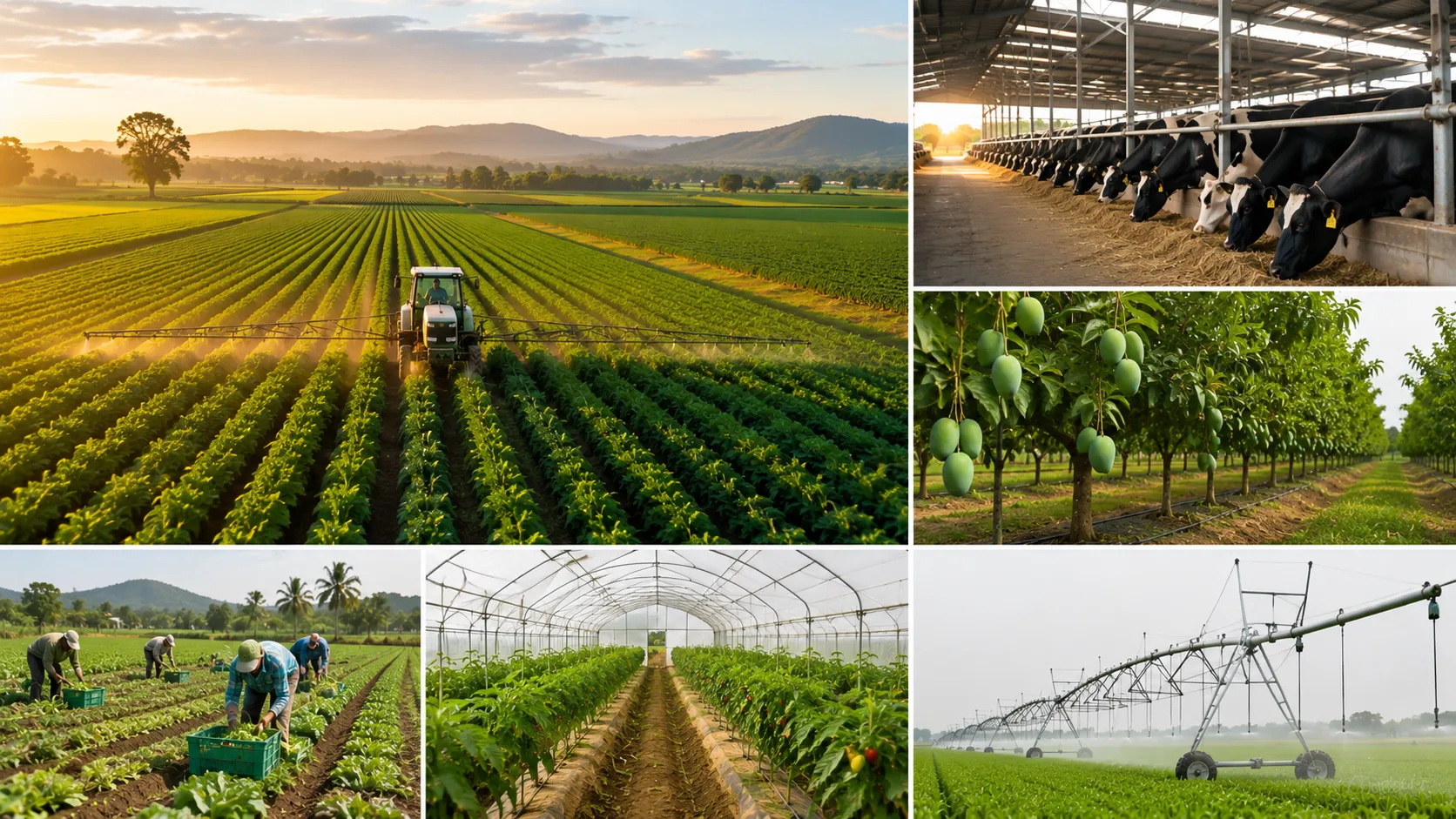
Mango tree farming in India has one significant advantage for non-farming investors: once established, the trees require relatively low annual maintenance. Unlike annual crops that demand intensive seasonal attention, a mature mango orchard follows a predictable management calendar irrigation management, pre-flowering nutrition, harvest logistics, post-harvest pruning. This is entirely manageable under professional farm supervision without requiring the landowner to be on-site.
At the same time, the orchard creates something that bare land simply cannot: a living asset that appreciates on the ground. Mature mango trees increase the commercial value of a farm plot in ways that annual crop fields do not. A ten-year-old orchard in full production is both an income-generating asset and a meaningful improvement to the underlying land value.
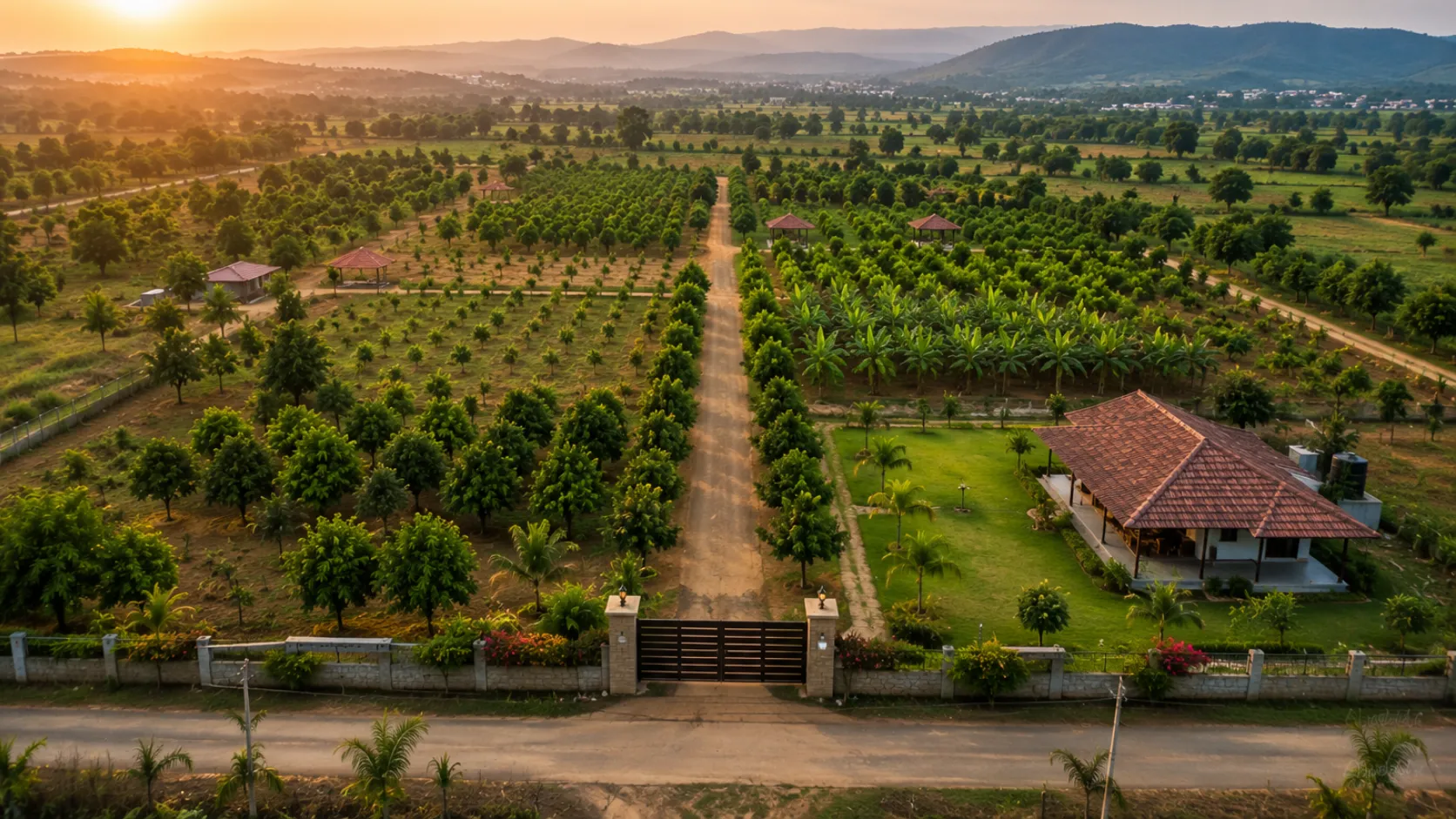
At Sanctity Ferme, mango trees are one of the sub-canopy species featured across our managed farm plots near Shoolagiri integrated within a multi-layer system that includes timber species, seasonal crops, and soil-building plants. You can see what this approach to sustainable farmland management looks like on the ground, and understand why life at Sanctity Ferme for our 1,400+ community members includes the quiet pleasure of fresh mangoes from trees they actually own.
The transformation that careful land management creates from bare or degraded land to a producing orchard takes time. We have documented it directly in our work cultivating life on barren earth. But the compounding nature of that improvement is what makes farmland genuinely different from almost any other asset class.
Mango Orchard by the Numbers
Metric | Figure |
Typical tree spacing (standard orchard) | 10m × 10m (~40 trees/acre) |
Years to first commercial harvest | 4–6 years |
Average mature yield per acre | 7–10 tonnes/season |
Net returns per acre (mature orchard) | ₹2–6 lakh/year (variety and market dependent) |
Productive tree lifespan | 40–50+ years |
Peak season in South India | April–July |
Drip irrigation subsidy available | Up to 70% under PMKSY |
Interplanted teak value (50 trees/acre, 20 years) | ~₹7.5 lakh/acre |
Conclusion: Plant Once. Earn for Decades.
A mango orchard is an unusual kind of investment. Most assets depreciate with time and use. A mango orchard does the opposite it appreciates, both in the value of its trees and in the annual income those trees generate. Each year of good management adds to yield capacity, soil quality, and the commercial viability of the farm.
For farmland investors with a medium-to-long horizon, this compounding dynamic is one of the most compelling arguments for mango orchard farming in India especially in regions like the Hosur–Shoolagiri belt, where climate, soil, market access, and established farming knowledge all align in the same place at the same time.
Sanctity Ferme has been building this kind of land across 300+ acres near Shoolagiri 90 minutes from Bangalore via NH44 for nearly a decade. Over 5 lakh trees planted. Land value moved from ₹55 to over ₹450 per sq. ft. A farm community of 1,400+ members who own plots that are genuinely getting better with time, one growing season at a time.
If you want to see a producing mango farm, walk the orchards, and understand what managed farmland ownership actually looks like in practice a site visit is where it starts.