Importance of Green Revolution in India's Economic Development
Discover practical gardening advice, expert landscaping tips, and inspiration to help you make the most of your outdoor space.
Sanctity Ferme Team

India has experienced a breakthrough in agricultural and economic history with the Green Revolution. It was brought into the light in the mid-1960s and made India go from a food-deficient country to a top agricultural producer. The movement has greatly increased the productivity and income of the people with high-yielding crops, modern irrigation and scientific techniques.
Historical Background
In India, the Green Revolution began in the 1960s under the leadership of Prime Minister Lal Bahadur Shastri and Agricultural Minister C. Subhramanium. The whole movement was a response to recurring food shortages, frequent famines and extreme reliance on food grain imports under the US PL-480 aid programme.
The groundwork was initiated with the formation of High-Yielding Variety (HYV) seeds developed by scientists like M.S. Swaminathan, along with the global influence of Norman Borlaug. These initiatives were adapted in India to align with local conditions.
During the beginning phase of the green revolution in 1966, the major implementation phase centred on states such as West Uttar Pradesh, Punjab and Haryana.
Core Components of the Green Revolution
The success of the Green Revolution was established on a set of interconnected components. These components include improved crop varieties, chemical inputs, consistent water supply, agricultural machinery and industrial support. Let’s have a quick look at some of these aspects and the impact Green Revolution in India created across these pillars.
1. High-Yielding Variety (HYV) Seeds
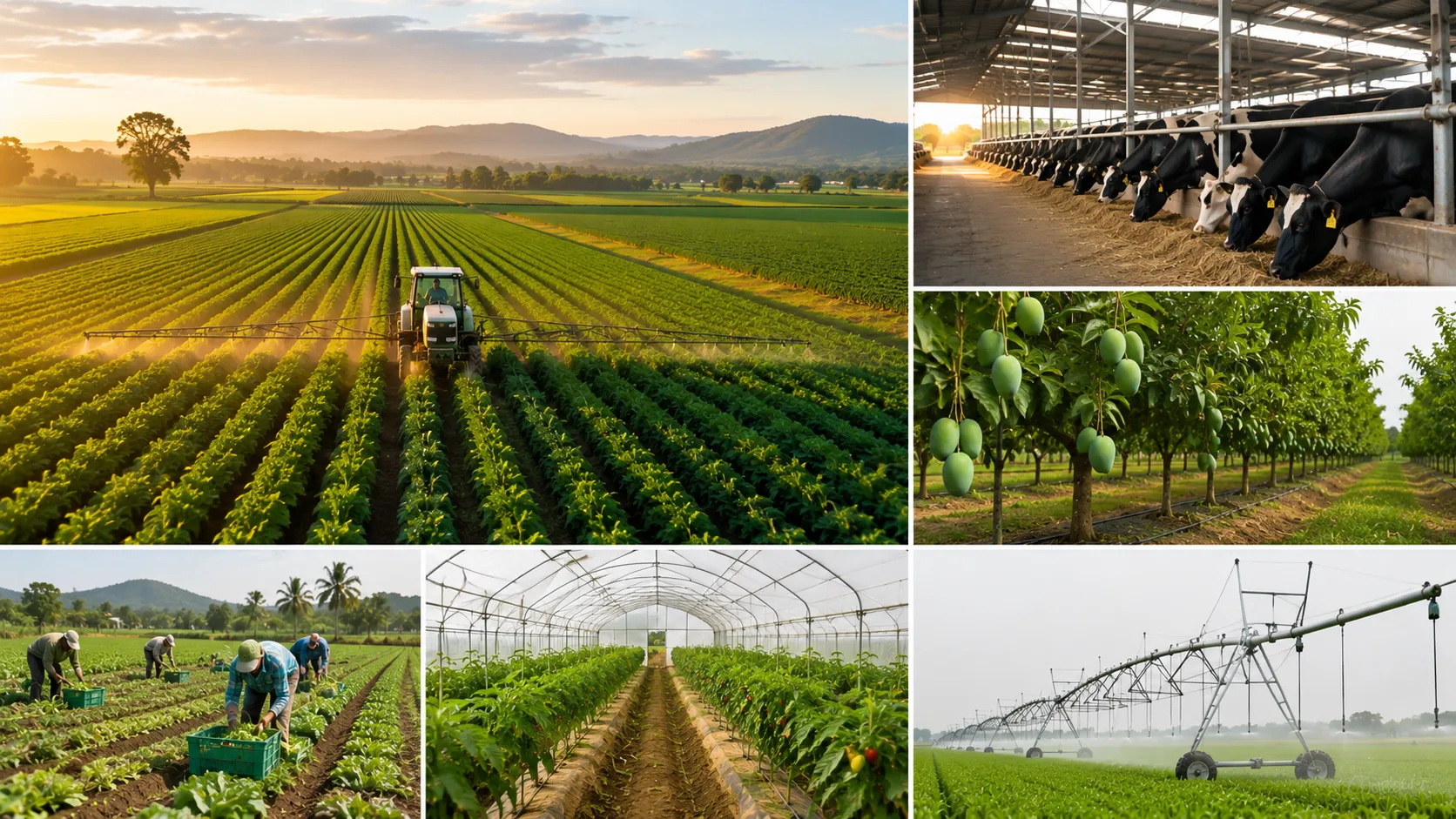
Among the merits of Green Revolution, the introduction of HYV seeds for popular cereals like wheat, rice and maize was highly beneficial for farmers. These seeds grow faster than older varieties and respond much more strongly for fertilisers and irrigation. These seeds have also shown improved resistance to pests and disease, which gradually made them an integral part of Indian agriculture.
2. Chemical Fertilisers and Pesticides
During the green revolution, farmers began to use high doses of chemical fertilisers such as nitrogenous, phosphatic and potassic compounds to their crops. They also started using pesticides and herbicides to safeguard crops from pests and weeds. Both of these inputs have raised yield per hectare by allowing HYV seeds to perform closer to their potential.
3. Irrigation Infrastructure
The green revolution and its effects can be clearly seen in how improved irrigation made farming more reliable in water-scarce areas. The supply of water is constant since HYV seeds and greater inputs require periodic moisture. In order to achieve this, there was an expansion of output canal systems, river valley projects, and tube wells in most regions. This increase in water supply has helped to reduce the dependency on erratic rainfall and made the double-cropping option feasible in many locations.
4. Mechanisation of Agriculture
The launch and widespread use of new generation tractors, harvesters, threshers and other machinery expanded its presence in farming. This facility has become helpful for farmers working on managed farmlands near Bangalore for more intensive cropping.
The volume of tractors rose from around 52,000 units in 1965 to 1.4 million by 1970. This result shows that mechanisation had become deeply rooted in Indian agriculture by the early 1990s.
5. Institutional and Policy Support
Government initiatives, financial reforms and new research systems worked together to make modern farming more accessible and sustainable for the future. In this regard, here are a few supports provided by the government:
Agricultural Price Commission and Minimum Support Prices (MSP) - H2
In order to safeguard farmers from price fluctuations and market uncertainty, the Agricultural Prices Commission was established in 1965. The body was later renamed the Commission for Agricultural Costs and Prices (CACP) and recommended minimum support prices for crops like wheat, rice, and pulses.
Food Corporation of India (FCI) and Public Distribution System (PDS) - H2
The Food Corporation of India (FCI) was established in 1965 to manage the procurement, storage, and distribution of food grains. Combined with the Public Distribution System (PDS), it ensured that surplus grains from productive regions like Punjab and Haryana reached the deficit states.
This structure has played a vital role in stabilising food prices, so that food shortages can be better addressed and provide better security during the initial period of the green revolution.
Regional Dimensions of the Green Revolution in India
The Green Revolution has shaped India’s agricultural landscape. Some regions advanced rapidly due to improved irrigation, fertile land and government focus. Here are a few characteristics of each region.
Region | Characteristics | Outcome |
Punjab and Haryana | Wide irrigation systems, fertile alluvial soils, credit, and machinery availability. | Grew to be the primary grain-growing area in India and provided a national food storehouse. |
Western Uttar Pradesh | Established canal irrigation, premature mechanisation, and well-established sugar industry interconnections. | Recorded high productivity and became one of the major agricultural centres. |
Eastern India (Bihar, West Bengal) | High rainfall but less irrigation | Achieved moderate success in agriculture |
Southern States (Tamil Nadu, Andhra Pradesh, Karnataka) | Dependence on monsoon rains and uneven irrigation facilities | Shows the limited scope of Green Revolution technologies. |
Benefits Of the Green Revolution
The green revolution brought sweeping agricultural and economic changes in India. Some of its key benefits are as follows:
Higher Crop Output: The use of HYV seeds, fertilisers and irrigation has raised yield across cereals like wheat and rice.
Economic Strength: It helps to boost rural income, stablise food prices and support industrial growth through agricultural surplus.
Employment Growth: The Green Revolution has helped to create new jobs in farming, food processing and farm equipment industries.
Rural Infrastructure: Expanded road networks, cold storage and electricity in farming regions.
Economic Impact of the Green Revolution
The importance of Green Revolution lies in how it shifted India’s economy from dependency on imports to agricultural self-sufficiency. The improvements in yields, income and employment created strong linkages between the rural and industrial development.
1. Rise in Agricultural Productivity
In India, crop production experienced unprecedented growth over the period of the 1960s up to the 1980s. By 1970, wheat production had gone up to above 55 million tonnes compared to 12 million tonnes in 1965 and overall food-grain production shot up to above 131 million tonnes during 1978 - 1979. These profits cut back food deficits and removed reliance on imports in the PL-480 program. The positive effects of Green Revolution have helped in stabilising food prices and established a food security background in the long term.
2. Contribution to GDP and Industrial Growth
The sector was contributing more to GDP in the 1970s because of increased agricultural output and it helped the industries. The irrigation projects, fertiliser plants and rural infrastructure were heavily invested in. With the increase in productivity, agriculture provided raw materials to industries such as textiles, sugar, and food processing.
Also, if you look at the Green revolution has helped which industry, it is clear that growth was strongest in those depending on farm produce and rural consumption.
3. Employment and Rural Prosperity
These outcomes show that what are the merits of Green Revolution go beyond crops by shaping livelihoods and regional economies. The Green Revolution has improved agricultural income, specifically in Punjab, Haryana and Western Uttar Pradesh. Rural households were more expended on housing, education and consumer goods, and provided non-farm employment. Moreover, the increase in purchasing power empowered the rural markets and promoted small-scale industry and services.
4. Long-Term Economic Effects
By the early 1990s, India was self-sufficient in food production and saved the foreign exchange to develop industries. If you look at what was the main objective of the Green Revolution. The answer is to achieve food self-sufficiency, reduce imports and modernise India’s agricultural practices to feed its growing population.
5. Contemporary Farming Evolution
The 1970s green revolution has also influenced a few agricultural aspects, which include water conservation and eco-friendly building methods. Water conservation is performed through rainwater harvesting and using water strategically to sustain farming, ponds and daily needs. Besides, eco-friendly building methods emphasise the use of mud and local materials to reduce carbon footprints and create spaces that harmonise with nature.
India’s Global Position in Food Exports
India ranks among the top global food exporters and holds a vital position to ensure food security and meet the growing demand for agricultural products. Besides that, India excels as the largest producer of milk and pulses, along with the second largest producer of rice, wheat, sugarcane, groundnut, and vegetables. It strengthens property owners' interest in farm land for sale in Bangalore as agriculture-driven investments gain momentum.
Top Export Products and Markets
India’s rice exports rose by 21% in FY2024 to $11billion. At the same time, tea exports have achieved a 10-year high of 255 million kg in 2024. Besides that, processed fruits and vegetables have reached about $729 million between April and August 2025.
Key markets for all of these products include the USA, UAE, China, Bangladesh, and many countries in West Asia, Latin America, and Scandinavia.
Export Policy and Incentive Drivers
The government’s strategic approach includes lifting rice export restrictions in late 2024. Incentive programs such as the Production Linked Incentive Scheme and APEDA’s export promotion initiative are increasing competitiveness in processed foods and agricultural tech.
Growth Outlook and Strategic Focus
By 2030, India would have a target of one hundred billion dollars in agricultural exports as compared to the current $51.9 billion in 2025, with special emphasis on value addition and product diversification. At the state level, there are differences in showing that those areas that invest more in logistics, cold storage and branding get higher export growth. This agricultural focus is increasing the interest among farmers in land for sale in Bangalore so that they can be a part of the emerging growth of India’s agricultural exports.
Final Thoughts
The Green Revolution has left a lasting impact on the Indian economy. It has also transformed the significance of agriculture in industrial and rural transformation. It has been successful because the policy, technology development and the efforts by farmers combine to transform the future of the nation. The conclusion of Green Revolution indicates how a movement whose seed was in the shape of a seed and irrigation expanded to form a source of food and financial liberty in India.
The heritage of this movement still enriches the progress of the Indian economy to empower future generations by being innovative and self-reliant. Sanctity Ferme (SF) continues this evolution with regenerative practices on restored quarry lands. Curious about sustainable farming opportunities? Discover life at SF or book a call with SF experts today!