What Is Commercial Farming? Meaning, Types & Benefits Explained
Discover practical gardening advice, expert landscaping tips, and inspiration to help you make the most of your outdoor space.
Sanctity Ferme Team
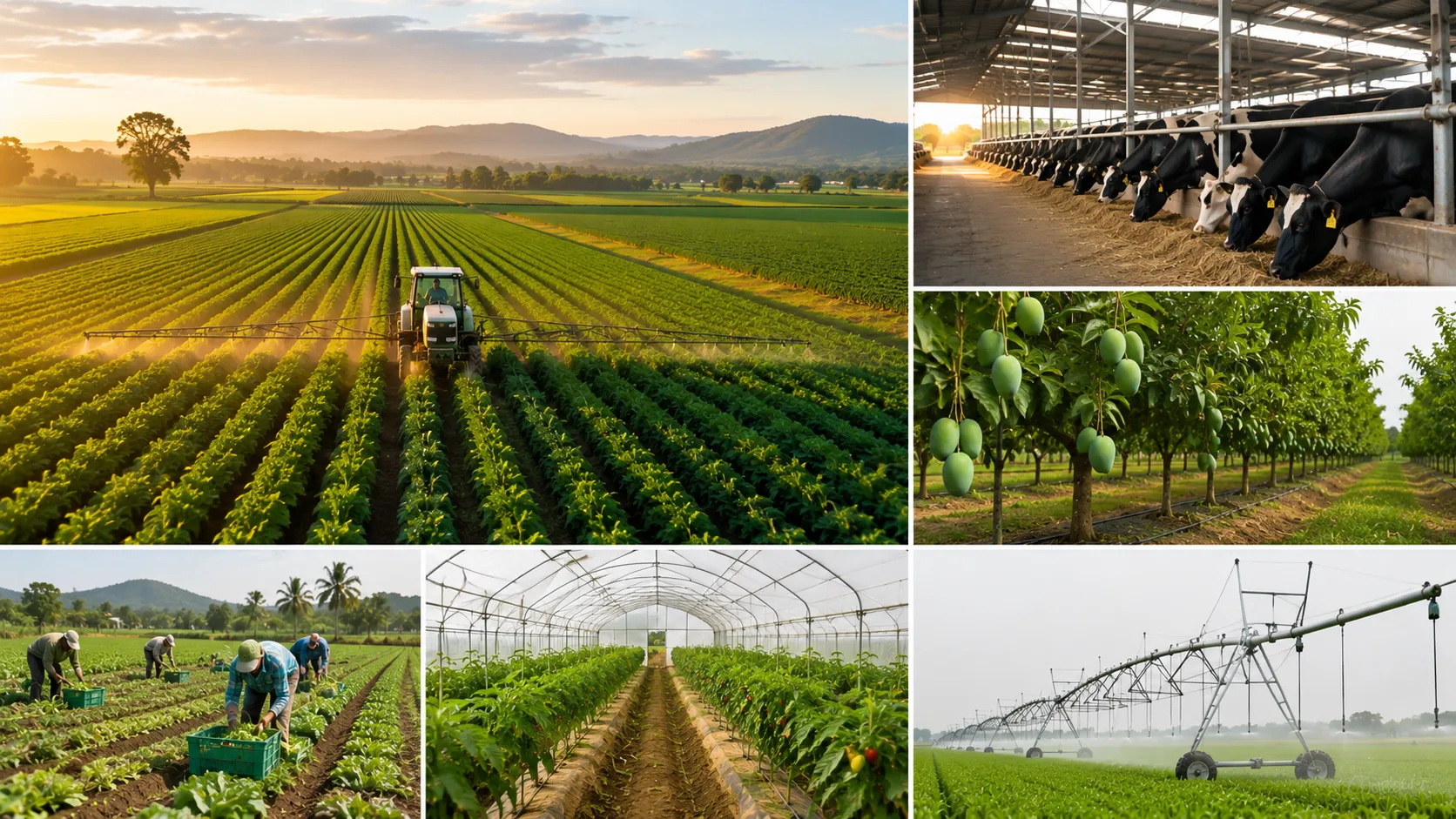
Most of us eat without ever thinking about the scale of production behind our food. The rice on your plate, the milk in your morning coffee, the vegetables in your dal a significant portion of it comes from commercial farming.
Understanding what commercial farming is, how it works, and why it matters is increasingly relevant not just for policymakers, but for investors and land owners looking at farmland as a long-term asset.
Here is a plain-language breakdown.
What Is Commercial Farming? Definition and Meaning
Commercial farming is the practice of growing crops or rearing livestock primarily for sale in the market, rather than for personal or household consumption. Every decision on a commercial farm what to grow, when to plant, how to irrigate is driven by market demand and the goal of generating consistent income.
This is how commercial farming differs fundamentally from subsistence farming, where the produce feeds the farmer's own family first. In commercial agriculture, the farm is run as a business: capital is invested, production is planned around buyers, and scale is optimised for profitability.
The commercial farming definition in geography and economics is consistent: it is agriculture oriented toward the market, supported by modern inputs, mechanisation, and professional management.
What Are the Key Characteristics of Commercial Farming?
The characteristics of commercial farming set it apart from traditional land use in several ways:
Large scale Commercial farms typically operate across hundreds or thousands of acres, relying on economies of scale to reduce per-unit costs
High capital investment Infrastructure, equipment, irrigation systems, and quality inputs require significant upfront and ongoing investment
Use of modern technology Tractors, GPS mapping, drip irrigation, drone monitoring, and data-driven soil management are standard in mature commercial operations
Specialisation Most commercial farms focus on one or two crops or livestock types to maximise yield efficiency
Hired labour Unlike family farms, commercial operations depend on organised, paid agricultural labour
Market-linked production Crop selection and timing are dictated by demand signals, pricing trends, and export opportunities
These features of commercial farming make it capable of feeding cities and supporting national food security at a scale that small holdings cannot.
What Are the Main Types of Commercial Farming?
The types of commercial farming vary by crop, geography, and scale. Here are the most common:
1. Grain Farming
Large-scale cultivation of staple crops like wheat, rice, maize, and barley primarily for consumption and export. This is one of the oldest and most widespread examples of commercial farming globally.
2. Dairy Farming
Cattle, buffalo, or goats are reared specifically for milk and milk-product production. New Zealand, Ireland, and parts of South India are known for their organised dairy belts.
3. Livestock Ranching
Animals such as cattle, sheep, and poultry are raised at scale for meat. This model is dominant in the US, Australia, and Brazil.
4. Plantation Agriculture
A single high-value crop tea, coffee, rubber, sugarcane, or palm oil is cultivated intensively on large landholdings. South India has a rich history of plantation farming, particularly in Tamil Nadu, Karnataka, and Kerala.
5. Mixed Farming
Crops and livestock are managed on the same farm. The synergy reduces risk: crop waste feeds animals, and animal waste improves soil fertility. This is an increasingly popular model in managed farmland projects.
6. Mediterranean Farming
Practiced in warm, dry climates suitable for figs, grapes, olives, and citrus. Common in Mediterranean countries and in parts of India with similar conditions.
7. Horticulture
Intensive cultivation of vegetables, fruits, and flowers. Horticulture-based commercial agriculture is growing rapidly near urban centres, driven by demand from city consumers for fresh, traceable produce.
What Are the Major Benefits of Commercial Farming?
Commercial farming delivers value across multiple levels:
Food security Large-scale, mechanised production ensures consistent food supply for urban populations that cannot grow their own.
Economic contribution Agriculture contributes significantly to India's GDP, and commercial agriculture is the engine behind exports of rice, spices, cotton, and processed foods.
Employment Commercial farms generate organised employment for agricultural labour, often in regions where industrial jobs are scarce.
Technology adoption The profitability model incentivises adoption of precision farming tools, better irrigation, and soil science which improve long-term land health.
Investor returns For landowners and investors, commercially managed farmland can generate returns through produce income, land appreciation, and tax-free agricultural income under Indian law.
Why Is Commercial Farming Important for Agricultural Growth and the Economy?
India is home to over 140 crore people. Feeding that population consistently, affordably, and across seasons requires a level of planning and output that small landholders alone cannot sustain.
Commercial farming bridges that gap. It brings capital, technology, and professional management into agriculture, lifting productivity per acre and improving market access for both farmers and buyers.
From an investor's perspective, commercial agriculture near growing cities like Bangalore creates a compelling case for farmland ownership. As urban demand for fresh, organic, and locally sourced produce grows, well-managed farmlands close to the city command premium prices both for their produce and their underlying land value.
Well-connected corridors such as the Shoolagiri-Hosur belt, roughly 90 minutes from Bangalore via NH44, are seeing sustained interest from investors who want exposure to this shift. Explore farmlands for sale near Bangalore if you are evaluating entry points.
Which Crops Are Commonly Grown in Commercial Farming?
Crop selection in commercial farming depends on climate, soil type, and proximity to markets. Common commercially grown crops include:
Grains Wheat, rice, maize, sorghum
Plantation crops Tea, coffee, sugarcane, rubber, arecanut
Horticulture Mango, banana, papaya, moringa, guava, tomatoes, leafy vegetables
Cash crops Cotton, groundnut, turmeric, chillies
Floriculture Roses, marigold, jasmine for urban and export markets
Near Bangalore and Shoolagiri, high-demand fruit trees like mango, moringa, and banana perform well in the red-clay soil and moderate climate. These crops are low-maintenance once established, generate recurring income, and attract strong prices from Bangalore's urban consumer base.
From Knowledge to Ownership
Understanding what is commercial farming is one part of the picture. The next is knowing how to participate in it not necessarily as a full-time farmer, but as a landowner whose property is professionally managed.
Sanctity Ferme has been building managed farmland communities near Shoolagiri since 2017 300+ acres under management, 5 lakh+ trees planted, and 800+ plots sold to urban investors who wanted the benefits of managed farmlands near Bangalore without the complexity of daily operations.
If you are curious about what responsible, community-rooted commercial agriculture looks like in practice, explore life at Sanctity Ferme or get in touch with the team to plan a site visit.
Frequently Asked Questions
What is commercial farming and how does it work?
Commercial farming is the large-scale production of crops or livestock for market sale, rather than personal use. It works by treating the farm as a business selecting crops based on demand, investing in modern inputs and machinery, and managing operations to maximise output and profitability.
What are the main types of commercial farming?
The primary types include grain farming, dairy farming, livestock ranching, plantation agriculture, horticulture, mixed farming, and Mediterranean farming. Each varies by crop type, geography, and scale of operation.
What are the key characteristics of commercial farming? Commercial farming is defined by large-scale operations, high capital investment, use of modern technology, crop specialisation, hired labour, and production decisions tied directly to market demand.
What are the major benefits of commercial farming?
Key benefits include food security for large populations, economic contribution through exports and employment, adoption of modern agricultural technology, and income potential for investors and landowners.
Why is commercial farming important for agricultural growth and the economy?
It brings scale, capital, and technology into agriculture raising productivity, improving market access, and supporting national food supply. For investors, commercially managed farmland near growing cities can offer land appreciation alongside agricultural income.
Which crops are commonly grown in commercial farming?
Common crops include wheat, rice, maize, sugarcane, tea, coffee, mango, banana, moringa, cotton, and floriculture crops. Selection depends on soil type, climate, and proximity to end markets.