Makhana Farming in India: Profit Per Acre, Cost & Market Potential
Discover practical gardening advice, expert landscaping tips, and inspiration to help you make the most of your outdoor space.
Sanctity Ferme Team
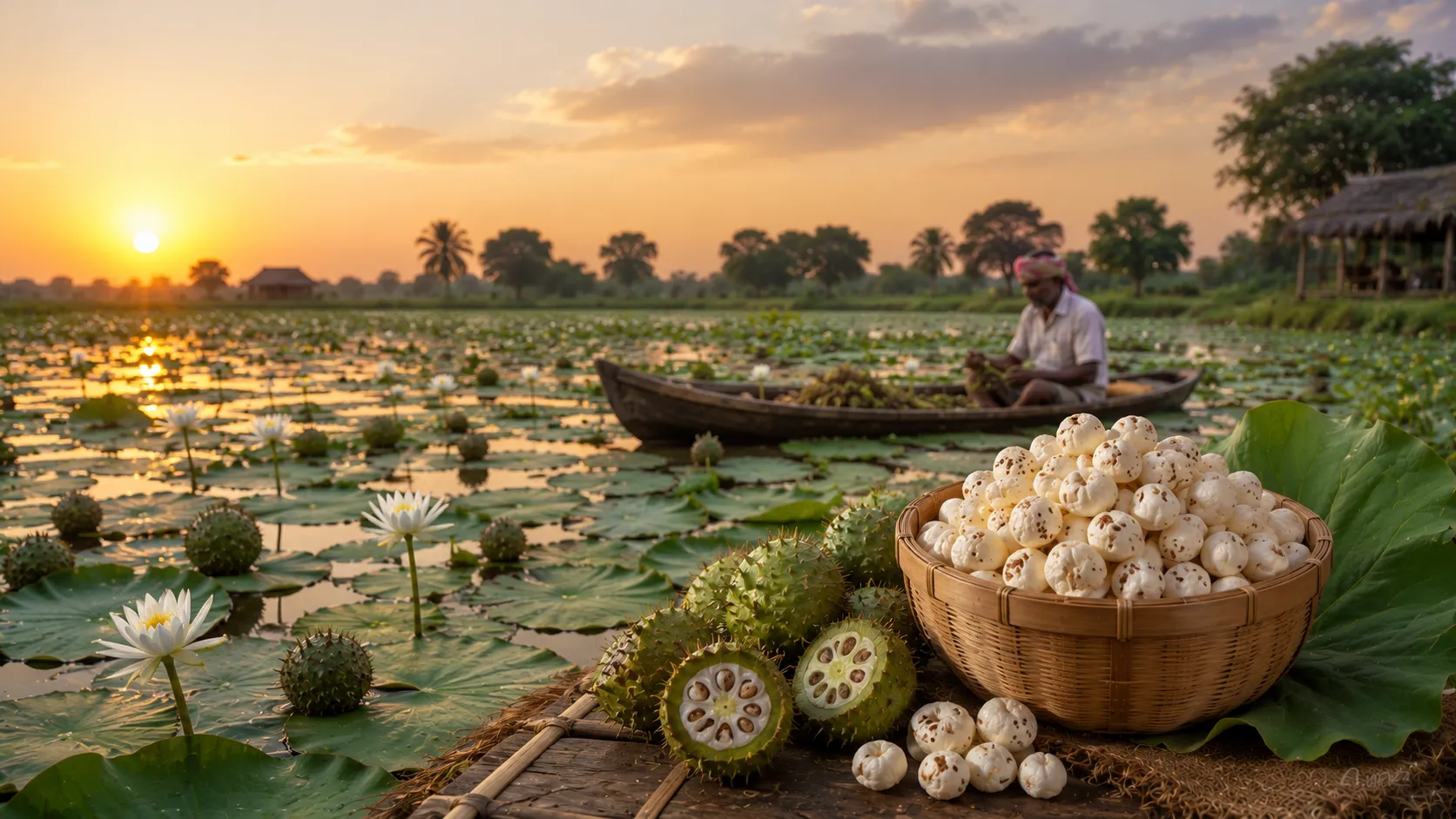
There's a quiet revolution happening in India's wetlands. Those light, crunchy fox nuts that have taken over gym bags, health food aisles, and festival snack plates makhana are driving one of the most interesting agricultural stories in the country right now.
Makhana farming in India has moved from a centuries-old tradition in Bihar's ponds to a nationally recognised crop with government backing, a dedicated research centre, and growing export demand from markets like the US, UK, UAE, and Japan. If you're exploring profitable farming ideas or simply want to understand how this crop works from water to snack bowl this guide covers it all.
What Is Makhana and How Does Makhana Farming Work?
Makhana (also called fox nut or gorgon nut) comes from Euryale ferox a water lily species that grows in still, shallow ponds and wetlands. Unlike most crops, makhana cultivation happens entirely in water. Broad, spiky leaves float on the surface while the fruits form underwater, filled with the seeds that eventually become the crunchy snack we know.
The process of how to grow makhana follows a clear seasonal cycle:
Pond preparation (January–February): Farmers clean the pond bed, remove weeds, and check water depth. Traditional pond systems require at least 4–5 feet of still water. A newer field system uses controlled waterlogged paddy fields at 1–1.5 feet depth.
Sowing (February–March): Seeds from the previous harvest are broadcast directly into the muddy water. They germinate within weeks, with floating leaves spreading across the surface.
Growing season (March–August): The plants spread densely across the water. Fruits form below the surface, maturing within 30–40 days of flowering. No chemical fertilisers are typically used the pond mud itself is nutrient-rich.
Harvest (August–October): Farmers dive into the pond and manually collect the submerged, thorny fruits a skilled, labour-intensive process passed down through generations.
Processing: Seeds are sun-dried, then roasted in hot sand or iron pans until they pop similar to popcorn into the light white balls sold in markets.
The entire process involves at least 8–10 manual steps before the product reaches a shelf. It is largely organic by default, which is one reason makhana has earned its "superfood" reputation.
Where Is Makhana Produced in India?
Makhana production in India is heavily concentrated in Bihar, which accounts for over 90% of the country's output and 80% of global production. The Mithilanchal region districts like Darbhanga, Madhubani, Sitamarhi, and Katihar has cultivated this crop for generations, using naturally occurring ponds and seasonal floodwaters.
Bihar Makhana received a Geographical Indication (GI) tag in 2022, strengthening its identity and market value globally.
Other producing states include West Bengal, Assam, Manipur, Odisha, and parts of Madhya Pradesh, though commercial-scale production outside Bihar is still limited. That's changing: as of 2025, the Union government has expanded makhana cultivation from around 13,000 hectares to over 35,000 hectares across multiple states, supported by the newly established National Makhana Board and the Makhana Vikas Yojana. States like Uttar Pradesh are actively developing pond infrastructure and training farmers to scale up production.
What Climate and Water Conditions Are Required for Makhana Farming?
Makhana is an aquatic crop with specific environmental requirements that determine where it can be grown successfully.
Water: Still, stagnant water is essential. The traditional pond system needs a minimum depth of 4–5 feet. The field system a newer, more accessible method works at 1–1.5 feet depth in waterlogged agricultural land. After transplantation, 4–5 irrigation cycles are typically needed if natural water supply is insufficient.
Climate: Makhana thrives in humid, warm conditions with adequate monsoon rainfall. The crop cycle runs from February to October, relying heavily on seasonal rain to maintain pond and field water levels. Eastern and central India's monsoon-fed wetland geography is naturally suited to it.
Soil: Clay-heavy pond beds that retain water and are naturally rich in organic matter from decomposed plant material and silt provide the ideal growing medium. After harvest, the residual pond mud acts as natural fertiliser for the following season, making makhana cultivation inherently regenerative.
The crop is not suited to dry, well-drained, or sandy soils which is why makhana farming is geographically specific to waterlogged or pond-rich terrain rather than typical agricultural plots.
What Is the Average Cost of Starting Makhana Farming?
Starting makhana cultivation requires modest upfront investment compared to many other commercial crops, though access to suitable water bodies is the primary constraint.
Approximate cost per acre (pond system):
Input | Estimated Cost |
Pond preparation / cleaning | ₹8,000–₹15,000 |
Seeds (makhana) | ₹5,000–₹10,000 |
Labour (sowing to harvest) | ₹15,000–₹25,000 |
Processing (roasting, drying) | ₹8,000–₹12,000 |
Miscellaneous / contingency | ₹5,000–₹8,000 |
Total (approx.) | ₹40,000–₹70,000 per acre |
The field system using waterlogged paddy land tends to be more accessible and slightly lower in setup cost, but requires proper water level management infrastructure.
Government schemes under NABARD, PM-Kisan, and state horticulture departments offer subsidies and support for makhana farming. The National Research Centre for Makhana (NRCM) in Darbhanga has also distributed high-yielding seed varieties to farmers across Bihar, Uttar Pradesh, and Chhattisgarh.
How Much Profit Can Farmers Earn Per Acre from Makhana Farming?
Makhana farming compares favourably to rice and wheat on a per-acre profit basis particularly because it is largely organic, requires no synthetic fertilisers, and commands a premium market price.
Revenue benchmarks:
Raw makhana seed yield: approximately 2.5–3 tonnes per hectare (~1 tonne of popped makhana per hectare)
Wholesale price of popped makhana: ₹400–₹700 per kg depending on grade and market channel
Farmers typically earn ₹40,000–₹60,000 net profit per acre in the traditional pond system, with higher margins possible through direct-to-consumer or processing partnerships
Market scale: India's makhana industry is currently valued at approximately ₹3,000 crore domestically, with the global market where India supplies 80% of demand valued at around $43 million (2023) and projected to reach $100 million by 2033. Export demand from the US, UK, UAE, Japan, and Australia continues to grow as the superfood positioning of makhana strengthens internationally.
Value-added products makhana flour, protein powder, snack variants, and cosmetics are expanding the market further, giving farmers and processors additional revenue streams beyond raw seed sales.
Is Makhana Farming Relevant Beyond Bihar?
The short answer is: yes, with the right conditions. The government's push to expand makhana cultivation beyond its traditional geography is deliberate. States with natural wetlands, seasonal flooding, or existing pond networks are being identified as new production zones.
For most farm investors and landowners in other parts of India including the Bangalore region makhana is not a direct cultivation opportunity, since it requires waterlogged terrain rather than the well-drained red soils typical of peninsular farmland. What it does demonstrate, however, is the broader opportunity in specialty and high-value crops that sustainable farmland models can support.
At Sanctity Ferme, the managed plantation approach across 300+ acres near Bangalore focuses on crops suited to the local terrain fruit trees, timber species, spice plants managed professionally so plot owners benefit from productive, maintained land without daily involvement. If you're exploring managed farmlands near Bangalore as an investment framework, the principle is the same: match the crop to the land, and manage it well.
Understanding crops like makhana also sharpens the lens on what makes any farming venture genuinely profitable: market demand, crop suitability, input efficiency, and long-term land productivity. These same criteria apply when evaluating farm land for sale in Bangalore corridors for any agricultural purpose.
You can read more about how sustainability practices at Sanctity Ferme shape crop selection and land management decisions and what life on a managed farmland looks like for our community of 1,400+ plot owners.
If you'd like to explore the model in person, a site visit gives you the clearest picture.
Frequently Asked Questions
What is the average cost of starting makhana farming?
Starting makhana cultivation in the traditional pond system typically costs between ₹40,000–₹70,000 per acre, covering pond preparation, seeds, labour, and post-harvest processing. Government subsidies under NABARD and state horticulture schemes can reduce this further for eligible farmers.
How much profit can farmers earn per acre from makhana farming?
Farmers typically earn a net profit of ₹40,000–₹60,000 per acre in a well-managed pond system. Higher returns are possible through direct sales, processing partnerships, or value-added product channels. Margins compare favourably to rice and wheat given makhana's premium market positioning and largely organic cultivation.
What climate and water conditions are required for makhana farming?
Makhana requires still, stagnant water at least 4–5 feet deep in the pond system, or 1–1.5 feet in the field system. It thrives in humid, monsoon-fed climates with naturally waterlogged or clay-rich terrain. Eastern India (Bihar, Assam, West Bengal) provides ideal natural conditions. Dry, well-drained soils are not suitable.
What is the market potential of makhana production in India?
India supplies approximately 80% of global makhana demand. The domestic industry is valued at around ₹3,000 crore, with international markets in the US, UK, UAE, Japan, and Australia growing steadily. The global market is projected to reach $100 million by 2033, driven by rising demand for healthy, plant-based snacks and superfoods.