Farmhouse Rules in Karnataka: Everything Land Buyers Should Know
Discover practical gardening advice, expert landscaping tips, and inspiration to help you make the most of your outdoor space.
Sanctity Ferme Team
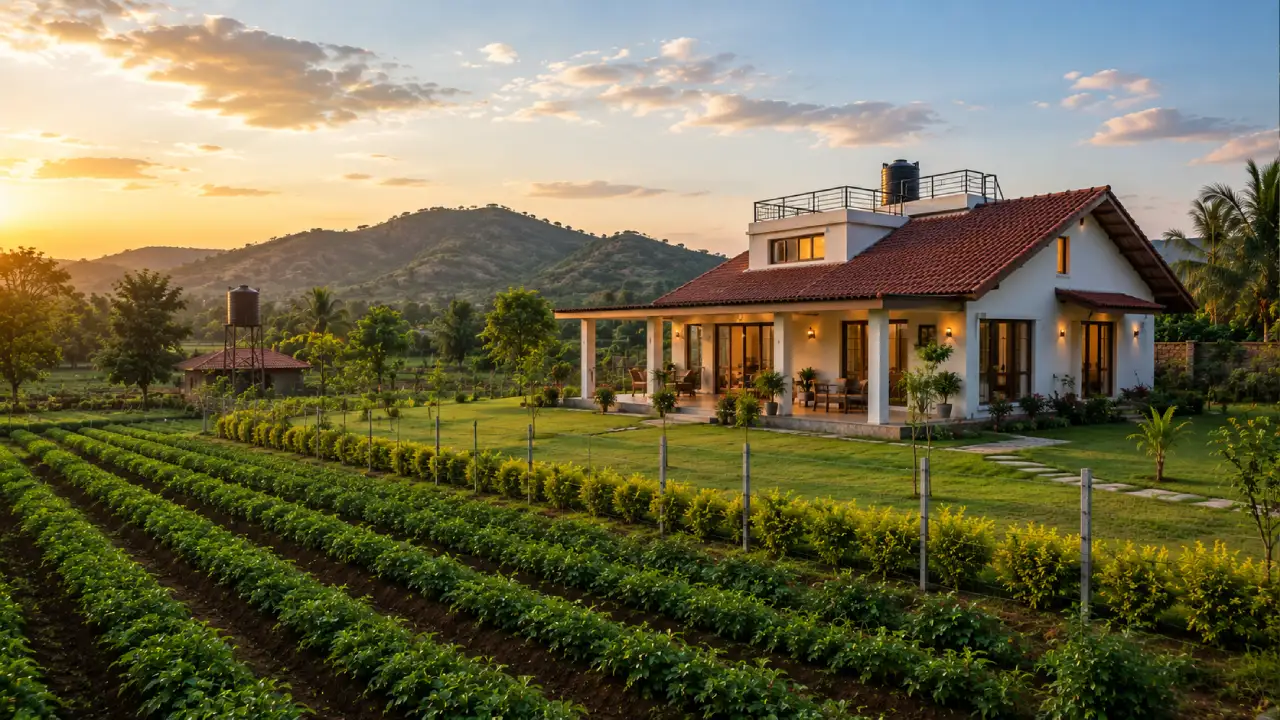
Buying agricultural land for a farmhouse involves more than checking the location, soil or surrounding greenery. Ownership of farmland, permission to construct and permission to use the property for residential purposes are separate legal matters.
The farmhouse rules in Karnataka allow limited construction connected with agriculture, but they do not automatically permit a villa, holiday home or commercial property. Buyers should understand the land measurements, permitted usage and approval process before finalising a purchase.
What Qualifies as a Farmhouse in Karnataka?
Property advertisements often use the word “farmhouse” loosely. Its legal meaning is more specific.
Section 95 of the Karnataka Land Revenue Act describes a farmhouse or farm building as a house attached to a farm and constructed on agricultural land. It may be used as the agriculturist’s residence or for keeping agricultural equipment and tethering cattle. The law also states that it should be used by the farmer and should not be let out to another person or agency for commercial activities.
A villa, homestay, resort, event venue or rental accommodation may not qualify merely because it stands on farmland. Such activities can require land conversion and separate commercial or planning permissions.
How Much Land Can Be Used for a Farmhouse?
The most important numerical condition under the farmhouse construction rules in Karnataka is the 10% limit.
Section 95 provides that a farm building or farmhouse must not cover more than 10% of the agricultural holding. This limit remains subject to any separately prescribed maximum and other planning or building rules that apply to the location.
The land calculation works as follows:
Total Agricultural Holding | 10% Of The Holding |
10 guntas | 1 gunta or 1,089 sq ft |
20 guntas | 2 guntas or 2,178 sq ft |
1 acre or 40 guntas | 4 guntas or 4,356 sq ft |
2 acres or 80 guntas | 8 guntas or 8,712 sq ft |
5 acres or 200 guntas | 20 guntas or 21,780 sq ft |
These figures represent 10% of the land area. They do not guarantee that the entire calculated portion can be covered by a building. Setbacks, road width, drainage, sanitation, height, zoning and local building requirements can reduce the area that receives approval.
Is Conversion Required for Farmhouse Construction?
A genuine farmhouse supporting agricultural activity may fall within Section 95(1), subject to other construction laws.
Conversion becomes relevant when agricultural land is diverted to a non-agricultural purpose. A house used mainly as a permanent residential villa, rental accommodation, commercial stay or event property should not automatically be treated as a farmhouse. Building a farmhouse on agricultural land in Karnataka remains legally connected with agriculture.
Before beginning construction, buyers should obtain clarity on:
Whether the proposed building qualifies as a farmhouse
Whether residential land conversion is required
Whether the property falls within a local planning area
Whether the master plan permits the intended activity
Whether the design satisfies local building regulations
Which authority must sanction the building plan
Who Can Buy Agricultural Land in Karnataka?
The rules governing agricultural land purchases changed considerably in 2020. The Karnataka Land Reforms Amendment omitted Sections 79A, 79B and 79C. These provisions had imposed restrictions linked to agricultural background and non-agricultural income. Their removal opened agricultural land purchases to non-agriculturists, subject to the remaining provisions of the law.
However, the change does not remove:
Agricultural land-ceiling requirements
Restrictions attached to government-granted land
Protections applying to certain SC/ST granted properties
Land-use and conversion requirements
Planning and building permissions
Restrictions applying to particular land classifications
Therefore, the ability to purchase farmland does not create an unrestricted right to construct a residence on it.
Which Permissions May Be Required?
The Karnataka farmhouse regulations work alongside Panchayat, planning and building laws.
A building licence or sanctioned plan may be required from the jurisdictional Gram Panchayat. Karnataka also has specific rules governing the control of building construction within Gram Panchayat areas.
Depending on the location and proposed use, buyers may need to approach:
The Gram Panchayat or relevant urban local body
The local planning authority
The Tahsildar or revenue authorities
The Deputy Commissioner where conversion is required
Other departments where environmental or restricted-land conditions apply
An approval from one authority should not be assumed to replace planning, conversion or building permission from another.
Which Land Documents Should Buyers Check?
The legal review should cover ownership, classification, boundaries and access.
Important records include:
Parent deeds and registered sale deeds
Current and historical RTC or pahani
Mutation register extracts
Encumbrance Certificate
Survey sketch and tippani
Phodi or subdivision records
Conversion order, where applicable
Master plan and zoning information
Building licence and sanctioned plan
Documents establishing legal road access
Grant records and PTCL verification
People evaluating managed farmlands near Bangalore should apply the same legal checks as they would to an independently purchased agricultural plot. Management, cultivation or maintenance support does not replace title verification, survey review or written approval for farmhouse construction.
Similarly, anyone considering farm land for sale in Bangalore should confirm that the survey number, ownership details, boundaries and recorded extent match across the sale deed, RTC and survey records. Buyers should also check whether the property lies within a planning area and whether the intended farmhouse use is permitted.
Final Thoughts
The farmhouse rules in Karnataka that buyers need to follow begin with the legal nature of the land. The 10% provision offers a useful starting point, but it should not be treated as an unconditional construction entitlement.
Land classification, ceiling limits, conversion status, zoning and local building permission must all be checked. A farmhouse purchase is better approached as a land and legal decision first, followed by design and construction planning.
FAQs
What are the rules for building a farmhouse on agricultural land in Karnataka?
A farmhouse must remain connected with agricultural use. The portion used for the farmhouse cannot exceed 10% of the holding, subject to prescribed limits and applicable planning and building laws.
Can anyone construct a farmhouse on farmland in Karnataka?
A lawful owner may propose a farmhouse, including a non-agriculturist who has legally purchased farmland. However, ownership alone does not remove zoning, land-use or construction requirements.
What permissions are required to build a farmhouse in Karnataka?
Requirements may include a Gram Panchayat building licence, sanctioned plan, planning-authority clearance and land conversion where the intended activity is non-agricultural.
Are there size or usage restrictions for farmhouses on agricultural land?
Yes, the farmhouse portion is limited to 10% of the holding. The structure must support agricultural use and cannot be let out for commercial activities under the statutory definition.
What legal factors should buyers verify before investing in farmhouse land in Karnataka?
Buyers should verify the title, RTC, mutation, survey boundaries, road access, encumbrances, land classification, ceiling compliance, zoning, conversion status and construction permissions.